


Content marketing can get messy. One minute, you’re debating which topics to write about for the week, and the next, you’re trying to remember if that blog post from a month ago was ever promoted.
That’s why having a content marketing strategy checklist is so helpful. Whether you’re a local business owner wearing many hats or a marketer managing a multi-channel calendar, this guide will help you build a repeatable process that keeps your goals clear, your messaging consistent, and your results improving.
Content
- The 14-point content marketing strategy checklist
- Define SMART content goals
- Develop audience personas
- Analyze what your competitors are doing
- Identify keywords to target
- Audit your existing content
- Create a content calendar
- Build content briefs
- Make sure the content is scannable
- Use calls-to-action and encourage the audience to engage
- Adapt content for different platforms
- Promote your best content with ads
- Ask connections, industry leaders, and influencers to share and collaborate
- Track KPIs
- Update content based on performance
The 14-point content marketing strategy checklist
Random acts of content marketing are tough to manage. Use these steps to build a solid, repeatable, measurable content marketing strategy that delivers constant results.
1. Define SMART content goals
Growing your following on Instagram isn’t a complete goal in itself. Neither is getting more site traffic. Real content goals need to be SMART:
- Specific: This should detail exactly what needs to be done.
- Measurable: Quantify your objective.
- Achievable: Set realistic objectives.
- Relevant: Do you have the resources and staff to achieve the objectives you’ve set?
- Time-bound: You need to define a deadline.
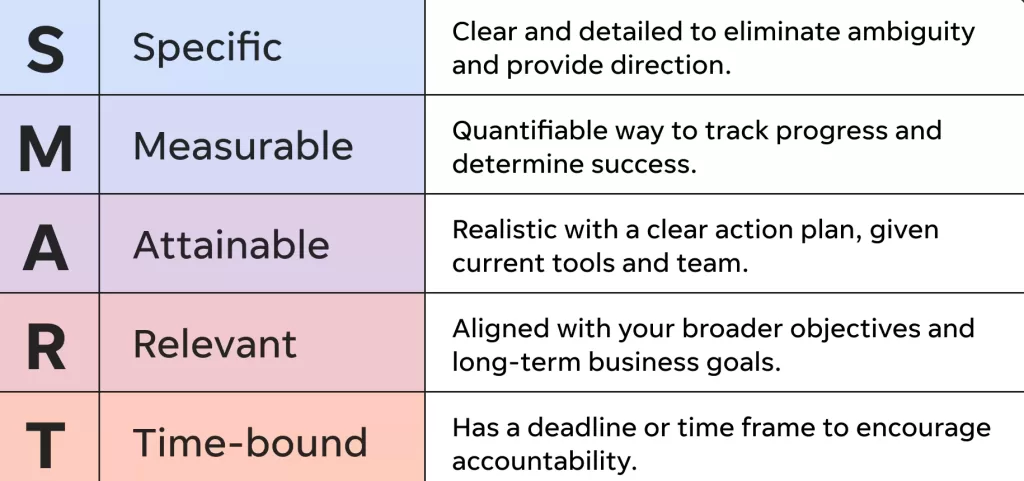
You’ve probably heard the acronym before. Here’s how it plays out.
Let’s say you run a yoga studio. A SMART goal is something like:
Increase organic traffic to our blog by 25% in the next three months by publishing weekly posts. Topics focus on yoga for stress relief, and target keywords include phrases like ‘beginner yoga poses’ and ‘yoga for anxiety.’
That kind of goal gives your content a job. And when your content has a clear goal behind it, it either performs well, or you quickly realize that it needs to be adjusted.
Tie your content goals to business outcomes. If you want more class signups, for example, the content could point people toward a free community flow on Saturdays. Or, if you want to sell more mats at the studio, the content could cover gear essentials or products that your instructors recommend.
🛑 Ready for more planning? Download 6 Simple Steps to a Complete Small Business Marketing Plan (+Template!)
2. Develop audience personas
Trying to connect with everyone is the easiest way to connect with no one. This is where audience personas come in. They’re like fictional client profiles based on real data.
Start by creating two or three personas, but don’t make them overly rigid. You’re probably not marketing to females aged 35-45 with incomes between $50,000 and $75,000.
Instead, you’re trying to win over “stressed-out Sally,” who teaches second grade and wants to join a studio that doesn’t feel intimidating. Or maybe “remote-work Randy,” who just moved to the area and wants to feel less tightness in his shoulders after sitting at his desk for eight hours every day.
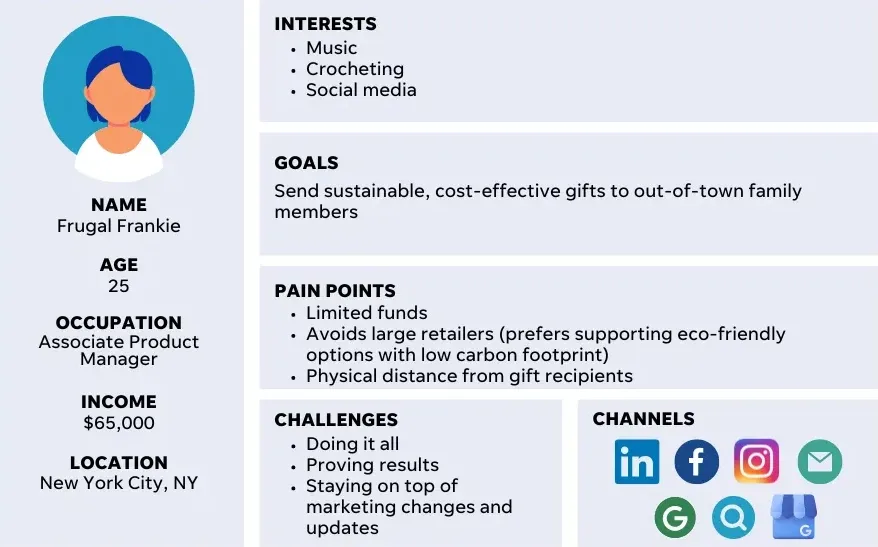
Interact with these types of people online and in the community to understand what motivates them. You could even interview a few college students and ask what content they enjoy. What are they Googling? What are the reasons they do yoga?
3. Analyze what your competitors are doing
Look at what other studios in your area are doing. And not so you can rip them off, but to get answers to these questions:
- What’s working for them? Does the competitor’s website rank for “yoga classes in [city]”? Do their Instagram Reels about breathing techniques get engagement?
- Are there any gaps? What aren’t your competitors talking about? Maybe no one’s covering yoga for people with scoliosis. Or maybe there’s a market for restorative practices they aren’t tapping into.
SEO tools like Ahrefs and Semrush can help you identify which content is gaining traction. But sometimes, just scrolling through comments and Google reviews can tell you everything that yogis care about. Even a brief competitive analysis can reveal a great deal.
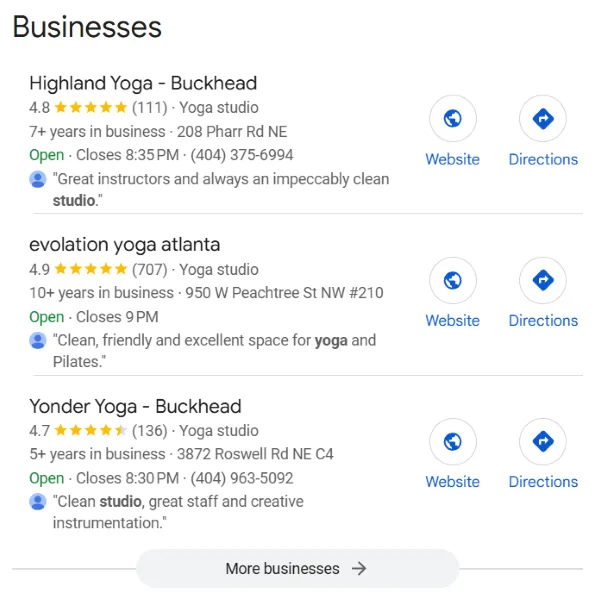
Take a look at your local competitors’ Google Ads and organic search results to see what you can learn.
4. Identify keywords to target
No one’s searching for “shoes that feel like walking on water.” Or at least not many, even if that sounds cool. People usually search for what they need, like “men’s athletic shoes” or “best sneakers for ankle support.”
That’s where keyword research comes in. You need to know which phrases people actually search. Use tools like Ahrefs, SEMrush, and WordStream’s Free Keyword Tool. You could even look at TikTok’s search bar auto-complete, especially if you know your audience is on the younger side.
There are several types of keywords to consider. Let’s say you run a sneaker store and you sell various brands like Nike, Asics, and so forth. You might target branded keywords, like “Nike tennis shoes.”

You might also target product- and model-specific keywords, like “Nike Pegasus shoes.”

And you might target customer-defining keywords, like “women’s tennis shoes.”

5. Audit your existing content
Before creating new content, review the existing content you already have. There could be some good stuff that just needs a refresh to pick up more steam.
A content audit isn’t that painful (we laid out the whole content audit process here).
Start with content that lives on your website. Throw all your page URLs into a spreadsheet and then ask:
- What’s still relevant?
- What’s outdated?
- What’s underperforming?
- What topics are missing entirely?
Going back to that sneaker shop example, maybe you’ve got a blog post on “Best sneakers for gym workouts” that’s five years old and only gets a trickle of traffic.
Can you update that content with new sneaker models and internal links to your latest inventory? Is it missing a section about a subtopic, like walking shoes?
Sometimes, refreshing an old piece of content will give you better results than a brand-new article can. It’s like removing the old laces on your favorite pair of shoes and putting on bright neon ones. Same shoe, fresh look.
6. Create a content calendar
Content calendars get a bad rap because people think they’re married to it. But a good calendar is flexible. And it keeps you from publishing similar things back-to-back or forgetting about seasonal topics.
A few things to lock in:
- Frequency: How often can you realistically publish? Weekly? Twice a month?
- Themes: Match your content to customer needs by season or product cycle (e.g., marathon training gear in summer).
- Formats: Mix it up with how-to guides, videos, listicles, customer stories, and more. Not everyone will consume the same format (here are the content formats currently winning search).
Here’s an example of what a calendar for that shoe store might look like in September:
| Week | Content Type | Topic | Differentiator |
| 1 | Guide | Best hiking shoes for fall hikes | Seasonal and uses keyword |
| 2 | Instagram carousel | How to pick the right shoe for your arch type | Educational and shareable |
| 3 | Blog post | Marathon-ready in 6 weeks: Gear & Tips | Combines conversion and storytelling |
| 4 | Email campaign | Customer favorites: Staff picks for rainy runs | Personal and sales-driven |
💡 A content strategy will deliver free leads. Learn how to get even more in this free guide: 14 Fast & Easy Ways to Get Free Leads (+Examples You Can Copy)
7. Build content briefs
Yoga teachers plan their classes with flow and structure, and that’s what a content brief will do for your blog post or video. It gives you background and direction, so you’re not wondering what to cover or how to lay things out.
A good content brief doesn’t have to be fancy. Here’s what you should include at a minimum:
- Primary keyword: Using a phrase like “restorative yoga” as the main focus.
- Secondary keywords: Including phrases like “yoga for beginners,” but with less of a priority.
- Persona: The type of person you’re tailoring the content to.
- Audience takeaway: What should someone learn, feel, or do after reading?
- Headline ideas: A couple of ideas to set the tone.
- Outline or subtopics: A simple structure with headings and bullet points of talking points.
- Call-to-action (CTA): What’s the next step? Book a class? Download a free pose guide?
- Internal links: Got a relevant class page or related blog post? Link to them.
8. Make sure the content is scannable
People like to skim and scan. They’re looking for quick answers, takeaways, and visuals to illustrate concepts. If your content is a wall of words, it’s overwhelming and not very inviting.
To keep readers engaged, structure your content so they can find what they need fast. Here are a few tips to do that:
- Use headings and subheadings: These guide the reader and make the content easy to skim. Not everyone will read your page from beginning to end.
- Use bullet points and numbered lists: These highlight bite-sized bits of information and keep attention from drifting. They make step-by-step instructions clear.
- Keep paragraphs short: If your paragraphs are longer than three to four lines, consider breaking them up. Nobody wants to sift through walls of text to find something.

Break up your long blog posts into scannable subtopics and add jump links to your table of contents for easy navigation.
9. Use calls-to-action and encourage the audience to engage
Ever read an article, get to the end, and then just leave? That’s what happens when there’s no clear next step.
Your content needs calls-to-action (CTAs) as a natural next step. But not always in a pushy, “buy now” way.
Let’s say your yoga studio publishes a post titled “3 Gentle morning stretches to help you wake up.” Don’t just end it with a friendly sign-off. Instead, try:
“Want to turn these stretches into a 30-minute flow? Stream our free morning yoga class for beginners.”
Or maybe you’re sharing an Instagram Reel that shows off your new candlelit restorative class. Wrap it with a CTA like “Tag a friend who needs this kind of chill in their life.”
CTAs can be soft nudges or actual invitations. Either way, they keep the momentum going, just like switching from one yoga pose to the next.
10. Adapt content for different platforms
It’s easy to just blast the same content across every platform, but don’t do that. Instead, repurpose content by tweaking it to fit the vibe and expectations of each space.
Let’s say your footwear store just launched a new guide that compares minimalist trail shoes. Instead of pasting the same message everywhere and calling it a day, do something like this:
- Instagram: Post a 15-second, slow-mo clip of shoes hitting the ground and a caption like “Maximum control. Ever tried barefoot-style?”
- LinkedIn: Break down the biomechanics in a thoughtful post for fitness professionals with a link to the guide and a message like “Here’s why more coaches recommend minimalist shoes for balance.”
- Email: Give your community timely perks, like a one-day flash sale of 20% off all trail shoes. Encourage subscribers to read the guide before ordering.
- YouTube: Turn the guide into a video. If you have a longer video, splice that up into short clips for social.
Shopify, for example, has both a blog post that explains drop-shipping and a YouTube video that complements each other.

11. Promote your best content with ads
We all want our content to be a success, and maybe even go viral. But not everything will, so try promoting your top-performing content with a paid boost.
Look at the engagement of your social posts and videos that are killing it with lots of clicks, comments, and even conversions.
You know that popular review post that compared running shoes for flat feet and got 100 comments? Promote that with ads. Double down on what’s already working for you.
12. Ask connections, industry leaders, and influencers to share and collaborate
You know what gets people to trust your business? Hearing good things about you from people they trust.
If you’re writing a piece about how long-distance runners can prevent injuries, try getting a quote from a physical therapist. Or interview a running coach. Then tag them in your posts, email them with the link, and say, “Hey, it would be great if you could share this!”
Even better? Invite them into the content process from the start. Collaborate on a co-branded piece of content. Create a social post featuring a sprinter or influencer who swears by the newest cross-trainers you sell (use these influencer outreach email templates to connect).
Find the people who are already engaging with your target audience (athletes, shoe enthusiasts, etc.) and collaborate on creating something they’d be proud to share.
Here’s an example of a video created by marketing influencer Laurie Wang, who breaks down the fundamentals of digital marketing. This helps HubSpot, the video’s sponsor, as she shares templates from the platform.

13. Track KPIs
For most businesses, content goals usually fall somewhere between “get more followers” and “build a loyal customer base.” How do you know if you’re moving in the right direction?
Track things that tell a story:
- Website traffic: Are your blog posts driving new visitors to your site?
- Engagement rates: Are your how-to videos getting views? Are people commenting or sharing?
- Lead generation: Are those guided meditation downloads turning into newsletter subscribers?
- Conversions: Are people who read that “Yoga for Back Pain” guide signing up for your beginner class?
The numbers will show you what’s going on. Check on your analytics data either weekly or monthly to see what’s working and what’s not.
14. Update content based on performance
Let’s say the blog post “3 Gentle Morning Stretches to Help You Wake Up” from earlier isn’t getting action. Rather than treating it as a lost cause, give it some TLC. Try this:
- Rewrite the headline so it pops: “Better than coffee? 3 Morning yoga poses that actually wake you up”
- Add visuals, like a short demo video or original photos from your studio.
- Conduct additional keyword research and update the content with relevant new terms.
- Expand on the content if you see opportunities to provide greater detail. Or turn the three posts into four.
- Promote the post again. Maybe it didn’t do well on Instagram, but it did on Facebook. Share it again there with a new message, or consider sharing only the images instead of a link.
The content marketing strategy checklist
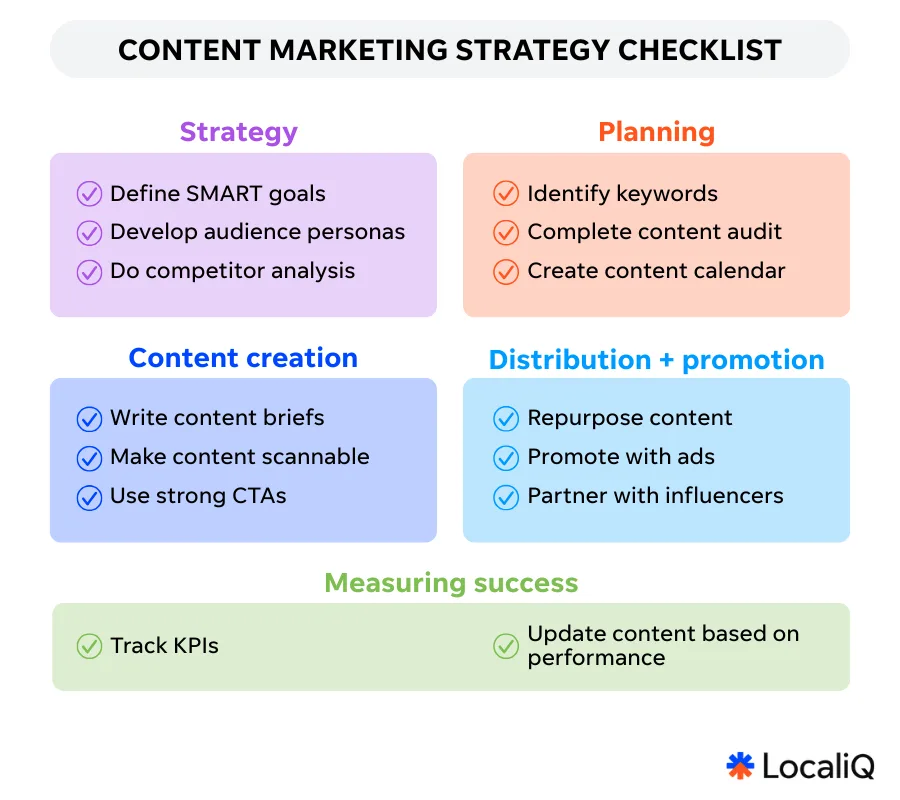
Whether you’re mapping out your first campaign or refining your content strategy, this checklist can be your go-to guide to build a repeatable process.
To recap, here are the 14 boxes to check off to ensure your content moves the needle:
- Define SMART content goals
- Develop audience personas
- Analyze what your competitors are doing
- Identify keywords to target
- Audit your existing content
- Create a content calendar
- Create content briefs
- Make sure the content is scannable
- Use calls-to-action and encourage the audience to engage
- Adapt content for different platforms
- Promote your best content with ads
- Ask connections, industry leaders, and influencers to share and collaborate
- Track KPIs
- Update content based on performance
Recommended for you







Unlock your business potential
We offer innovative technology and unparalleled expertise to move your business forward.