


If you’re considering cutting back on investing in SEO because of AI Overviews, zero-click searches, or ChatGPT, the data doesn’t support that move.
The numbers show SEO still dominates demand capture, conversion, and downstream revenue. AI is changing how search behaves, not replacing it.
In this article, we’ll walk through key SEO facts–backed by data–that clarify what’s actually happening in search and why pulling back on SEO now is more likely to weaken your position than protect it.
Contents
- Search demand hasn’t disappeared
- SEO still drives revenue, not just traffic
- AI visibility depends on SEO authority
- Cutting SEO often increases costs elsewhere
- What should businesses actually do for SEO success in 2026?

Search demand has not disappeared
Before debating tactics, we need to answer the core question: Has search demand meaningfully moved away from Google and traditional search?
The short answer is no.
Google still processes ~373x more searches than ChatGPT
The data confirms it:
- Google processes roughly 8.5-9 billion searches per day.
- ChatGPT processes approximately 25–30 million search-like queries per day.
Search is still where commercial intent lives.
Yes, people use ChatGPT to summarize ideas or get quick explanations. But when they want more information, they still open Google.
Maeve Cifuentes, Founder & CEO at Flying Cat Marketing, sees this clearly in client data: “AI tools are changing how people gather information, but they haven’t replaced commercial search behavior. When buyers are comparing vendors or evaluating pricing, they still go to Google. That’s where intent becomes measurable.”
That’s the distinction.
AI helps people think. Search is where they decide.
If you cut SEO because AI usage is rising, you’re not moving budget away from a declining channel. You’re stepping away from the largest concentration of buying intent on the internet.
💡 Boost your SEO strategy and keep costs low with this guide to free ways to get on the first page of Google!
68%–93% of online experiences still start with search
Depending on the study, between 68% and 93% of online experiences begin with a search engine.
That includes:
- B2B discovery
- Local services
- Ecommerce research
- Software comparisons
AI tools often assist mid-journey research. But they rarely initiate discovery at scale.
Here’s what often happens in practice:
- A buyer encounters a problem.
- They search to understand it.
- They narrow options.
- They evaluate vendors.
- They convert later.
AI compresses steps 2 and 3. It doesn’t eliminate step 1.
If SEO is your discovery layer, cutting it weakens your ability to enter the buyer journey at all.
For SMBs without massive brand awareness, search visibility is often the difference between being considered and being invisible.
SEO still drives revenue, not just traffic
The second misconception driving SEO budget cuts is this: “If clicks are declining, revenue will decline.”
That’s not always true. And in many cases, it’s backwards.
Organic search drives ~53% of all trackable website traffic
A recent study from Search Engine Land proves that organic search accounts for roughly 53% of all trackable website traffic.
But raw traffic isn’t the full story.
What we’re seeing now is this: informational clicks may dip, but commercial pages hold steady. In some cases, they perform better.
Maeve puts it simply: “We’ve seen CTR soften on informational terms, but revenue-driving pages remain resilient. Commercial-intent SEO still converts at a rate that social and paid rarely match. The traffic may look flatter, but the intent is stronger.”
That’s the nuance many teams miss. Sessions might look stagnant. Revenue doesn’t follow the same pattern.
When someone searches “best accounting software for small construction business,” they’re not casually browsing. They’re narrowing options. They’re evaluating.
That intent still runs through search.
🚨 Want more data and insights like these? Download our Big Small Business Website Trends Report: SEO, GEO, & the Future of Traffic.
Organic search converts better than paid and social traffic
Here’s some data from authoritative brands to prove this:
- Organic search conversion rates average 14–16%.
- Paid search averages around 9–10%.
- Social media traffic averages under 3%.
This makes sense, as nearly 70% of businesses are satisfied with their SEO results.

The gap isn’t small. It’s structural.
Here’s why: Organic search captures active intent.
When someone types “Best accounting software for small construction business,” they’re not scrolling. They’re not killing time. They’re evaluating vendors.
That’s late-stage, high-commercial intent traffic.
Paid and social often interrupt, while organic responds to actual demand. This is also where much of the AI anxiety gets overstated.
AI tools are influencing early research. They help buyers understand categories, summarize differences, and narrow options. But when buyers move into serious evaluation mode, they still go to search.
As Claudia Bird, Senior Content Writer at Grizzle.io, explains: “AI visibility is crucial for reaching today’s in-market buyers and how they’re searching. But Google still dominates for seriously evaluating vendors. Traffic may be flatter (thanks to AI summaries), but more informed, decision-ready visitors are engaging. Pull back on SEO now, and you cut off one of your highest-intent channels.”
That distinction matters.
Yes, some informational CTR has softened. Yes, AI Overviews compress certain top-of-funnel queries. But the remaining traffic is often more qualified. These visitors arrive with context. They are comparing options. They are validating pricing. They are closer to making a decision.
If you reduce SEO investment because sessions look flatter on the surface, you risk cutting off one of the strongest commercial-intent channels available to your business.
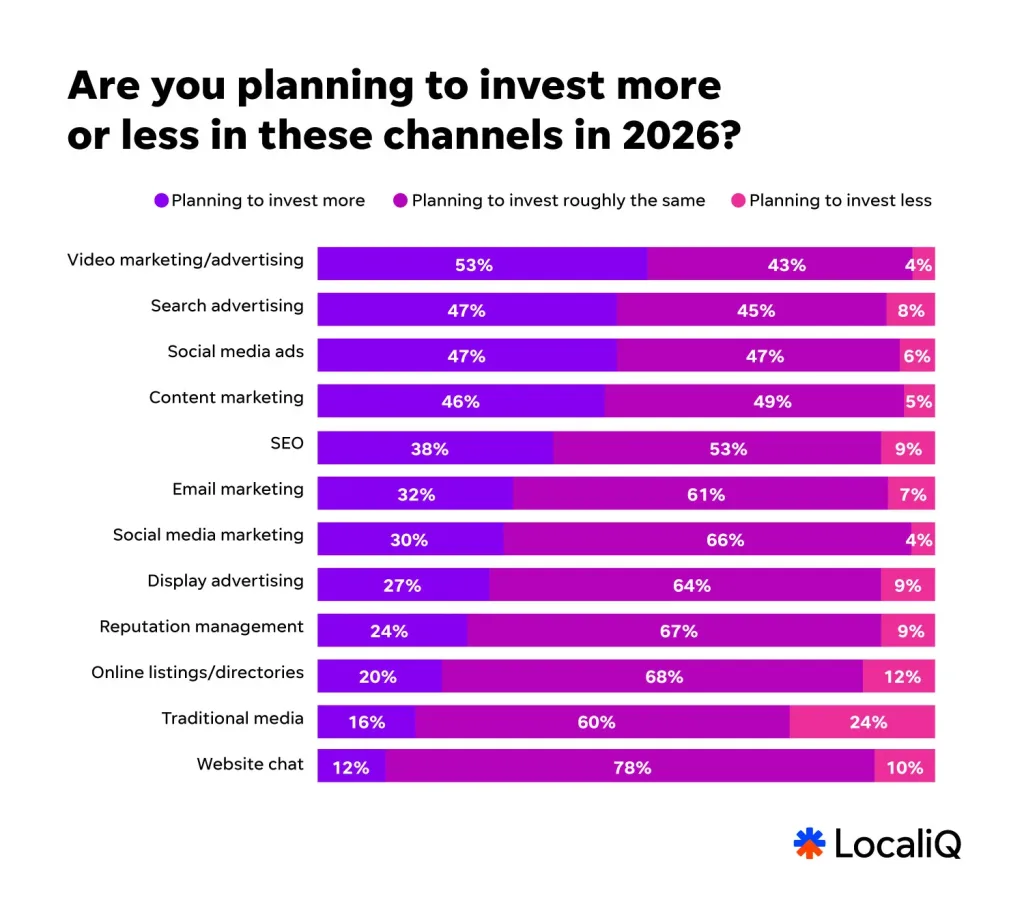
For SMBs, that’s not a tactical adjustment. It’s a structural mistake. This is a known trend, as only 9% of small businesses plan to invest less in SEO this year, and for good reason. Continuing to invest in SEO, or dedicating even more resources to this channel, is what most SMBs are doing, as it’s strategically the best move for a strong online presence.
58–65% of Google searches now end without a click
That’s according to a SparkToro study. But that conclusion skips a key detail.
Most zero-click searches happen because Google displays answers directly in:
- Featured snippets
- Knowledge panels
- Local packs
- AI Overviews
In every one of those scenarios, a brand is still visible.
The user may not click, but they still see you. Visibility now happens before the visit, and that visibility shapes perception.
Google itself has noted that appearing in search results features often increases branded search over time. When users repeatedly see a brand in answers, summaries, and panels, recall builds. They search for that brand later.
That is the real shift that’s happening now: SEO is influencing decisions earlier in the journey.
Here’s what that looks like in practice:
- A user sees your brand inside an AI Overview.
- They do not click.
- Later, they search your brand directly.
- They convert on a direct visit.
Most attribution models will credit “direct” or “branded search.” SEO gets none of the recognition, but the influence happened upstream.
For SMBs, the implication is straightforward: If your competitors appear in AI summaries and you do not, they control the framing. They shape the shortlist. They become the remembered option. Even if the click happens later.

AI visibility depends on SEO authority
Here’s the part most people are getting wrong. You cannot “pivot to AI” and cut SEO.
AI Overviews don’t operate in a vacuum.
AI Overviews pull from pages that already rank
Semrush and Moz both found that most AI Overview citations come from pages already ranking in the top 10.
AI doesn’t invent authority. It pulls from it.
Meg Scarborough, Founder and former CEO of Megawatt, now part of LaunchSquad and a Senior Advisor on Content, sees this shift happening in real time.
“I’ve noticed with clients that we’re seeing more inquiries for demos come in via AI searches,” Meg said.
“My sense is that buyer research behaviors are shifting a bit, and the types of content we need to be putting out to appeal to these new behaviors and to ensure we appear in AI searches and prompts is shifting. But I would not recommend anyone stop investing in SEO or even pull back. Just make sure your SEO investment includes AIO and GEO; make sure you’re using tools or working with experts that understand how the landscape is shifting today.”
That’s the nuance.
Buyer behavior is evolving. Content strategy needs to evolve with it. But that evolution builds on SEO authority. It does not replace it.
“You can’t optimize for AI without optimizing for authority. AI systems lean on existing ranking signals. If your content doesn’t earn visibility in search, it won’t exist in AI responses either,” Maeve said.
There isn’t a separate track where you skip search and optimize for AI instead.
SEO builds the foundation. AI layers on top.
If you cut SEO now, you’re not protecting yourself from AI disruption. You’re weakening the signals AI depends on to surface you in the first place.
Strong domains lose fewer clicks to AI disruption
Here’s another reality: According to SEJ, high-authority domains are seeing CTR pressure in some verticals, but they’re not disappearing.
They still show up in:
- AI summaries
- Knowledge panels
- Local packs
- Top results
Smaller, lower-authority sites usually get hit first. They lose impressions, and then they lose clicks.
Stronger sites tend to hold their ground.
Why? Because when Google changes how results are shown, it falls back on domains it already trusts. And that same trust carries into AI summaries.
For SMBs, SEO isn’t just a growth lever; it’s part of the foundation.
When things get uncertain, cutting SEO might seem harmless. You may not see an immediate drop.
But over time, visibility erodes, competitors gain ground, and rebuilding that authority later costs a lot more than maintaining it now.

An example of a domain rating check.
Cutting SEO often increases costs elsewhere
Here’s a financial angle most businesses overlook:
Paid media costs continue to rise
Our own study shows that Google Ads CPCs increased roughly 13% year-over-year across many verticals.
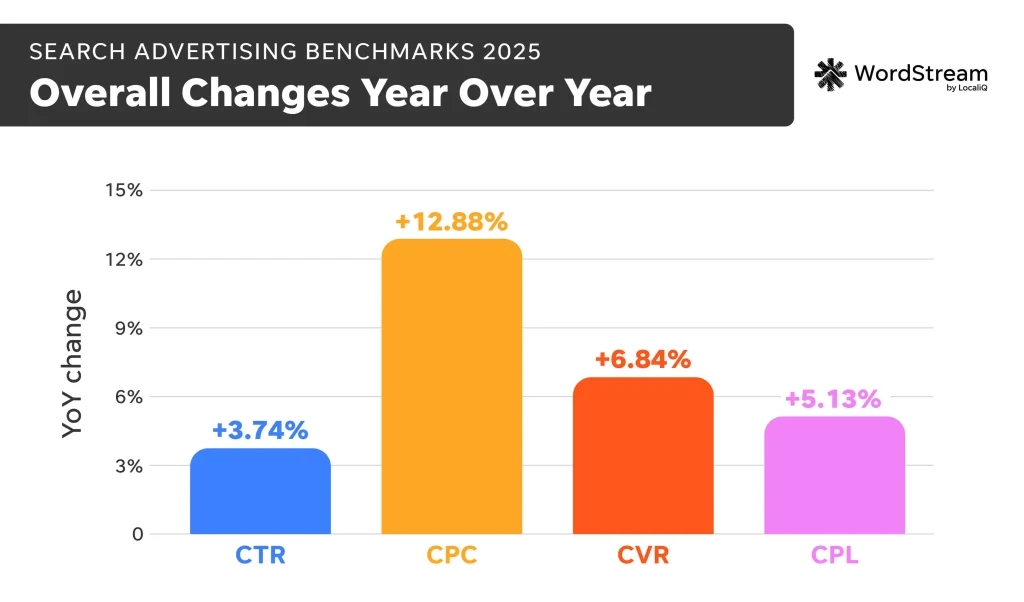
That number on its own is concerning. And it is unlikely to reverse.
As Stephanie Heitman, Associate Director of Content at LocaliQ and WordStream, puts it: “Search ad costs have increased for the last five years, and we unfortunately don’t see that stopping anytime soon. With increased competition and an even more crowded SERP space with the addition of AI Overviews, the best search strategy is one that includes both paid and SEO.”
Here is what that means in practice:
If you hold organic positions for your core commercial keywords, you capture demand without paying for every visit.
If you do not, your only option is to enter the auction.
When SEO performance slips, paid has to fill the gap. You buy traffic you used to earn. You compete in more auctions. Your cost per acquisition rises.
Now extend that across the market.
If many companies pull back on SEO and push budget into paid at the same time, the auction tightens:
- More bidders
- Higher CPCs
- Thinner margins
This is why the channels are not separate decisions.
Strong organic visibility reduces the amount of traffic you need to purchase. Weak organic visibility increases your dependency on paid.
Heitman puts it clearly: “The best way to maximize your search costs is to invest in both a paid and organic strategy so you can show up multiple times on the SERP.”
That dual presence matters even more now. AI Overviews compress attention. Ad inventory gets more competitive. The page has more layers competing for the same click.
If you rely heavily on paid search in that environment, rising CPCs directly inflate your customer acquisition cost.
Organic rankings work as insulation.
When you rank for high-intent queries, paid becomes a lever you pull strategically. Without that foundation, paid becomes your lifeline.
Cutting SEO does not lower your exposure to cost. It concentrates it in the most volatile part of search.
SEO delivers the highest long-term ROI
HubSpot’s 2026 marketing report shows that SEO offers some of the highest long-term ROI. That isn’t because it’s cheaper, but because it compounds authority, topical depth, backlink equity, and branded search traffic.

Every optimized page strengthens your internal linking structure. Every ranking improves your domain’s credibility. Every mention increases the likelihood that you’re cited in AI summaries. Every branded search reinforces your relevance signals.
SEO is not a campaign; it’s accumulated positioning.
As Stephanie Yoder, Director of Content at Rebrandly, explains: “Execs are frequently enamored with SEM and other paid traffic techniques because it’s a direct line between money in and money out. But as soon as you turn off that money spigot growth completely stops. SEO on the other hand requires some patience as you lay the foundation, and requires upkeep over time, but when done right you have a growth engine that reaps dividends for years.”
That difference becomes clearer when you zoom out.
Let’s imagine two similar local accounting firms. Both allocate $60,000 per year to marketing.
Firm A: Paid-only strategy
- Spends the full $60K on Google Ads each year.
- Generates consistent leads.
- Stops spending? Leads stop immediately.
- CPC increases 15–20% annually due to competition.
- By year three, they’re paying more for the same volume of leads.
Over three years:
- They’ve spent $180,000.
- They own no lasting visibility asset.
- Their CAC rises as paid costs rise.
- Growth is tied directly to ad spend.
Firm B: Compounding SEO strategy
- Invests $40K in SEO, $20K in paid in year one.
- Year one builds content, authority, and commercial pages.
- Year two sees stronger rankings for “small business tax accountant near me” and “CPA pricing for startups.”
- Paid dependency decreases slightly because organic fills the gap.
- Year three, branded search volume increases. CPC exposure declines.
Over three years:
- They’ve also spent $180,000.
- But they now rank for multiple commercial terms.
- They receive ongoing organic leads.
- They rely less on rising CPC auctions.
- Their visibility feeds AI summaries and local pack presence.
Same spend, but very different position. Firm A rents visibility, while Firm B owns it.
Now layer in AI.
If AI Overviews cite “top-rated small business CPA firms in Denver,” which firm is more likely to appear?
The one with structured, authoritative, ranking content. Not the one running ads.
The risk in cutting SEO isn’t just losing traffic; it’s losing the compounding effect that strengthens your position over time.
So what should businesses actually do for SEO success in 2026?
The lesson here is not “publish more blog posts.” The lesson is to do SEO strategically.
That means:
- Prioritize commercial-intent keywords.
- Build topical authority around revenue-driving categories.
- Publish proprietary insights where possible.
- Structure content clearly for both users and AI systems.
- Treat SEO as infrastructure, not promotion.
AI is raising the bar for clarity and authority; it is not removing the need for visibility. If anything, it increases the value of being a trusted source.
What the data actually says about SEO
The data does not say:
- SEO is dying.
- AI replaced search.
- Organic budgets should shrink.
The data says:
- Search still owns intent.
- Organic still drives the majority of traffic.
- Organic converts at higher rates.
- AI inherits SEO authority.
- Visibility compounds.
- Absence compounds faster.
If you stop investing in SEO now, you are not adapting to change.
You are reducing your presence in the largest active demand channel available to your business.
And once you fall out of the demand layer, it is much harder to climb back in. Long story short, smart businesses are growing their SEO investments. For help growing yours, check out our solutions!

Recommended for you





Unlock your business potential
We offer innovative technology and unparalleled expertise to move your business forward.