


The path to your website is more convoluted than ever. Customers can find you through a dozen different platforms. Even SEO isn’t straightforward, with AI Overviews stealing clicks and more people turning to AI search engines for answers and product recommendations.
How are other small businesses managing this new complexity? Where are they losing traffic? And which channels are emerging as the new winners?
Knowing these answers is the key to attracting more visitors, leads, and customers for your own business. To get them, we surveyed over 300 SMBs in our first-ever Small Business Website Trends Report: SEO, GEO, & the Future of Traffic from WordStream.
You can see the full report on WordStream or have it sent to your inbox. And for the top 10 insights that’ll help inform your 2026 marketing strategy, read on.
10 biggest takeaways from WordStream’s Small Business Website Trends Report
We distilled the most fascinating facts from the report to help you understand the shifts in traffic, SEO, and GEO…and to strengthen your game plan for 2026 marketing.
1. SMBs are losing traffic to search algorithms and AI…
In the survey, 40% of small businesses said they’ve experienced at least some traffic disruption due to changes in Google’s algorithm and the increased application of AI in search.
The larger the business, the larger the hit. 46% of SMBs with 11 to 100 employees (the largest segment in our survey pool) said they’ve seen a decline in traffic.

In the report, we segmented businesses into three groups by employee count: solopreneurs, two to 10 employees, and 11 to 100 employees.
We’ve written about the challenges that stemmed from Google’s core updates and AI Overviews before. It seems that many small businesses are feeling the traffic pinch from them.
2. …but they still say SEO is performing well
Even with a decrease in traffic for some, 72% of SMBs say their SEO performance is either very or somewhat effective. That’s encouraging, since so many buyers still turn to search engines to find products and solutions (that’s especially true for searches with local intent).

When you look at it by business size, you see that solopreneurs and businesses with 2-10 employees have less confidence in their SEO success. That suggests they’re either less able to directly affect SEO or don’t have the tools to measure it as effectively as larger businesses.
🔎 Get updated tips for your SEO strategy with our free guide >> How to Do SEO Right–Right Now!
3. Social media has overtaken SEO as a key traffic source
When asked which were their main sources of website traffic, SMBs named social media (64%) more often than any other option, including SEO (52%).

While social networks have become a popular place for buyers to discover brands and products, it is surprising to see them outpace search when it comes to driving website traffic. Social media marketing has historically been seen as an engagement and brand-building channel—not a primary driver of site visits.
The result aligns with what we learned in our Small Business Marketing Trends Report. There, social media marketing and social media advertising were the two most used marketing channels by SMBs.

If traffic from search continues to decline, social media may become an even bigger part of the small business marketing mix.
4. For small businesses, websites are still essential for growth
94% of the SMBs surveyed said that their website is at least somewhat important to achieving their goals (39% called it extremely important).
Websites become more critical as businesses grow. Those SMBs with 11-100 employees were most likely to say their website was very or extremely important (78%).

The SMBs with websites note they play key roles in growth, including:
- 70% say visitors can buy directly from their site.
- 69% say it’s a major source of leads or prospects.
- 62% say their current business model wouldn’t be possible without their website.
Even as more avenues open to attract customers, lead-generating websites remain a critical hub that most SMBs rely on to convert traffic into sales.
🔎 Want searchers to see (and click on!) your site? Download our free guide >> Ways to Make Your Website More Visible on Google
5. Driving and converting traffic are the biggest website and SEO challenges
Whether we’re talking about SEO or managing a website, the biggest challenge noted by SMBs is generating traffic and leads. 35% said that was their biggest website hurdle, while 42% said the same about SEO.
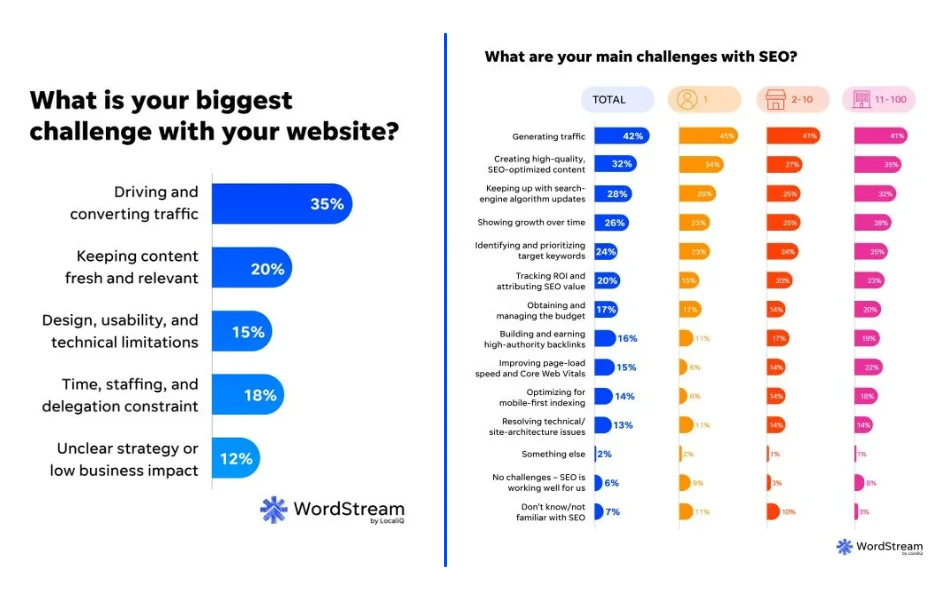
Creating and keeping fresh and relevant content was the number two challenge for both SEO (32%) and websites (20%).
With so many SMBs—especially the smallest ones—managing these jobs in-house, it’ll be critical for them to stay on top of changes and trends to compete.
6. A third of small businesses don’t have a website (and many don’t plan to)
After noting how important websites are to most of the SMBs in our survey, it was very interesting to learn that a third of small businesses don’t have one. And of that group, 43% say they have no plans to ever launch one.
That number is highest among solopreneurs (56%). It’s possible that those one-person teams lean more heavily into service-based businesses or those that sell through marketplaces like Etsy. They wouldn’t be as reliant on a website for growth.

Half of businesses without a site say they rely on customer word of mouth or local referrals. Another 35% said it was because they use social media, marketplace platforms, or directory listings for their online presence.
7. Website traffic is more critical than ever
Not only do SMBs say their websites are an important platform for growth, but most (61%) say the traffic that comes to their websites is even more important than it used to be. The biggest businesses are more likely to have this opinion (76%).

This makes sense, since we see how many SMBs rely on their sites to generate leads and close sales. It shows how important it is to find ways to drive traffic to your website through SEO, paid ads, and other strategies.
It also highlights that the third of the businesses we surveyed that don’t have a site may be missing out on what many others say is a critical factor for growth.
8. 50% of SMBs manage SEO in-house
Half of SMBs said they take on the job of SEO in-house. For solopreneurs, that number nudges up to 57%. Just 19% of those one-person brands use an agency, while 53% of the largest businesses do.

Luckily, over 71% of all businesses (and 72% of solopreneurs) said they were extremely or very familiar with SEO. That’s not unexpected since so many SMBs have a hand in optimizing their site for search.
9. Half of SMBs are already monitoring their AI referrals and mentions
A somewhat surprising 48% of SMBs say they are extremely or very familiar with generative engine optimization (GEO), and a full half of them are monitoring referrals from AI answer engines.

Platforms like ChatGPT and Gemini still only represent a small portion of the search market compared to Google. But they’re gaining ground. And they can be particularly helpful for smaller brands, since most AI citations come from websites that aren’t in Google’s top ten results.
Small businesses that learn GEO can take advantage of this citation arbitrage to grab traffic from AI search engines.
10. Page structure and readability are top GEO tactics
It’s good to know that SMBs are thinking about GEO, but what are they actually doing to improve it?
35% of them said they’re focusing on structuring pages and making sure they have clear, descriptive headings. Another 26% said that optimizing the readability with short paragraphs and bullet lists was a topic tactic.

What jumps out about this list is that most of these actions also support good SEO. So while a small business is actively trying to get cited on Gemini or Perplexity, they may also be increasing their chances of ranking in traditional search results.
Use these insights to inform your marketing strategy for 2026
Small businesses are deciding where they need to spend time and which channels deliver the best results. This overview touches on some of those plans, but you can get all of the insights and data we gathered from over 300 SMBs by downloading the full report. Then reach out, and we’ll help you craft a competitive marketing strategy built for growth.
Here’s a recap of the top takeaways from The Small Business Marketing Trends Report for 2026:
- SMBs are losing traffic to search algorithms and AI…
- …but they still say SEO is performing well
- Social media has overtaken SEO as a key traffic source
- For small businesses, websites are still essential for growth
- Driving and converting traffic are the biggest website and SEO challenges
- A third of small businesses don’t have a website (and many don’t plan to)
- Website traffic is more critical than ever
- 50% of SMBs manage SEO in-house
- Half of SMBs are already monitoring their AI referrals and mentions
- Page structure and readability are top GEO tactics

Recommended for you





Unlock your business potential
We offer innovative technology and unparalleled expertise to move your business forward.