

According to a LocaliQ survey of over 380 business owners, 60% are using AI for their marketing for everything from content creation to reporting and lead management.
AI is touted as a magical little helper ready to tackle all your needs—marketing or otherwise. It can be endlessly useful, sure. But what about the ways it’s actually making your marketing worse?
I asked several experts to share the top ways AI is hurting your marketing and what to do about it to preserve your results—and your sanity.
6 ways AI is hurting your marketing (+what to do about it)
- It’s stealing your website traffic
- It’s making you sound like everyone else
- It’s making your creative look (AI) sloppy
- It’s changing the buyer’s cycle (for the worse!)
- It’s giving you less control over your advertising campaigns
- It’s spamming your customers’ inboxes and making it harder to stand out
1. It’s stealing your website traffic
This one hurts, personally. AI has cut traffic to websites dramatically. I’m talking 40-60% in some cases, according to Search Engine Journal.
People are clicking on results less and less in favor of taking the AI results at face value (searches on Google end without a click 68% of the time). And AI is using your content to create answers without sending (much) traffic your way.
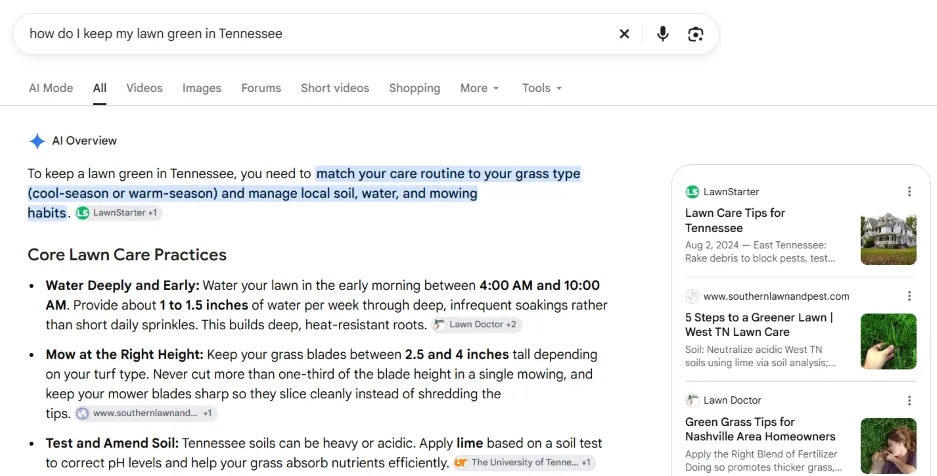
It’s a sad reality, and something we have to deal with.
What to do about it: One of the most important things you can do to mitigate declining traffic is to focus on converting the traffic you are getting.
In many cases, the majority of the traffic you’re losing to AI is top-of-funnel traffic, meaning traffic from searchers who were looking for a quick answer or a specific piece of information, and they weren’t going to convert. And while that was still nice traffic to have, it’s not what’s going to line your pockets.
“We’re constantly testing our most valuable pages to get more leads from a smaller pool of visitors,” said Elisa Gabbert, Director of Content & SEO for LocaliQ. “We’re also closely monitoring which content types perform best in this environment and creating more of them, whether it’s original studies or free tools.”
Run a website audit to understand where you’re winning conversions and where they might be leaving your site without taking the next step. Then, add easy conversion points, like website chat, a click-to-call feature for mobile, and a way to text your business.
Goran outlined more ways to squeeze results from dwindling website traffic in this article.
🔎 Get updated tips for your SEO strategy with our free guide: How to Do SEO Right–Right Now! >>
2. It’s making you sound like everyone else
AI-generated content is easy and cheap to scale, meaning it’s pretty much everywhere. And it’s making content across websites, social sites, emails, and ads sound eerily similar.
(Side note: You’re safe from AI-generated content on the LocaliQ and WordStream blogs—we’re still writing our content the old-fashioned way: by humans.)
“AI has made ‘pretty good copy’ basically free. Unfortunately, ‘pretty good copy’ was already abundant,” said Oskar Duberg, freelance writer and fractional content marketer.
And he’s right. AI copy isn’t bad—it’s just formulaic. Readers have started flagging copy cadences, terms, and even punctuation (although I will continue to use my beautiful em dashes) as AI copywriting tells.
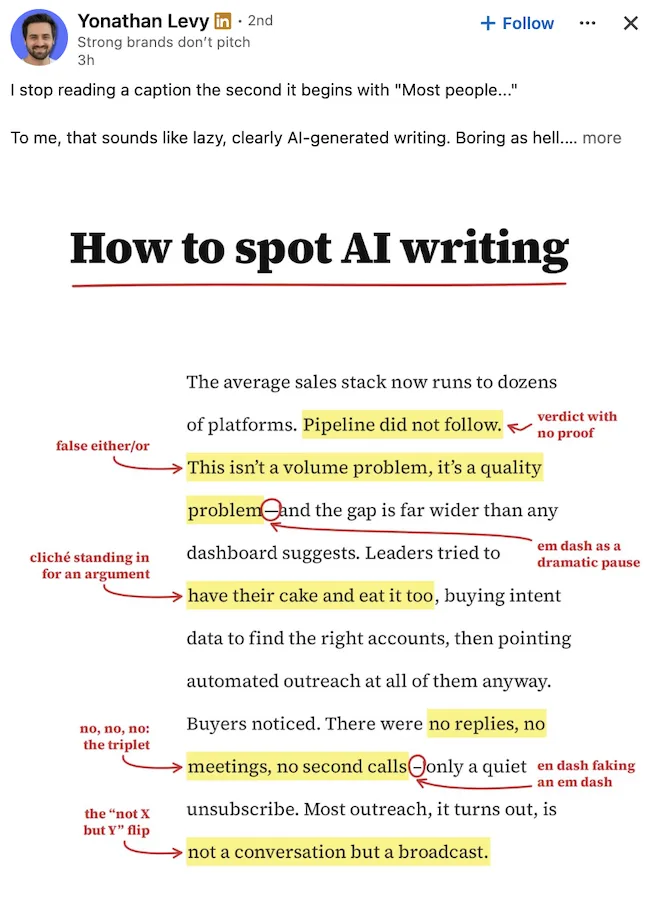
This LinkedIn post highlights some AI writing patterns.
But there are other, less obvious signs copy was written by AI. Many of those hinge on bland, non-descriptive language that’s not really saying much of anything.
AI only knows what you tell it, meaning it lacks something that can help good copy stand out as great: specificity.
What to do about it: Build a strong brand voice and write clear, descriptive copy with specifics, whether that’s results, insider knowledge, or original data, to help you cut through the AI clutter and connect with customers.
“Give me a point of view—something only you would say—that’s how you’ll win me over,” Oskar said.
To help you identify the marketing copy that’s boring your customers (and costing you conversions), we built a fun copy grader: You Sound Like Everyone Else. Test your copy, get an originality score, and see the edits you need to make so your copy sounds all your own.
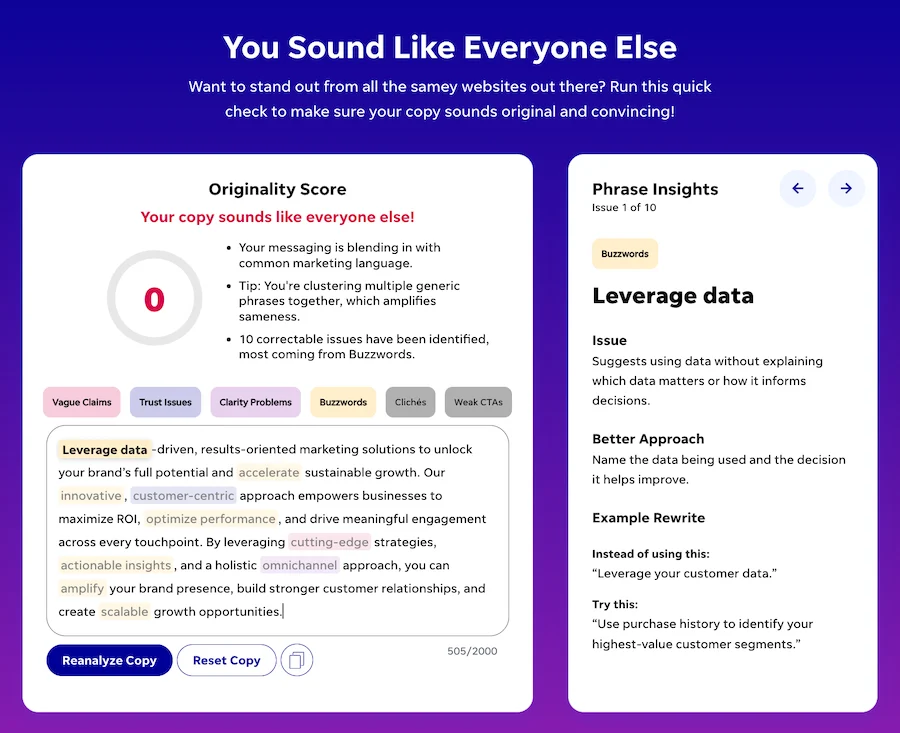
3. It’s making your creative look (AI) sloppy
AI is making it easier than ever to create custom graphics. But these AI-created graphics end up looking kind of the same across the board—giving you a strange sense of déjà vu. Sure, the content is different, but they all have the same visual style. (AI loves a large headline, oversaturated colors, overcrowded design, and itty-bitty text and icons—not to mention a fake “hand-painted” font.) And your customers are catching on.
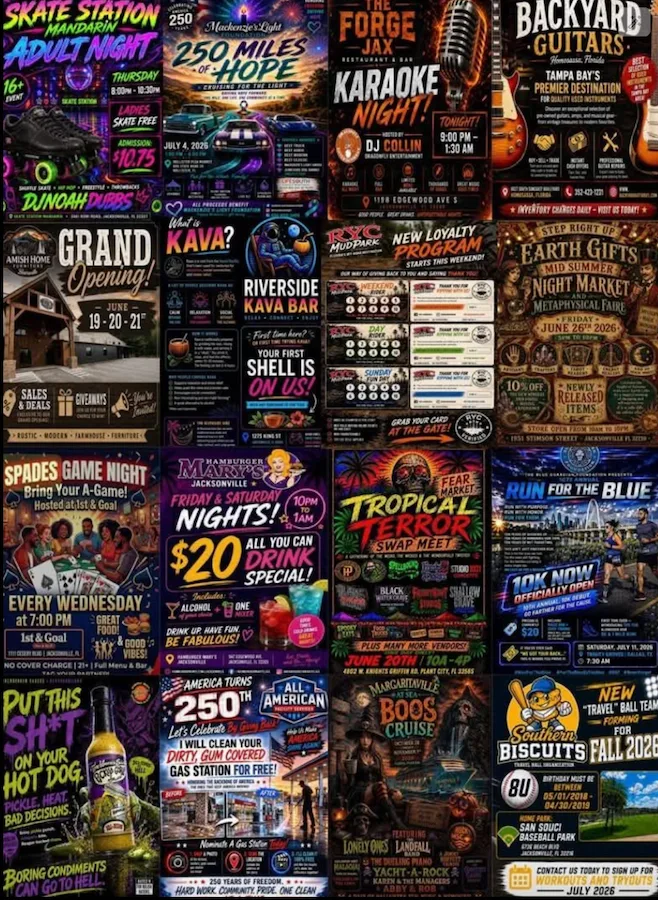
Thanks to this site for rounding some up for us.
This doesn’t mean you can’t or shouldn’t use AI to help you design your marketing graphics. But it does mean you have to be really specific in the prompts, guidelines, and edits you make while working with your AI platform.
What to do about it: LocaliQ Creative Director Alex Moreira suggests creating very clear brand guidelines to feed the AI platform—going beyond colors, fonts, and logo usage and leaning into who your business is, what you represent, and what you want customers to see, feel, and do once they see your graphic.
“AI is limited to the information you give it and what it has access to online,” Alex said. “To get a good output, you have to put in the work to be specific so the AI has a better understanding of what you’re hoping to achieve with your design.”
She also said it’s helpful to look at AI outputs as a jumping-off point rather than the end result.
“AI design still needs art direction and assistance,” she said. “If you can build on what the AI created, make sure it aligns with your brand style, and give it a little something extra, you can stand out from the other AI-assisted designs across the web and maintain consistency for your brand identity.”
Always check AI’s design output before publishing it, paying close attention to accuracy, consistency, and a lack of typos.
4. It’s changing the buyer’s cycle (for the worse!)
AI has completely changed the way we search for businesses. People are now turning to AI tools to help them find new businesses, and it’s giving them a shortlist to evaluate directly within the chat. No more searching and scrolling through search engines, looking at third-party reviews, and checking out a few different websites before narrowing down to a select few options.
“Most of the damage AI does to small businesses happens before anyone visits their website,” said Goran Mirkovic, Senior Organic Growth Specialist at BX Studios.
“A homeowner asks ChatGPT who to call about a furnace that won’t kick on, and the answer has already split local companies into specialists and everyone else. If your homepage says ‘full-service solutions’ and your Google Business Profile describes you differently, AI goes with the safest generic description, and you end up in the ‘everyone else’ group,” he said.
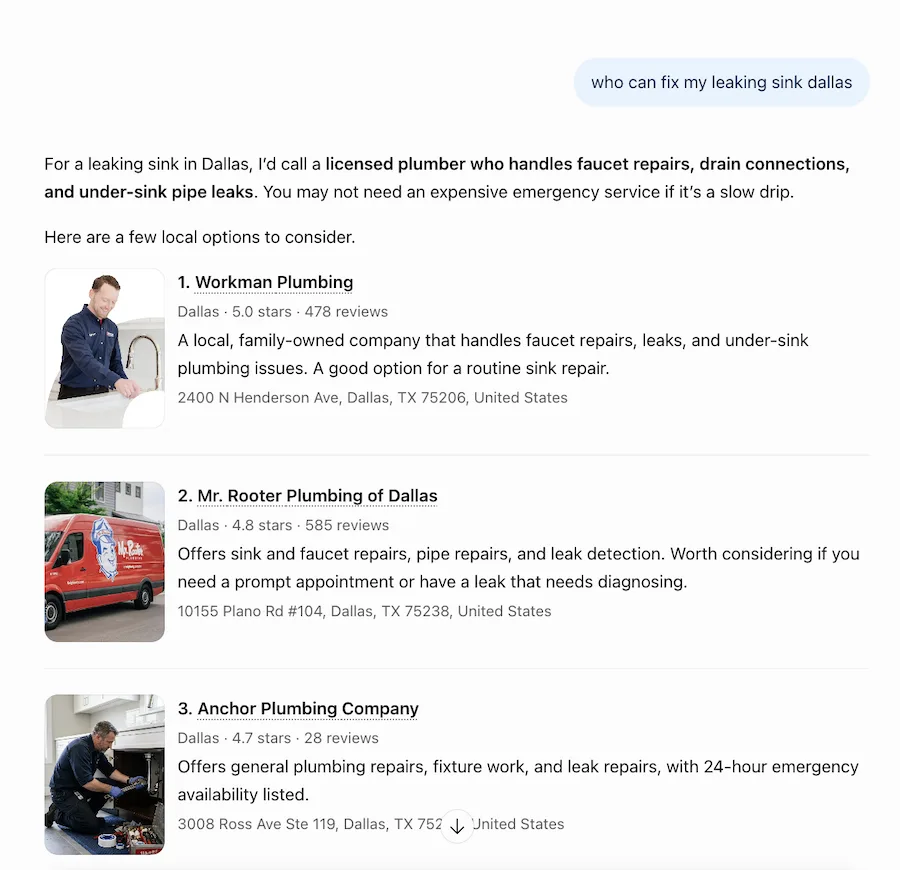
What to do about it: Consistency is the name of the game if you want the best chance of influencing AI search platforms.
“Write one plain sentence about who you serve and what you do best, then repeat it on your homepage, your service pages, your Google Business Profile, and your review replies,” said Goran.
“AI trusts what it sees repeated across sources. A dental practice that says ‘family dentistry with same-week emergency appointments’ everywhere will get recommended for exactly that. A practice that describes itself differently on every page gets averaged into nothing.”
It’s also important to build a solid online reputation, because, in many cases, AI search is considering those in its results. The language customers use in reviews can reinforce what you’re telling AI about your business and help you show up for more natural language queries. Ask your customers to leave you reviews outlining the problem they encountered and how your business was able to fix it.
⭐️ Need help getting more reviews? Get templates, tips, and ideas in our free guide >>
5. It’s giving you less control over your advertising campaigns
AI is woven into pretty much every advertising platform from Google Ads to Meta and more. And while AI features can help you make quick, impactful optimizations to your campaigns based on performance, it can also give you less control and oversight of your campaigns—if you’re not careful.
“Google Ads can make it seem as though reducing management leads to better performance,” said Cliff Sizemore, Senior Growth Marketing Manager at LocaliQ. “While automation can deliver results, it can also make inefficiencies harder to see.”
Cliff cautions against letting your advertising platforms run campaigns unchecked.
“Advertisers still need to shape the strategy, verify conversion data, and critically assess what AI is optimizing for,” he said.
What to do about it: Check in on your campaigns and your performance regularly, schedule routine audits to make sure your campaigns are set up and running correctly, and tell the platforms the types of conversions you’re focused on to guide the way it’s optimizing campaigns.
It’s also crucial to stay up to date on platform updates that can influence campaign performance. For example, Google Ads recently released new features to give advertisers a little more control over how their budget is allocated across channels.
Here are some resources that can help you:
- Free Google Ads Performance Grader
- Free Facebook Ads Grader
- How to Track Google Ads Conversions in the Age of AI
- The Guide to the Perfect Google Ads Account Structure
6. It’s spamming inboxes, making it harder to stand out
AI spam is flooding inboxes, and it’s making email marketing more difficult for businesses.
“AI has made it easier than ever to create email content, but it hasn’t made people care more about what’s in their inbox,” said Heidi Hickman, an email marketing expert and senior marketing manager at LocaliQ.
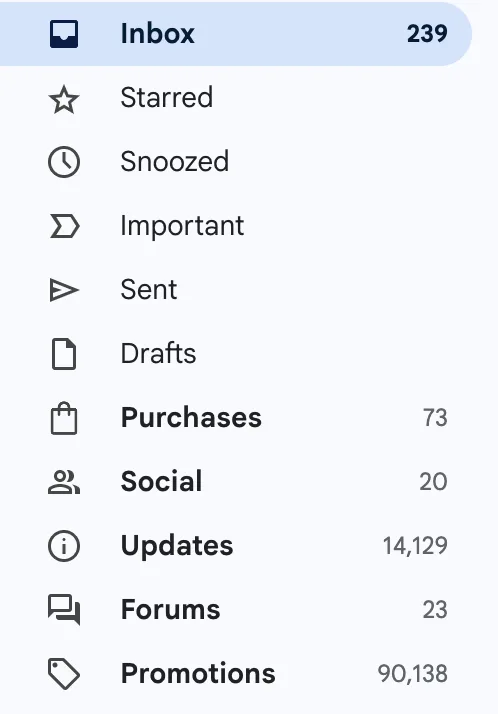
A vulnerable look at my personal email inbox. 90,000 promotions to sift through…
People are getting more emails than ever (a 4% increase year-over-year compared to 2025—which adds up fast), so it’s crucial to stand out.
What to do about it: Don’t let AI dictate your strategy. Take time to review your campaign results, including open rates, click rates, and unsubscribes, to understand what’s resonating with your audience and what’s driving them to jump ship. Then, A/B test subject lines, calls-to-action, and offers to pick out patterns that drive engagement.
“AI is a helpful tool, but ultimately, it’s the strategy behind your campaign that will move the needle—and that comes from you,” Heidi said.
It’s also important to segment your email list so you’re sending the most relevant messages to your audience.
“The email marketers who break through will be the ones who understand their audience, recognize what matters to them, and deliver something genuinely useful,” Heidi said.
Try some of our free email marketing tools to help:
Use AI responsibly to avoid marketing disasters
What’s the main takeaway here? Using AI is (almost) unavoidable, and in many cases, it’s helpful and saves you time. However, there are precautions you have to take if you want to maintain control over your campaigns, how you show up online, and how people perceive your business. That means reviewing every AI-generated output, creating and establishing clear brand guidelines, and keeping a close watch on your campaign performance.
Want help keeping all these pieces moving smoothly? We can help! Reach out to learn more.

Recommended for you






Unlock your business potential
We offer innovative technology and unparalleled expertise to move your business forward.