


Online search is changing because AI tools like Google AI Overviews, ChatGPT, and Perplexity are answering questions directly instead of just showing links.
If you’re marketing a small business, this is a big shift.
To get found, your business now needs to optimize not just for search engines, but for AI systems that generate those answers.
50% of small businesses say they’re already monitoring AI traffic referrals and mentions, which is a great start. But to improve, you’ll need to take action.
That’s where GEO (generative engine optimization) comes in. It’s a technical name, but it’s really about making sure AI understands and trusts your website so it recommends it during relevant user conversations.
In this guide, we’ll explain exactly what GEO is, how it’ll help you find more customers, and how you can show up in more AI answers.
Contents
- What is GEO?
- How is GEO different from SEO?
- Why does GEO matter for small businesses?
- 5 best GEO tips for small businesses
- The small business GEO checklist
What is GEO?
GEO is the practice of optimizing content and building online credibility, so AI platforms like ChatGPT, Gemini, and AI Overviews understand, trust, and reference your business when they generate answers.
To make that a little simpler, GEO means you’re making it really easy for AI platforms to use your website as a source in their replies, which gives you exposure to the people asking those questions.
Check out this response from Perplexity for the question, “When’s the best time to plant grass seed in Indianapolis?”

The sources it uses are embedded in the answer and offered in the sidebar. Those businesses did a great job of creating content that Perplexity’s AI could both understand and trust.
That’s the goal of GEO—to get visibility in AI platforms. There are two versions of that visibility.
Brand mentions in AI recommendations
A brand mention is when an AI platform directly mentions your brand in a response to a question. They’re incredibly valuable because the questions are usually asking for recommended businesses or products. You want your business to show up as a top choice.
Here’s ChatGPT’s answer to “What’s the best plumber in Charlotte, NC to help me install a new water heater?”

How did those businesses get picked? We’ll explain that in a bit.
💡AI isn’t just for search! Download 14 No-Brainer Ways to Use AI for Social Media (+20 Prompts)
Content citations in AI answers
Content citations are references or links to your website that AI systems use as a supporting source when generating an answer. This type of AI visibility is better for building trust and brand awareness.
Here’s an AI Overview from Google describing how to clean a stain from your car seat.

It doesn’t call out specific brands. But as you scroll through the AI Overview, you’ll get links to several videos and how-to guides that’ll introduce you to the brands that created them. That’s how you generate awareness and trust through AI citations.
How is GEO different from SEO?
SEO focuses on getting clicks from search engines by ranking your content higher on their results pages. GEO focuses on positioning your content as a source in AI answers.
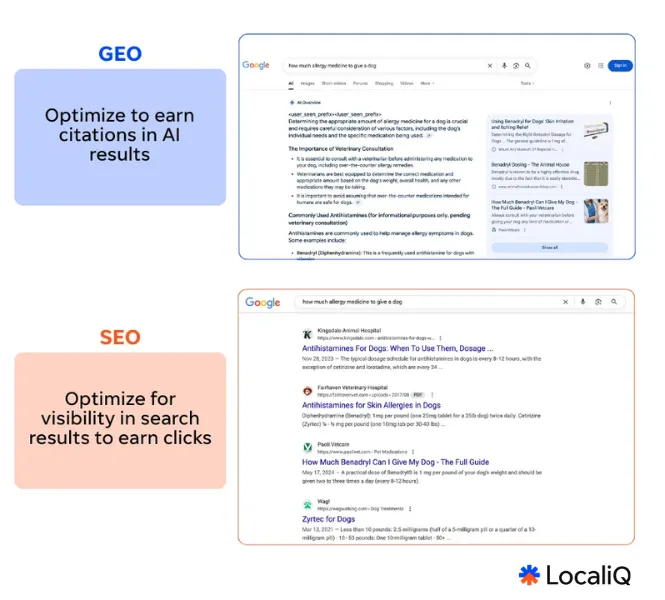
Both AI platforms and traditional search engines help people find information on the web; they just do it differently.
Search engines crawl web pages to find the ones that most likely match a query. AI systems synthesize information from multiple sources into a single response.
That makes SEO and GEO different in a few ways:
- Goal: SEO aims to secure top, clickable rankings on results pages; GEO aims for citations and mentions in AI answers.
- On-page structure: SEO uses keyword-rich, long-form content that search engines can crawl; GEO is built on concise, Q&A-style content with a logical structure that helps AI understand and summarize.
- Authority signals: SEO relies heavily on backlinks from trusted websites, domain age, and how people engage with a web page to gain authority with search algorithms; GEO requires a consistent presence on multiple high-quality platforms and clear expertise signals (like author credentials).
- Measurement: For measuring SEO, it’s rank tracking and traffic from search engines; for GEO, it’s brand mentions and content citations.
| SEO | GEO | |
| Goal | Secure top, clickable rankings on search results pages. | Earn citations and brand mentions within AI-generated answers. |
| On-page structure | Uses keyword-rich, long-form content optimized for search engine crawling and indexing. | Uses concise, Q&A-style content with a logical structure that helps AI understand and summarize information. |
| Authority signals | Relies heavily on backlinks from trusted websites, domain age, and user engagement signals. | Requires a consistent presence across multiple high-quality platforms and clear expertise signals (such as author credentials). |
| Measurement | Measured through rankings and traffic from search engines. | Measured through brand mentions and citations in AI-generated responses. |
👀 Looking for ways to get found in traditional search engines? Get your copy of How to Do SEO Right—Right Now
Why does GEO matter for small businesses?
AI has changed how buyers discover new products and businesses online:
- Over 60% of US adults say they use AI to search for information (that number climbs to 74% for adults under 30).
- Roughly 30% of Google searches now include an AI Overview.
- When there’s an AI Overview in the result, clicks to top-ranking content drop by 34% to 58%.
- 36% of US consumers say they’ve discovered a new product or brand through ChatGPT.
Whether it’s during a Google search or a conversation with an AI platform, people are clicking less and asking more. The small businesses that adapt to this shift in behavior will find a new source of customers who are ready to buy.
Let’s look at five ways you can gain visibility in AI platforms and get in front of those interested buyers.
5 best GEO tips for small businesses
Keeping in mind the way AI platforms differ from traditional search algorithms, here are five tips to build your GEO strategy around.
1. Audit your AI footprint
A strategy is a roadmap, and the best place to start any journey is to figure out where you are. In the case of GEO, that means learning what AI platforms know about your business now and how it compares to your competitors.
You can check your AI footprint by prompting AI platforms with questions like:
- “What can you tell me about [your business]?”
- “What are the pros and cons of using [your business]?”
- “Who are the best [industry] companies in [city]?
- “Who should I talk to about [specific problem you solve]?”
For example, if you’re an attorney in Jacksonville and you want to be known for drafting wills, you’d start by asking platforms like ChatGPT for the best local firms in your area.

Did you show up? Are the bullet points consistent with the message you want people to see?
Next, ask the AI to tell you all about your own firm.

As you scroll down, you’ll see a plethora of information about the firm, like how long it’s been around, what customers say about it, the number of partners, and so on.
Are those the right services it should focus on? Is the information about your firm complete and correct?
Try this on at least four to five AI platforms.
Next level tip: Make note of how the answers are structured and what information needs to change. That will guide you as you work through the next GEO tips.
2. Optimize content for the way AI learns from web pages
We mentioned that AI systems “read” content differently than traditional search algorithms. AI is less concerned about keywords and more focused on identifying patterns to extract key information that it can add to its answers.
Content that gets cited by AI the most:
- Has headings that match user questions.
- Provides direct, concise answers to those questions immediately.
- Front-loads critical information at the top of the page.
- Organizes key information in bulleted and numbered lists.
- Includes FAQ sections to quickly address related questions.
- Uses schema markup to add structure.
- Adds expertise signals like expert quotes, original data, and personal experience.
This post from an estate planner is a great example.
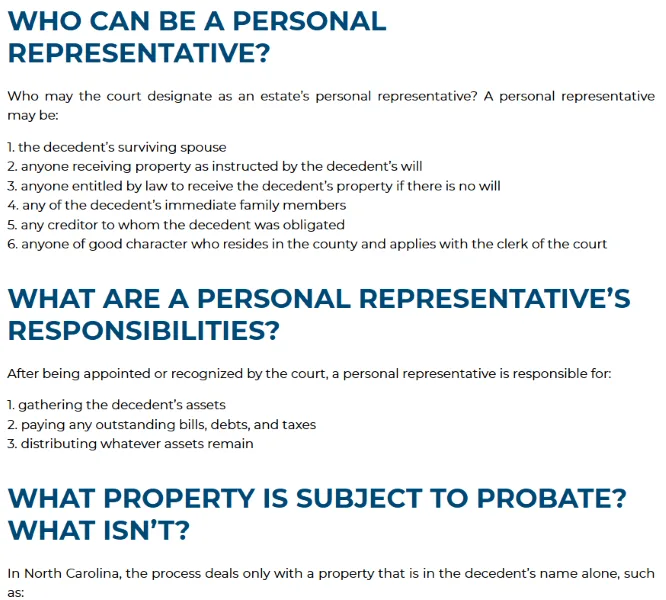
You can quickly spot the question-style headers and immediate answers. It uses numbered lists to clearly lay out steps for each question. And there are frequent mentions of location, which helps local businesses get found in AI Overviews and other AI answers.
Here are four resources to help you plan and create content that AI systems will scoop up:
- The New Content Formats Winning in AI Search
- Why Your First 200 Words Are Crucial for AI Search Optimization
- AI Is Making Your Content Lose Accuracy Faster. Here’s How to Fix it
- Schema Markup for AI: Types, Benefits, & How to Set It Up
3. Expand your online presence
Large language models (LLMs)—the brains of AI search engines—learn about topics from all across the web. So when someone asks AI for the best local pastry or tire shop, it doesn’t just read your website; it looks to see where else your business has been mentioned to decide if you’re a reliable source for its answer.
All this means that you need to get your brand mentioned positively in places that cover topics related to your business.
Here’s where to start.
Business listings
Business listings are one of the most missed opportunities for small businesses. When you’re looking for a quick, cheap way to boost your GEO, absolutely start by making sure your business is represented in the most important directories like:
- Google Business Profile
- Yelp
- Yellow Pages
- Better Business Bureau
- Industry directories like Angi and Zocdoc
- Local directories like your town’s chamber of commerce
When someone looks for a reputable dealer to help with their first-ever car purchase, you better believe that AI has scoured directories to find its recommendations.

Here are a handful of guides that’ll help you get your online listings in tip-top shape:
- 8 Google Business Profile Optimization Tips to Stand out in Search Results & Map Listings
- The Complete Guide to Local Citations (+A Handy Checklist)
- How to Add or Claim a Business on Yelp (+7 Tips!)
Digital PR
Digital PR means getting your business mentioned or featured on reputable websites, news outlets, and online publications to build credibility, visibility, and authority online.
There are lots of ways to earn mentions for your business, like:
- Become an expert source for local reporters (when the local news wants a quote about healthcare, they’ll come to you).
- Publish press releases for notable events like opening a new location, changes of management, growth milestones, etc.
- Apply for local business awards.
- Take part in local events like volunteering at 5k races.
Here’s an example of how to turn your expertise into online mentions that help boost AI authority. This sales manager for a car dealership in Salina, Kansas, has built a reputation as the Ford Video Guy, getting his dealership mentioned on all sorts of industry forums, news reports, and industry publications…simply by sharing his expertise.

Engage in relevant forums like this to give AI platforms more places to see your brand.
Social media
Social media can have a more direct influence on GEO than traditional SEO, because AI systems often look at actual brand mentions and discussions on social networks, not just backlinks.
ChatGPT, Gemini, and the like use public content from Reddit threads, Facebook comments, and so on as training data. Whenever your brand is discussed on those sites, it gets picked up by AI and used as a relevance and authority signal.

Ask me anything (AMA) events are perfect opportunities to boost trust and impact your GEO.
4. Share multi-modal content
Multi-modal content means sharing your message using multiple formats like text, images, video, and audio. Using multiple types of content supports GEO in two ways.
First, multimodal content gives AI more ways to interpret your information. Large models increasingly process text, visuals, and sometimes audio together. A clear diagram, a labeled image, or a short explanatory video can reinforce the meaning of the written content, making it easier for the system to grasp the concept and summarize it correctly.
Second, multimodal content increases the number of surfaces where your brand can appear. A written guide might be cited in an AI answer, while an accompanying chart, infographic, or video may appear in image or video results. Each format creates another pathway for AI systems to discover and reference your information.
Look at this AI Overview answering “How do I plant a tree from a seed?” Not only does it include a video link if you scroll down, but its text answers are based on the contents of several YouTube videos.

Here are some ways you can leverage multi-modal content for GEO:
- Add descriptive alt text to images: Write clear, specific alt text that explains what the image shows and how it relates to the topic so AI systems and search engines can understand the visual content.
- Use visuals to explain key ideas: Include charts, diagrams, screenshots, or infographics that reinforce important points in your article and make complex information easier to interpret.
- Embed helpful videos when relevant: Short explainer videos or demonstrations can reinforce your written content and give AI systems another format to understand and surface your expertise.
- Pair visuals with clear captions: Add short captions under images, charts, or graphics to explain what they show—this provides additional context that AI systems can extract.
- Structure information in multiple formats: Present key information in text, bullet lists, tables, or step-by-step visuals so both readers and AI systems can easily interpret and summarize the content.
5. Publish content for prompts, not queries
AI tools are teaching people to ask much more specific questions. Instead of typing “best physical therapist,” a potential patient now asks, “Who is the best physical therapist near me that takes my insurance, has good reviews, and specializes in helping runners recover from shin splints?”

And they often don’t stop there. About a third of users ask AI follow-up questions.
The takeaway is that your website needs to answer your customers’ specific questions and the next questions they’re likely to ask.
Here are some ways you can create a site that’s built to answer complex prompts:
- Identify the real questions customers ask: Look at sources like Google’s “People Also Ask,” customer emails, sales calls, reviews, and tools like AnswerThePublic to find the exact questions people ask about your products or services.
- Create pages that answer one question clearly: Structure content so each section or page directly answers a specific question with a clear heading (for example, “How long do dental implants last?”), followed by a short, direct explanation.
- Anticipate logical follow-up questions: After answering the main question, include sections that address the next questions users often ask, such as cost, timeline, risks, or alternatives.
- Use FAQ and conversational formatting: Publish FAQs, Q&A sections, and bullet lists that mirror the way people phrase questions in AI tools, making it easier for AI systems to extract and reference your answers.
- Creating content hubs: Build interconnecting pages that answer different aspects of a central topic.

Content hubs help you build topical authority with AI systems.
The GEO checklist for small businesses
There’s a metric ton of information out there already about how to show up on AI-generated answers. And while much of it is valid, it’s also overkill for most small businesses that have so much to tackle in a day.
Use this simple GEO checklist while you create content and think of new ways to increase your online footprint.

Turn GEO into a small business lead generation machine
The early days of SEO were chaotic. But within the chaos was an opportunity for early adopters to grab lots of consumer attention.
We’re currently in the same state of AI search. With just a few non-technical tweaks to your website and a little focus on being mentioned online, you can be the brand that AI recommends and cites most often.
If you’d like a boost getting found online, contact us, and we’ll show you how we can help you get more leads from AI, search, social, and more.

Recommended for you






Unlock your business potential
We offer innovative technology and unparalleled expertise to move your business forward.