


AI Overviews are changing search, and many businesses are feeling it. What’s usually missed is why visibility is actually dropping.
AI Overviews reward clarity. Businesses that clearly explain what they offer, how pricing works, who delivers the service, and what happens next tend to show up more often.
That is actually good news for local businesses. Competing in AI search does not require technical tricks. It comes down to clear service pages, usable pricing information, visible staff credentials, and straightforward FAQs.
This article walks through everything you need to know about AI Overviews, including best practices so Google can confidently reference your business in AI Overviews.
Contents
- What are AI Overviews?
- How AI Overviews are impacting local search
- Why local businesses should care about AI Overviews
- How Google chooses which local businesses to cite in AI Overviews
- Best practices for your local business to show up in AI Overviews
- Common local business mistakes that block AI visibility
- How to track when AI Overviews are citing your local business
What are AI Overviews?
AI Overviews are AI-generated answers to queries that typically show at the top of Google search results. These AI summaries aggregate content from across the web to give searchers a quick overview of their query.

AI Overviews get their content from a variety of sources, including community forums like Reddit, social media sites like Facebook and Instagram, video sites like YouTube, business websites, and other website content.

🔎 Get updated tips for your SEO strategy with our free guide >> How to Do SEO Right–Right Now!
How AI Overviews are impacting local search
Local visibility feels unstable right now because AI Overviews change how search works at a basic level.
In traditional search, Google showed a list of websites and sent people to click through them. AI Overviews work differently. They do not rank websites and pass traffic down the page. They build an answer.
Google pulls short explanations from multiple sites and combines them into a single response that solves the search right away.
Here’s a simple example: Someone searches “personal trainer near me.”
Instead of sending them to five different websites, Google may show an AI summary that explains:
- What personal training usually includes
- How sessions are typically priced
- Who personal training is best for
- What certifications trainers often have
- Where to find personal trainers

Each of those pieces can come from a different local business website. One site explains pricing. Another explains what happens in a session. A third lists trainer credentials. The searcher gets the answer without visiting any of those pages.
That is the key change.
👀 Want to know how 300+ SMBs are responding to changing trends in SEO and GEO? Get the Website & SEO Trends Report >>
Why local businesses need to adjust their strategies for AI Overviews
By late 2025, AI Overviews appeared on roughly 16% of all Google searches (up from single digits earlier in the year). Based on current patterns, that number is still growing, especially for high-intent searches where people want to make a decision quickly.
This has real consequences for local businesses. Independent studies show that organic click-through rates can drop by up to 60% when an AI Overview appears, even for businesses ranking near the top of the page.
For local businesses, this means rankings alone no longer guarantee visibility. For local searches, the AI response needs to answer a short list of practical questions a customer uses to decide fast:
- What the service is
- Who it is for
- How it works
- What it costs or how pricing works
- Who provides it
- Where it is available
Businesses that answer these clearly give Google what it needs to build a reliable response. Pages built around slogans, brand messaging, or vague promises do not.

This student housing apartment community includes information that will help it get surfaced in AI Overviews.
The shift is simple: In local search, visibility now depends less on how persuasive your website sounds and more on how clearly it explains what your business actually does.
How Google chooses which local businesses to cite
As teased above, Google’s AI is designed to avoid uncertainty. When it assembles an answer, it looks for information it can reuse without interpretation.
For local businesses, the signals Google relies on are consistent:
- Clear definitions of each product or service.
- Pricing context that sets expectations.
- Identifiable people behind the business.
- Direct answers to common customer questions.
- Strong, location-specific details.
When all of these are present, Google can reuse the content confidently. When one is missing, the system hesitates. In practice, hesitation usually means the business is left out.
This explains a pattern many local businesses are seeing. They still perform well in traditional search results but fail to appear in AI Overviews. Nothing is technically broken. The site simply does not provide enough clarity for Google to reuse its content safely.
Most local business pages are written to persuade rather than explain. They lead with long introductions about values, passion, or experience. The actual business or service description appears much later.
That structure fails in AI search.
AI systems read from the top. If the first screen does not clearly explain the service, the page becomes unusable. Google does not scroll and hope meaning becomes clearer later.
Best practices to show up in AI Overviews
Let’s dive into some best practices that can help your local business get surfaced in AI Overviews.
1. Structure your pages the right way
At the top of each product or service page, Google should be able to extract four things immediately:
- What the service is: A plain description of what you actually do, not a headline or value statement.
- Who the service is for: The type of customer or situation this service applies to.
- What problem it solves: The specific issue a customer is trying to fix.
- How it works in simple terms: A short, practical explanation of what happens when someone uses the service.
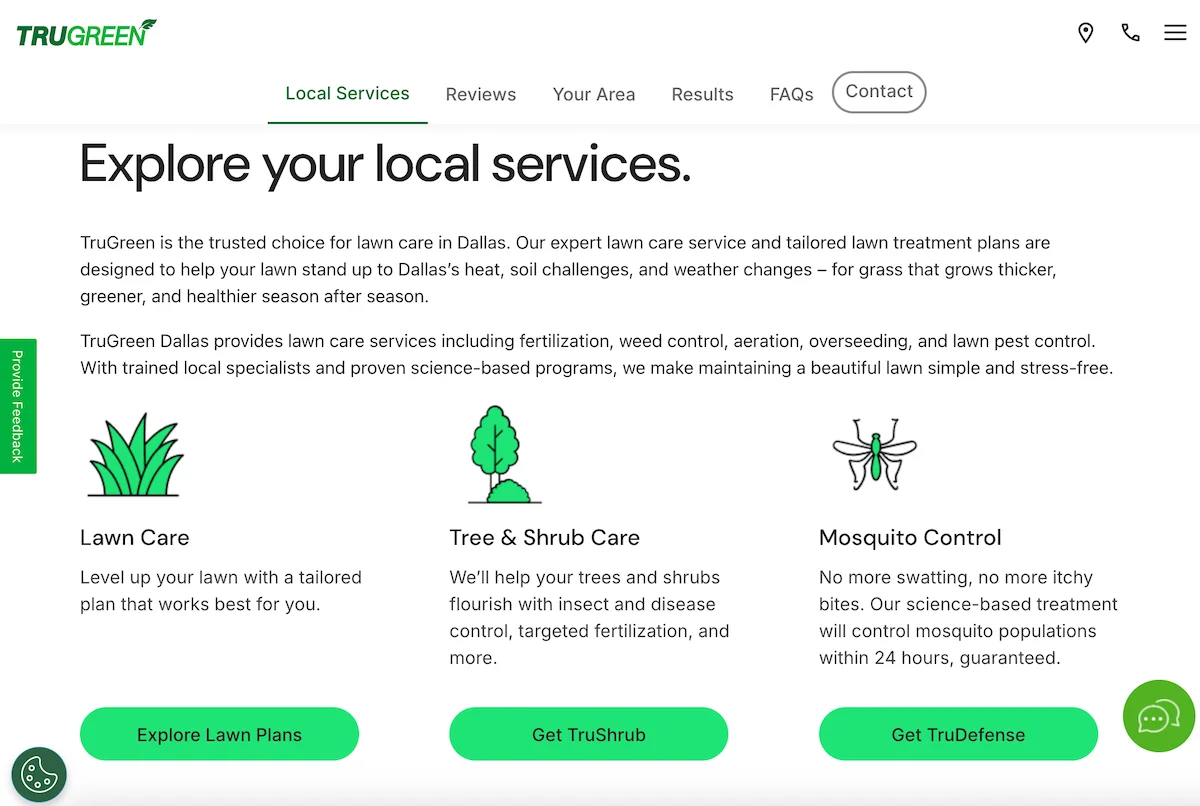
If these elements are buried halfway down the page, Google often ignores the page entirely.
AI systems read top-down. They do not scroll and piece things together the way humans do.
⭐️ Want searchers to see (and click on!) your site? Download our free guide >> Ways to Make Your Website More Visible on Google
2. Only include one service per page
Each core product or service you offer should have its own page. When multiple services are combined into one long page, Google cannot isolate explanations cleanly. That makes reuse risky.
For example, a gym that lists personal training, group classes, nutrition coaching, and physical therapy all on one page forces Google to interpret where one service ends and another begins. Interpretation introduces uncertainty. Uncertainty gets filtered out.
Separate pages reduce that risk. Each page gives Google one clear explanation it can safely reuse.
Here’s a practical example from Massage Envy:

Their service pages start by explaining the treatment itself. They describe what it is, who it helps, and what happens during a session. That structure makes the content easy to summarize and safe to reuse. Google does not have to guess.
They avoid the common problems that hurt AI visibility, including:
- Multiple services combined on one page
- Long introductions about values or philosophy before the service is explained
- Vague phrases like “high-quality solutions,” “tailored approach,” or “best-in-class service”
3. Create good pricing pages
Pricing is one of the strongest signals for AI Overviews. It reduces uncertainty more than almost anything else.
Local businesses often avoid pricing because they fear losing leads. In AI search, hiding pricing creates a bigger problem. When Google cannot understand pricing context, it cannot answer cost-related questions. When it cannot answer those questions, it removes your business from the response.
Pricing does not need to be exact. It needs to be explained.
Pricing formats that work well
Different businesses can use different formats. What matters is clarity. Common formats that work include:
- Starting prices
- Price ranges
- Membership tiers
- Service bundles
A gym might list monthly membership tiers. A clinic might list consultation fees. A home service business might list starting prices with variables explained.
What to do when exact prices aren’t possible
Many local businesses cannot publish fixed prices, or it doesn’t align with their business type. That is normal. What matters is pricing logic.
If prices vary, explain:
- What affects the cost
- What is included
- How estimates are created
- What a customer should expect before work starts
This allows Google to answer “how much does this usually cost” without inventing numbers.
Here’s an example from Merry Maids:

Merry Maids does not publish exact prices. Instead, their pricing pages explain what influences cost, how estimates are prepared, and why they go that route. They focus on pricing logic, not price points. That gives Google enough context to answer pricing questions without guessing or inventing numbers.
4. Add staff bios to boost visibility signals
AI Overviews care about who provides the service. Anonymous businesses are harder to trust than named professionals. This is not about branding or personality. It is about accountability.
Google pays attention to people because:
- Real names increase trust: A named provider is easier to verify than an unnamed team. Names signal that the business stands behind the service.
- Credentials reduce uncertainty: Licenses, certifications, and formal education clarify whether someone is qualified to perform the service.
- Experience clarifies expertise: Years in practice or areas of specialization help Google understand depth, not just claims.
If your site says “our experienced team” but never names anyone, Google has no concrete entity to attach expertise to. The claim becomes vague, and vague information is less likely to be reused in AI Overviews.
What makes a strong staff bio for AI visibility
A strong staff bio does not need to be long. It needs to be specific and factual.
At a minimum, each bio should include:
- Full name
- Role
- Certifications or licenses
- Years of experience
- Area of focus or specialization
This applies across industries. A personal trainer, a dentist, a technician, or a therapist all benefit from the same structure. The goal is to make expertise explicit rather than implied.
Avoid generic bios that repeat the same text for every staff member. Duplicate or thin bios reduce clarity and provide little value to AI systems.
Here’s an example from Thrive Dental:

Thrive Dental lists dentists and hygienists with clear roles, credentials, and education. Google does not have to infer who provides care or why they are qualified. The information is explicit and verifiable.

That clarity makes the content safe to reuse in AI Overviews. Google can confidently include the business when answering questions about dental services, providers, or qualifications.
For local businesses, staff bios are no longer just a trust signal for customers. They are a visibility signal for AI-driven search.
5. Include FAQs as a primary source for AI answers
FAQs have quietly become one of the most valuable assets for AI visibility, especially for local businesses. That is because the format aligns almost perfectly with how people search and how AI systems respond.
Most AI Overviews are built by answering questions. When Google looks for content to reuse, FAQ sections often provide the cleanest, lowest-risk material available on a site.
FAQs appear frequently in AI Overviews for three reasons:
- The question format mirrors real searches: People search in questions, especially for local services. “How much does a gym membership cost?” “Do I need an appointment?” “What happens on the first visit?” FAQs match that structure exactly.
- Answers are direct and contained: A good FAQ answer focuses on one issue and resolves it clearly. That makes it easier for Google to reuse without pulling extra context from other parts of the page.
- Google can reuse them without guessing: When a question and answer are tightly paired, Google does not have to infer intent or fill gaps. That reduces risk, which increases the chance of inclusion.
What FAQs should cover for local businesses
FAQs work best when they address the practical concerns that stop customers from booking, calling, or visiting. These are rarely marketing questions. They are operational ones.
Every local business should cover:
- Pricing basics: Not exact prices if that is not possible, but how pricing works.
- Availability and scheduling: Appointments, walk-ins, peak times, and wait expectations.
- First visit expectations: What happens, how long it takes, what to bring, and how to prepare.
- Cancellations or commitments: Notice periods, contracts, minimum terms, or penalties.
- Insurance or eligibility: Coverage, accepted providers, age limits, or requirements.
If customers ask these questions by phone or email, they belong in your FAQs.
How good FAQ answers are written
FAQs fail when they are treated like marketing copy. They succeed when they are treated like instructions.
Strong FAQ answers follow a few simple rules:
- One question per section: Do not bundle multiple concerns into one answer.
- One clear answer: Resolve the question directly before adding any extra context.
- No sales language: Avoid phrases like “industry-leading,” “best-in-class,” or “designed to delight.” They add noise and reduce clarity.
FAQs should explain how your business works, not persuade someone to choose you.
Here’s an example from Anytime Fitness:

Anytime Fitness answers practical membership questions plainly. They explain access rules, billing, contract terms, and cancellations in straightforward language.
Because the answers are specific and operational, Google can reuse them easily in AI Overviews. The content does not require interpretation. It simply resolves the question.
For local businesses, that is exactly what AI systems are looking for.
6. Add location pages to help Google understand where you operate
AI Overviews tie answers to geography. Google treats each location as its own entity.
If your business operates in multiple areas, each location needs a page that clearly explains:
- Which services are offered at that location: Not every location offers everything. Google needs to know what is available where.
- Which staff work there: Even a partial staff list helps Google connect people to places.
- Local hours and contact details: These confirm that the location is active and distinct.
- Location-specific FAQs: Parking, access, local scheduling rules, or service limitations all matter.
These details help Google confidently answer questions like “Who provides this service near me?” or “Which location should I contact?”
Tips for great location pages
Most location pages fail for predictable reasons:
- Copy-pasted pages with the same text reused across locations.
- Generic descriptions where only the address changes.
Google detects duplication immediately. When every location page says the same thing, Google cannot tell which one to reference. That uncertainty causes the pages to be ignored in AI Overviews.
Here’s an example from Servpro:
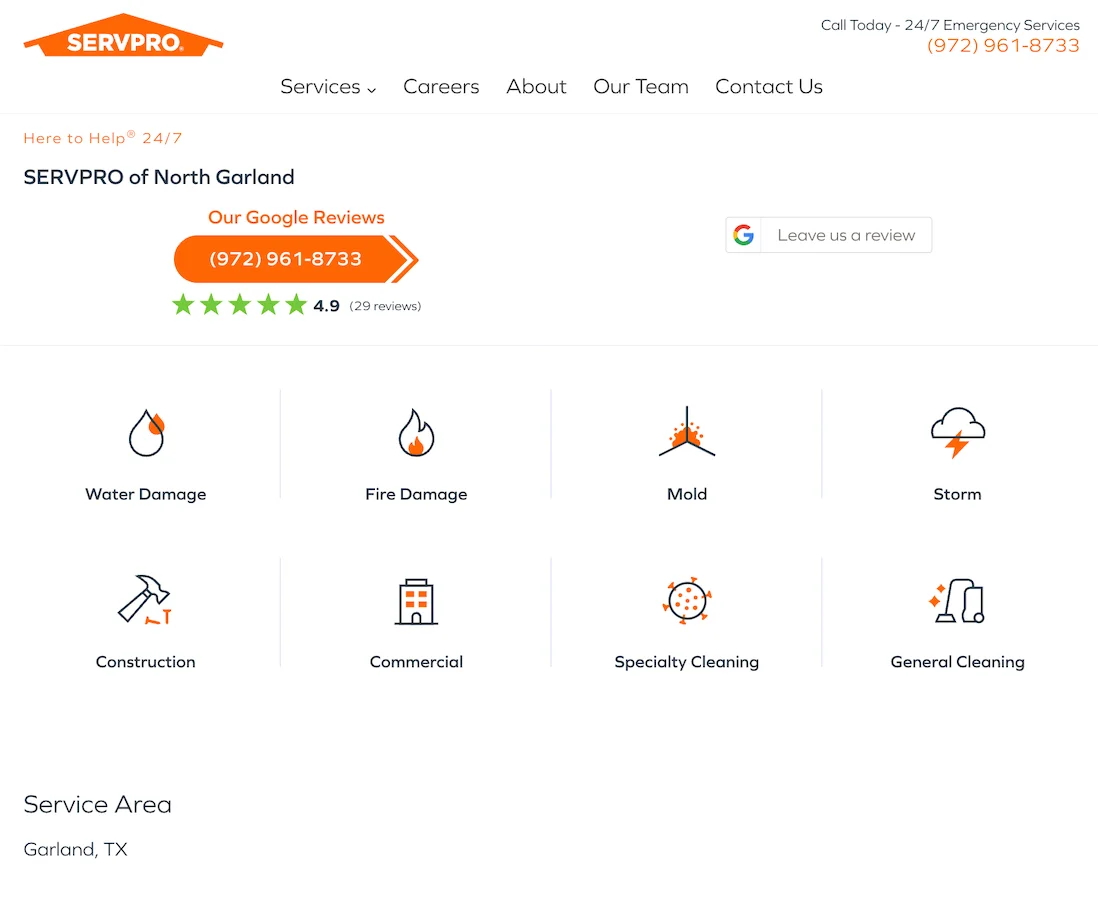
Each Servpro location page contains unique service details, contact information, and local context. Google can clearly distinguish one location from another.
That structure allows Google to reference the correct Servpro branch when answering local AI queries. There is no guessing involved.
For businesses with multiple locations, this approach is no longer optional. It is how Google understands where you actually operate.
Common local business mistakes that block AI visibility
Across gyms, clinics, and service providers, the same issues appear repeatedly:
- One generic services page for the entire business: Google cannot isolate explanations for individual services.
- No pricing context anywhere on the site: Cost-related questions cannot be answered safely.
- Missing or thin staff bios: Expertise cannot be verified.
- FAQs that are hidden or missing: Practical questions remain unanswered.
- Heavy design with very little text: Visual polish replaces explanation.
Nothing appears broken. Rankings may even look fine. But AI systems cannot confidently reuse the content, so the business is excluded from AI Overviews
How to track when AI Overviews are citing your local business
AI visibility often shows up indirectly. Early signals include:
- Search impressions increasing while clicks stay flat: Your content is being surfaced, but users are not visiting the site.
- Branded searches rising: People see your business name in AI answers and search for it later.
- Customers repeating phrases from Google: Language from your site appears in conversations or inquiries.
These signals indicate that your content is being reused inside AI answers. Your explanations are trusted, even if users never click through.
For local businesses, this is the new visibility baseline. Being cited matters even when clicks do not follow.
Make AI Overviews work for your local business
AI Overviews for local businesses reward clarity, not clever copy.
Local businesses win by explaining things plainly. If your site clearly defines services, shows real people, sets pricing expectations, answers common questions directly, and ties everything to location, Google can reuse your content with confidence (and here’s what AI gets wrong about SEO).
That is how small businesses get cited instead of skipped.

Recommended for you







Unlock your business potential
We offer innovative technology and unparalleled expertise to move your business forward.