


Want to reach high-intent buyers fast? Search advertising is one of your best bets. When someone searches for “Brake repair near me” or “Honda dealer with the best inventory in Sacramento,” they’re open to seeing and clicking your well-targeted ad.
But it’s no easy task to predict just how well your search ads will perform. Or what you should expect to spend. Especially now, with forces like changing tariffs, fluctuating fuel costs, mixed interest-rate messaging, and the stop-and-start pace of EV infrastructure and tax benefits.
What cost per click, click-through rate, and cost per lead are other businesses in your niche seeing? And what can you do to get even better results from each campaign?
To answer these questions, we’ve partnered with WordStream by LocaliQ to analyze data from thousands of our customers’ advertising campaigns across Google Ads and Microsoft Ads. Plus, we’ve asked auto-industry marketing experts for their top tips to drive more leads and boost the ROI of your search ads.
Contents
- Search ads benchmarks for automotive: Key takeaways
- Automotive search ads benchmarks by metric
- Tips for automotive businesses to improve search ad campaigns
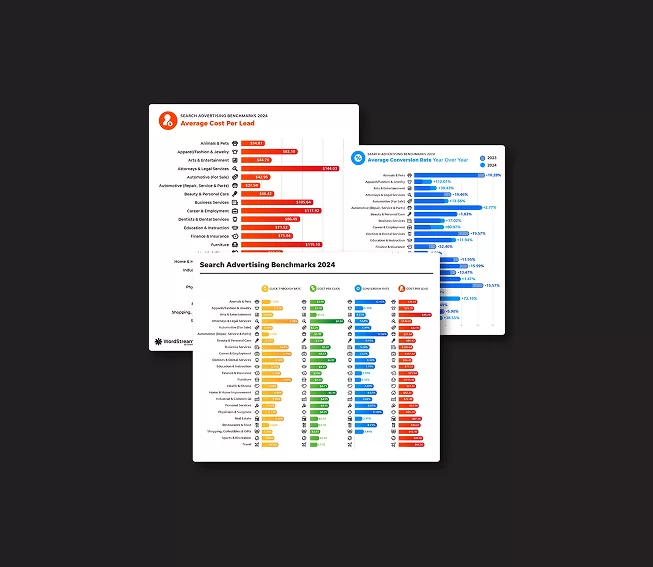
❓Want to see how the automotive industry stacks up against others in Google and Microsoft advertising results? Download our latest, complete search ads benchmarks report for free here!
Search ads benchmarks for automotive: Key takeaways
The average automotive business experienced different outcomes from its search ads than we saw in the overall search ads benchmarks across all industries. For example, the average click-through rate across all industries fell slightly, while automotive ads enjoyed an average CTR increase of nearly 5%. The rise in search ad CPC was significantly higher for automotive businesses than for industries overall.
Here are the key trends to consider as you create your search ads strategy for the upcoming year.
- Average click-through rate decreased for over half of automotive businesses, but increased overall by 4.93%. This differs from our full-industry Google Ads benchmarks, where CTR decreased slightly overall (-0.3%). Higher fuel prices are keeping buyers cautious and selective rather than driving them out of the market, a split that may explain why dealers focused on fuel-efficient vehicles like Honda and Toyota saw more competition and outsized CTR gains.
- Average cost per click decreased for just 16% of automotive businesses, while increasing 12.58% overall. This increase is much steeper than our overall benchmark (3.04%). CPC is a strong measure of industry competition, so this sharper rise tracks with what we’re seeing on the spending side: total franchised dealership advertising expenditures jumped from $4.28 billion to $5.04 billion between H1 2025 and H1 2026, meaning more dollars are chasing the same clicks.
- Average conversion rate increased for 71% of automotive businesses, up 2.56% overall. This increase is slower than our overall benchmark (8.78%). Rising affordability pressure may be behind the broader gain. With new vehicle prices settling near a $50,900 average and the typical U.S. vehicle now approaching 13 years old, fewer people are casually browsing. More of today’s clicks come from shoppers who already need a repair or a vehicle, which tends to convert at a higher rate.
- Average cost per lead increased for 52% of automotive businesses, adding to an overall increase of 4.09%. That’s a significant departure from the all-industry average, where CPL dropped by 4.88%. That increase may tie back to the NADA report showing an increase in ad spend. More dollars fighting for the same customers can push up conversion costs.

Automobile consumer purchase intent remains steady this year, but shoppers’ interest is not evenly distributed. And the results of our benchmarks report show this effect.
For example, higher gas prices and inflation, coupled with a rollback of EV credits, are pushing more buyers to search for less-expensive, fuel-efficient hybrid sedans and smaller SUVs over large vehicles and (more expensive) full EVs. Dealers that focus on this type of vehicle, like Hyundai, are seeing higher CTRs and CPCs in the face of that competition.
That competition is showing up in cost, too. Total franchised dealership advertising expenditures jumped nearly 18% between H1 2025 and H1 2026. With more dollars chasing the same pool of clicks and leads, it’s no surprise CPC (+12.58%) and CPL (+4.09%) both climbed well above the rates we saw across other industries.
We also saw Auto Service & Repair CPCs go up (+27.13%) while CTRs decreased (-7.35%). The average US passenger vehicle is four years older now than it was in 2000, which would explain the added competition and cost of clicks in that niche. The lower CTR may also be a competition effect, if more ads are showing on the results page.
Increasing interest rates, fuel-price instability, and an ongoing question of tariffs will make it incredibly important to find and convert buyers as efficiently as possible.
Automotive search ads benchmarks by metric
Ready for a deep dive into the pay-per-click (PPC) data trends for the automotive industry? Here are the Microsoft and Google Ads metrics for each automotive subcategory.
🚨 Let’s see if we can tune up your search ads. Use our Free Google Ads Grader to get a full report on how to tune up your search strategy.
Average click-through rate
Click-through rate is a great benchmark for how well your ad targeting is working and how clickable your search ad is. Clicks may not guarantee conversions, but they’re an important data point for honing your search ad strategy.
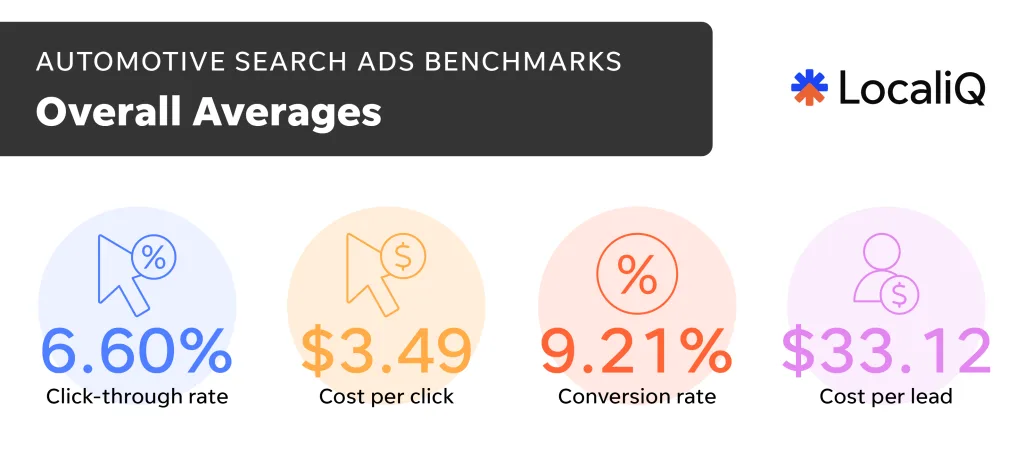
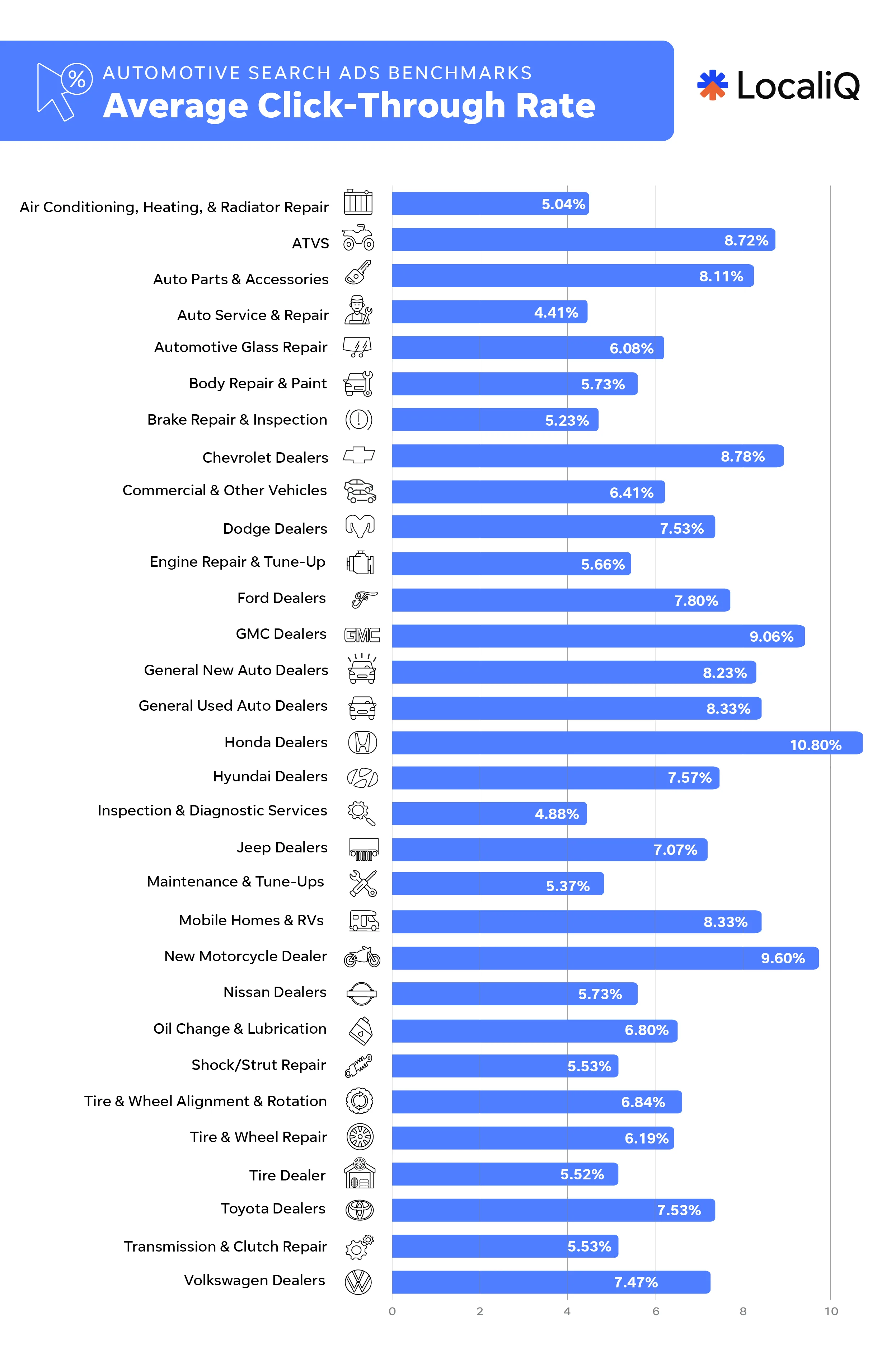
The overall average click-through rate for automotive search ads is 6.60%.
| Automotive subcategory | Average click-through rate |
| Air Conditioning, Heating, & Radiator Repair | 5.04% |
| ATVs | 8.72% |
| Auto Parts & Accessories | 8.11% |
| Auto Service & Repair | 4.41% |
| Automotive Glass Repair | 6.08% |
| Body Repair & Paint | 5.73% |
| Brake Repair & Inspection | 5.23% |
| Chevrolet Dealers | 8.78% |
| Commercial & Other Vehicles | 6.41% |
| Dodge Dealers | 7.53% |
| Engine Repair & Tune-Up | 5.66% |
| Ford Dealers | 7.80% |
| GMC Dealers | 9.06% |
| General New Auto Dealers | 8.23% |
| General Used Auto Dealers | 8.33% |
| Honda Dealers | 10.80% |
| Hyundai Dealers | 7.57% |
| Inspection & Diagnostic Services | 4.88% |
| Jeep Dealers | 7.07% |
| Maintenance & Tune-Ups | 5.37% |
| Mobile Homes & RVs | 8.33% |
| New Motorcycle Dealer | 9.60% |
| Nissan Dealers | 5.73% |
| Oil Change & Lubrication | 6.80% |
| Shock/Strut Repair | 5.53% |
| Tire & Wheel Alignment and Rotation | 6.84% |
| Tire & Wheel Repair | 6.19% |
| Tire Dealer | 5.52% |
| Toyota Dealers | 7.53% |
| Transmission & Clutch Repair | 5.53% |
| Volkswagen Dealers | 7.47% |
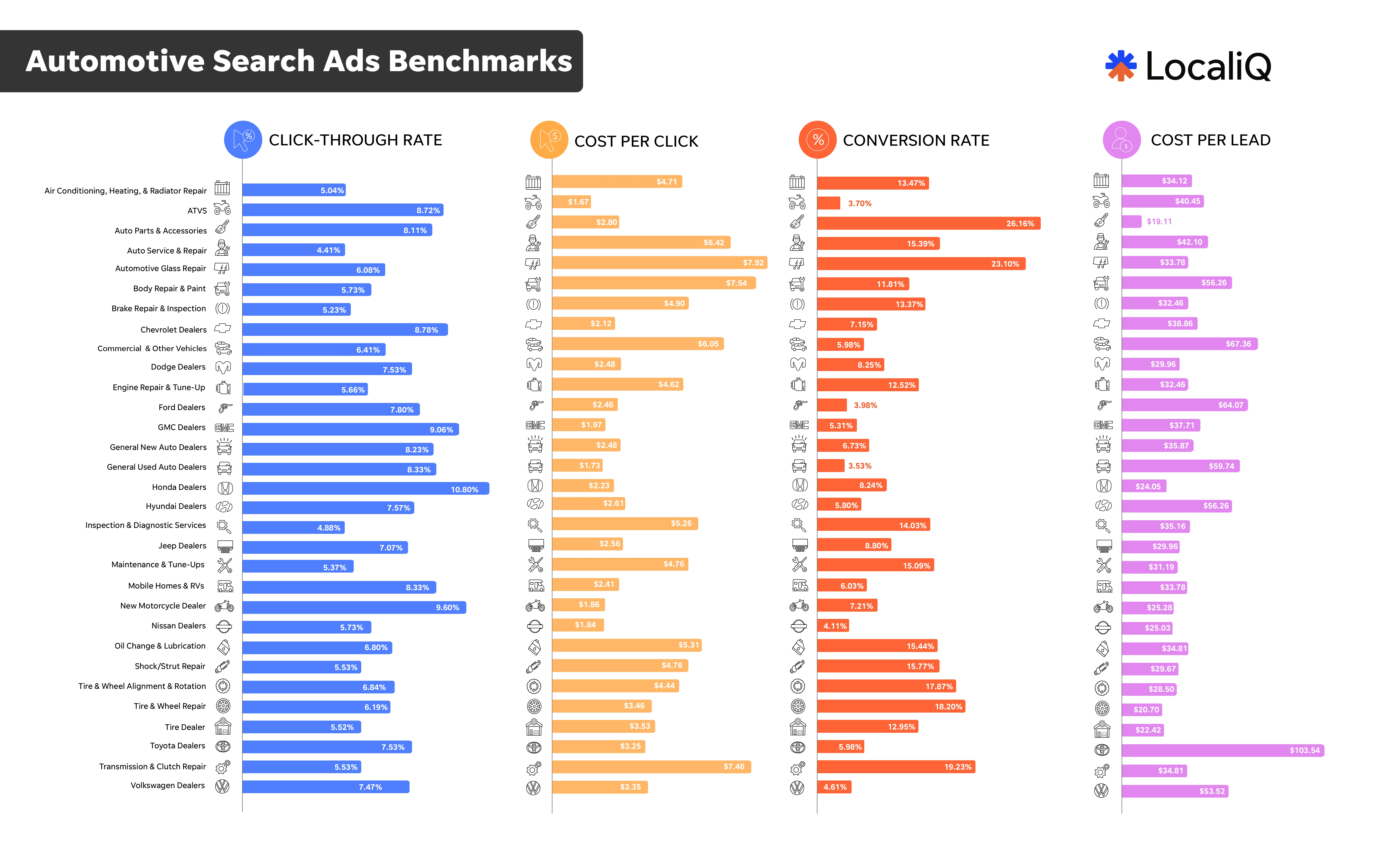
The automotive businesses that saw the best CTRs were Honda Dealers (10.80%), New Motorcycle Dealers (9.60%), and GMC Dealers (9.06%).
The automotive businesses with the lowest CTRs were Auto Service & Repair (4.41%), Inspection & Diagnostic Services (4.88%), and Air Conditioning, Heating, & Radiator Repair (5.04%).
Average CTR year over year
Nissan Dealers experienced the highest CTR drop year over year at -18.84%. The next two automotive subcategories that saw the largest declines in click-through rate were New Motorcycle Dealer (-15.49%) and Air Conditioning, Heating, & Radiator Repair (-13.55%).
On the flip side, Toyota Dealers enjoyed the biggest increase in CTR with an increase of 18.77%. This was followed by Honda Dealers with an average CTR increase of 17.14% and General New Auto Dealers with an increase of 15.27% year over year.
Average cost per click
Consider CTR and cost per click (CPC) in tandem. High CTRs are good, but if your CPC is also high, your search ads budget will rise quickly. The ideal situation is a high CTR (lots of clicks) and low CPC (low price for those clicks). CPC is affected by things like your bidding strategy and how competitive the keywords you choose are.
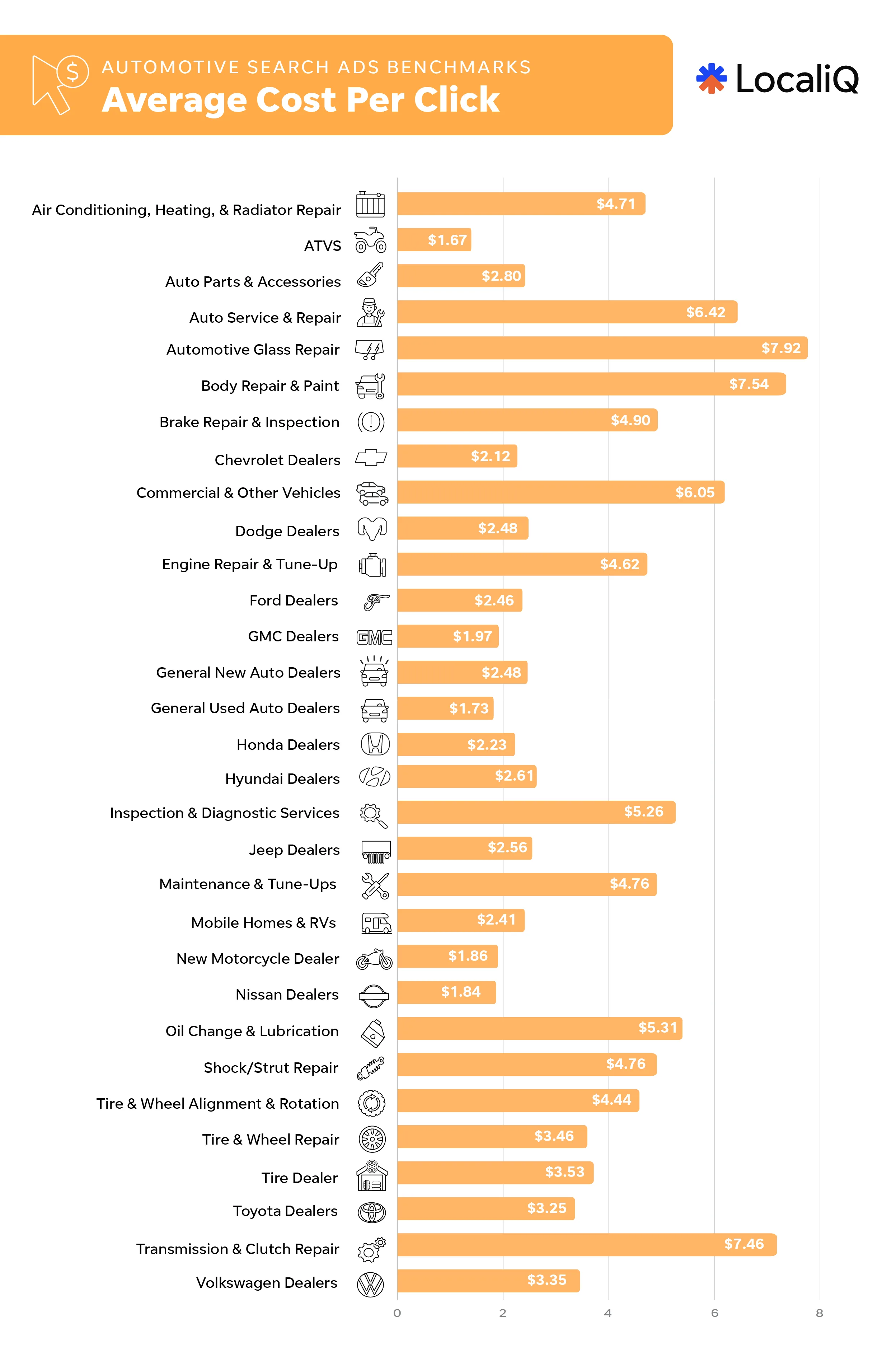
The average CPC for the automotive industry is $3.49.
| Automotive subcategory | Average cost per click |
| Air Conditioning, Heating, & Radiator Repair | $4.71 |
| ATVs | $1.67 |
| Auto Parts & Accessories | $2.80 |
| Auto Service & Repair | $6.42 |
| Automotive Glass Repair | $7.92 |
| Body Repair & Paint | $7.54 |
| Brake Repair & Inspection | $4.90 |
| Chevrolet Dealers | $2.12 |
| Commercial & Other Vehicles | $6.05 |
| Dodge Dealers | $2.48 |
| Engine Repair & Tune-Up | $4.62 |
| Ford Dealers | $2.46 |
| GMC Dealers | $1.97 |
| General New Auto Dealers | $2.48 |
| General Used Auto Dealers | $1.73 |
| Honda Dealers | $2.23 |
| Hyundai Dealers | $2.61 |
| Inspection & Diagnostic Services | $5.26 |
| Jeep Dealers | $2.56 |
| Maintenance & Tune-Ups | $4.76 |
| Mobile Homes & RVs | $2.41 |
| New Motorcycle Dealer | $1.86 |
| Nissan Dealers | $1.84 |
| Oil Change & Lubrication | $5.31 |
| Shock/Strut Repair | $4.76 |
| Tire & Wheel Alignment and Rotation | $4.44 |
| Tire & Wheel Repair | $3.46 |
| Tire Dealer | $3.53 |
| Toyota Dealers | $3.25 |
| Transmission & Clutch Repair | $7.46 |
| Volkswagen Dealers | $3.35 |
The automotive businesses that saw the best CPCs were ATVs ($1.67) and General Used Auto Dealers ($1.73), with Nissan Dealers close behind at third ($1.84).
The automotive business categories with the highest CPCs were Automotive Glass Repair ($7.92), Body Repair & Paint ($7.54), and Transmission & Clutch Repair ($7.46).
Average CPC year over year
The automotive industries with the largest year-over-year CPC increases were Toyota Dealers (+69.27%), Shock/Strut Repair (+42.09%), and Maintenance & Tune-Ups (+37.57%).
Conversely, Nissan Dealers (-43.38%), Volkswagen Dealers (-9.70%), and ATVs (-7.22%) experienced the largest drop in CPCs.
Average conversion rate
Conversion rate tells you how well an ad turns viewers into leads or sales. It’s also a barometer of your overall ad performance, from targeting to copy.
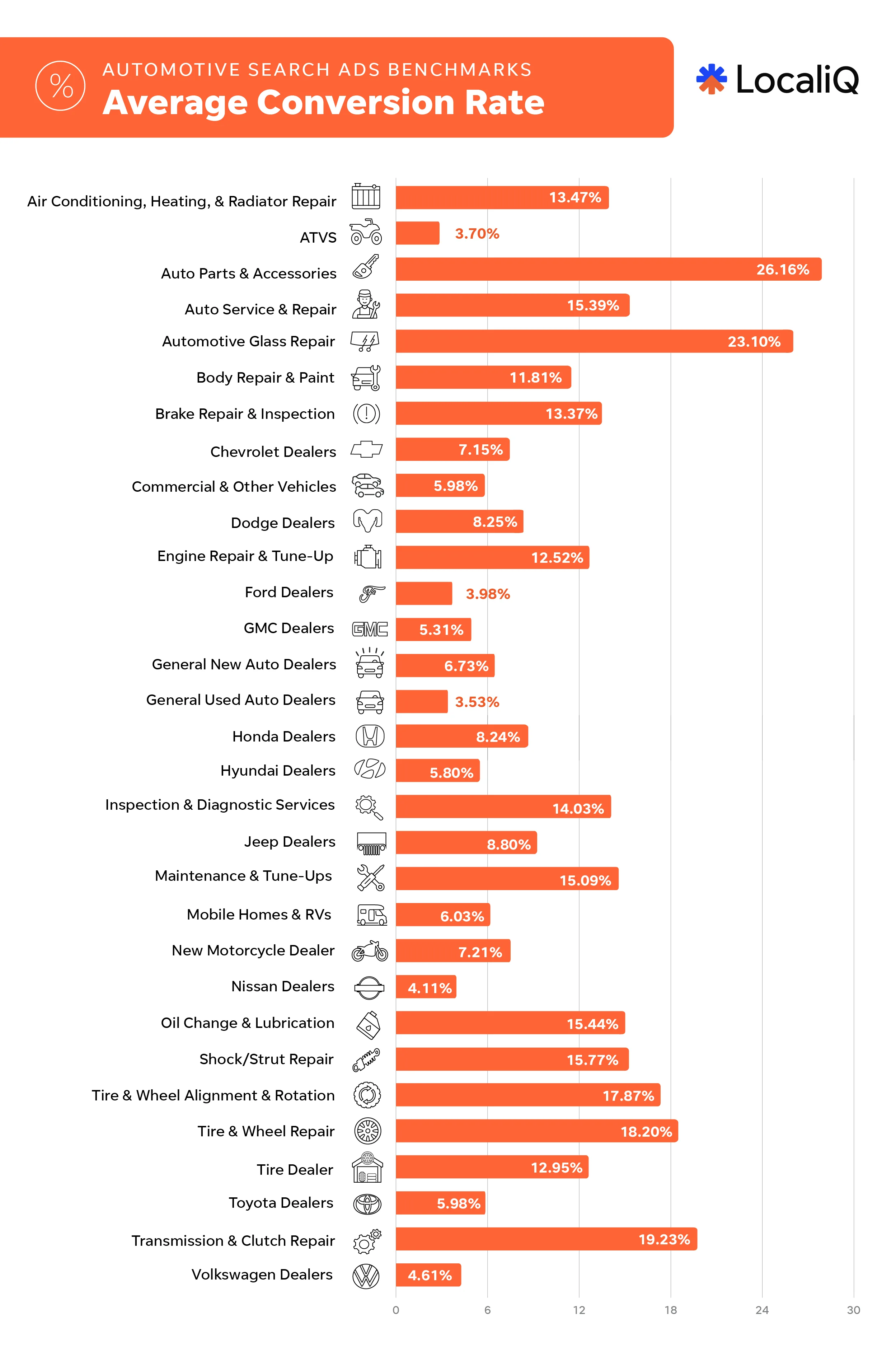
The average conversion rate for automotive businesses is 9.21%.
| Automotive subcategory | Average conversion rate |
| Air Conditioning, Heating, & Radiator Repair | 13.47% |
| ATVs | 3.70% |
| Auto Parts & Accessories | 26.16% |
| Auto Service & Repair | 15.39% |
| Automotive Glass Repair | 23.10% |
| Body Repair & Paint | 11.81% |
| Brake Repair & Inspection | 13.37% |
| Chevrolet Dealers | 7.15% |
| Commercial & Other Vehicles | 5.98% |
| Dodge Dealers | 8.25% |
| Engine Repair & Tune-Up | 12.52% |
| Ford Dealers | 3.98% |
| GMC Dealers | 5.31% |
| General New Auto Dealers | 6.73% |
| General Used Auto Dealers | 3.53% |
| Honda Dealers | 8.24% |
| Hyundai Dealers | 5.80% |
| Inspection & Diagnostic Services | 14.03% |
| Jeep Dealers | 8.80% |
| Maintenance & Tune-Ups | 15.09% |
| Mobile Homes & RVs | 6.03% |
| New Motorcycle Dealer | 7.21% |
| Nissan Dealers | 4.11% |
| Oil Change & Lubrication | 15.44% |
| Shock/Strut Repair | 15.77% |
| Tire & Wheel Alignment and Rotation | 17.87% |
| Tire & Wheel Repair | 18.20% |
| Tire Dealer | 12.95% |
| Toyota Dealers | 5.98% |
| Transmission & Clutch Repair | 19.23% |
| Volkswagen Dealers | 4.61% |
The automotive businesses that saw the best CVRs were Auto Parts & Accessories (26.16%), Automotive Glass Repair (23.10%), and Transmission & Clutch Repair (19.23%).
The automotive businesses with the lowest CVRs were General Used Auto Dealers (3.53%), ATVs (3.70%), and Ford Dealers (3.98%).
Average CVR year over year
The industries with the biggest drop in conversion rates were Nissan Dealers (-55.62%), Hyundai Dealers (-44.31%), and Chevrolet Dealers (-31.11%).
At the same time, Toyota Dealers (+158.44%), Mobile Homes & RVs (+47.05%), and GMC Dealers (+31.58%) showed the largest increases in CVR.
Average cost per lead
Cost per lead (also called cost per conversion, cost per action, or cost per acquisition) shows you how much you’ll spend to convert a customer. This metric most closely highlights the ROI of your search ad budget.
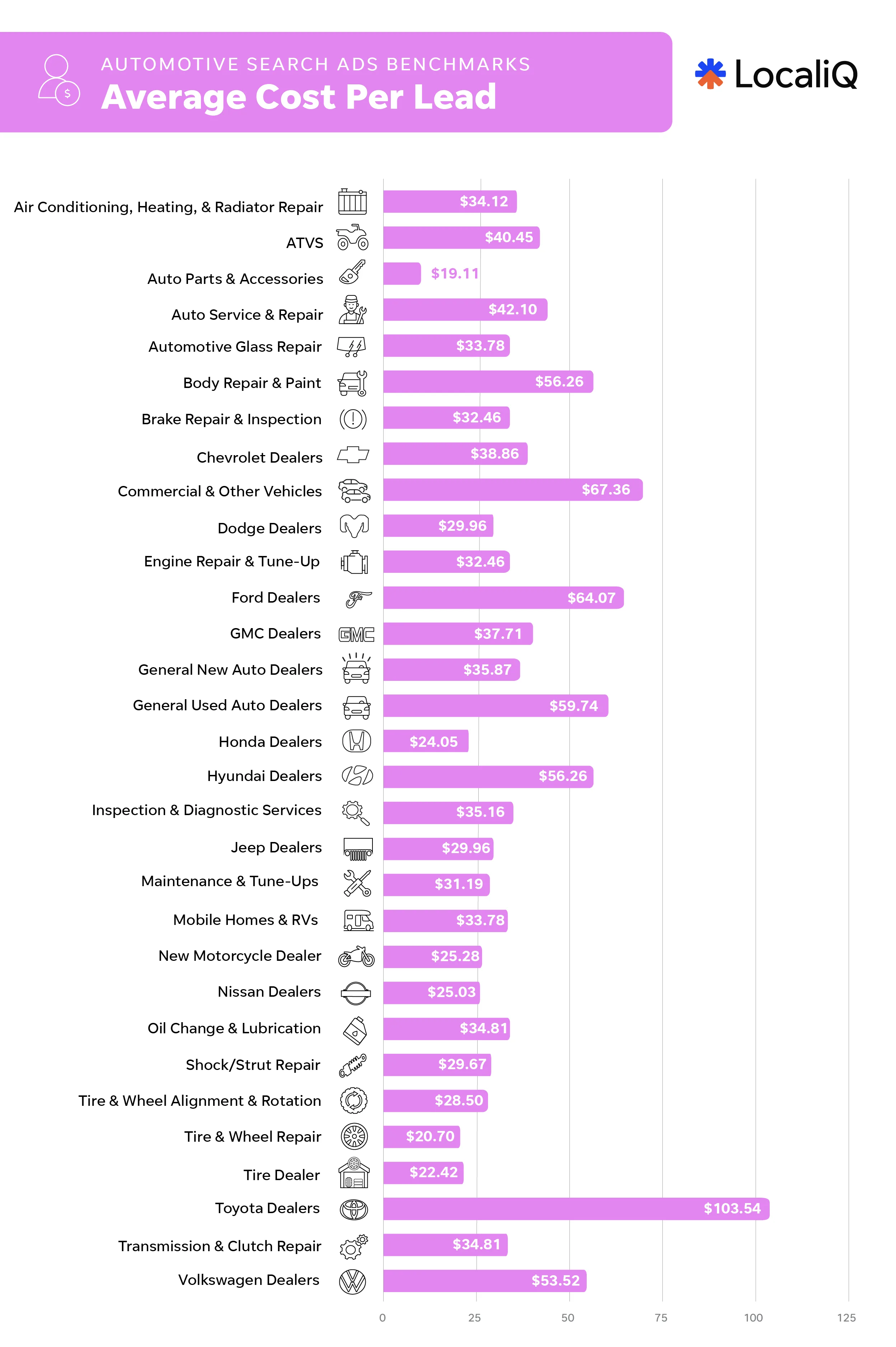
The average CPL for automotive businesses is $33.12.
| Automotive subcategory | Average cost per lead |
| Air Conditioning, Heating, & Radiator Repair | $34.12 |
| ATVs | $40.45 |
| Auto Parts & Accessories | $19.11 |
| Auto Service & Repair | $42.10 |
| Automotive Glass Repair | $33.78 |
| Body Repair & Paint | $56.26 |
| Brake Repair & Inspection | $32.46 |
| Chevrolet Dealers | $38.86 |
| Commercial & Other Vehicles | $67.36 |
| Dodge Dealers | $29.96 |
| Engine Repair & Tune-Up | $32.46 |
| Ford Dealers | $64.07 |
| GMC Dealers | $37.71 |
| General New Auto Dealers | $35.87 |
| General Used Auto Dealers | $59.74 |
| Honda Dealers | $24.05 |
| Hyundai Dealers | $56.26 |
| Inspection & Diagnostic Services | $35.16 |
| Jeep Dealers | $29.96 |
| Maintenance & Tune-Ups | $31.19 |
| Mobile Homes & RVs | $33.78 |
| New Motorcycle Dealer | $25.28 |
| Nissan Dealers | $25.03 |
| Oil Change & Lubrication | $34.81 |
| Shock/Strut Repair | $29.67 |
| Tire & Wheel Alignment and Rotation | $28.50 |
| Tire & Wheel Repair | $20.70 |
| Tire Dealer | $22.42 |
| Toyota Dealers | $103.54 |
| Transmission & Clutch Repair | $34.81 |
| Volkswagen Dealers | $53.52 |
The automotive businesses that saw the best CPLs were Auto Parts & Accessories ($19.11), Tire & Wheel Repair ($20.70), and Tire Dealer ($22.42).
The automotive categories with the highest CPLs were Toyota Dealers ($103.54), Commercial & Other Vehicles ($67.36), and Ford Dealers ($64.07).
Average CPL year over year
The Jeep Dealers subcategory showed the largest decrease in CPL compared to the prior year (-48.32%). The next two were Nissan Dealers (-34.94%) and Volkswagen Dealers (-23.66%).
The automotive industries that saw the largest increases in cost per lead were Hyundai Dealers (+84.04%), Chevrolet Dealers (+46.20%), and Inspection & Diagnostic Services (+22.13%).
Expert tips to improve your automotive search ads campaigns
Not getting the results from search ad campaigns you hoped for? They just need a little tune-up. Here are four tips from experienced auto industry marketers that’ll add horsepower to your search advertising strategy.
1. Make sure your paid search strategy follows your inventory
One of the best ways to lose money on search ads is to pay for clicks on items you can’t sell. For auto dealers, that means tying ads to inventory.
“Your paid search partner should be actively reviewing inventory levels and aligning budget and visibility with what you actually need to sell,” said James Maurer, VP of auto sales at LocaliQ. “Low-volume but high-interest vehicles—such as sports cars or specialty models—can generate significant search activity and consume a disproportionate share of budget without producing comparable sales volume.”
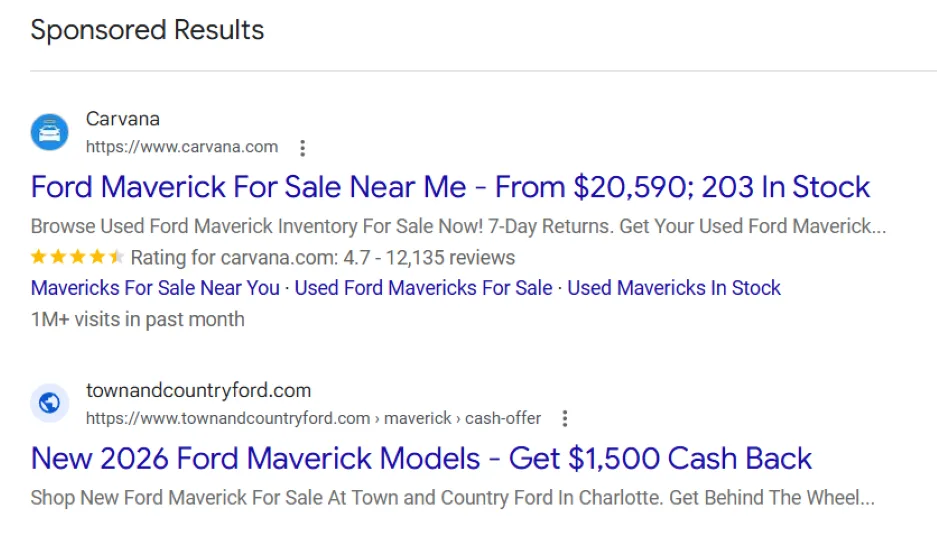
Align your ads with your inventory for more efficient search marketing.
When someone searches for a specific vehicle “near me,” they’re showing the highest buying intent. The dealer that has it in stock and shows that in their ad will win the sale.
“Campaigns should account for inventory depth, sales objectives, and model-level opportunity so your dollars are concentrated where they can have the greatest impact,” James said.
2. Watch AI adoption and start winning the shopper earlier
AI has changed the way influence happens in search. Shoppers now learn about your dealership, vehicle features, etc. from an AI answer without clicking to your site.
This calls for rethinking the buying journey and finding ways to get in front of customers earlier.
“As consumers increasingly use AI to research vehicles, compare models and narrow their choices, Google’s traditional micro-moments will continue to evolve,” James said. “Strong lower-funnel Search and Vehicle Listing Ad campaigns remain important, but dealerships also need to establish visibility earlier in the research journey.”
Think about the keywords you target with ads. Consider more comparison queries like “[Model A] vs [Model B]” or trim level searches, “Best car for [X]” searches, and terms around affordability and reviews. Those will show your ad to earlier-stage buyers and establish your business as the best option before an inventory search.
“The more familiar and credible your dealership becomes while shoppers are deciding what to buy, the better positioned you are to convert them when they begin deciding where to buy,” James added.
3. Leverage targeted promotions
There are several levers you can pull in audience targeting and bidding to improve your search ads results. But one of the biggest ways to give your automotive marketing a boost is with a time-sensitive discount or deal.
“Limited-time promotions are one of those strategies that always seem to help drive better CTR, CPC, and CPLs,” said Alan Moore, Digital Marketing Strategist at LocaliQ. “Savvy buyers are clued in to look for deals, so a promotion in your search ad stands out.”
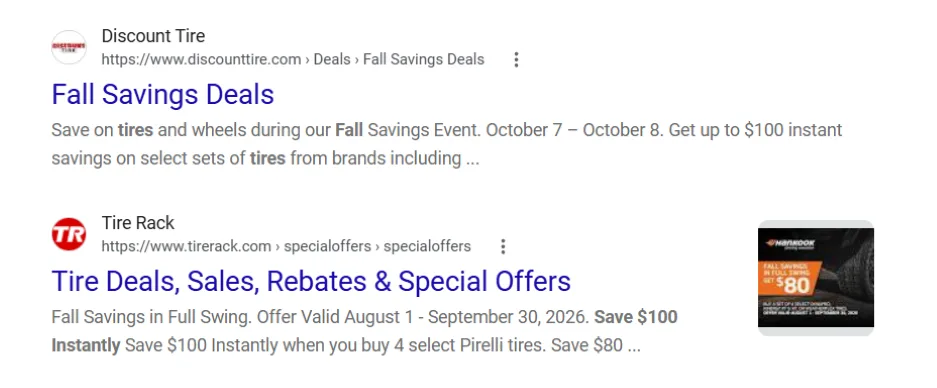
One great aspect of advertising promotions in search is that you get almost instant feedback. If the ad isn’t performing, you can quickly switch the offer or copy to see what will.
4. Nail down your account basics
Many auto advertisers end up with results that fall behind the average performance in their industry because they let account basics slip. We recently analyzed over 15,000 Google Ads accounts and found that the foundational parts of campaigns have a huge impact on performance.
“Despite how much AI is involved in targeting and optimization now, the fundamentals haven’t changed when it comes to improving conversion rates over time,” said Brett McHale, Founder of Empiric Marketing.
In fact, adding just one negative keyword to your search or campaigns can triple your conversion rates.
The most effective accounts nail down their structure and focus on fundamentals like CTR and Quality Score to drive strong Google Ads results.
Drive more traffic and sales with your automotive search ads
Search advertising is changing, but it’s still a top channel to reach high-intent vehicle and auto service shoppers.
Instability, especially with various pricing pressures, makes targeting and budgeting a little more difficult. The updated benchmarks in this report can help you establish goals and provide guidance on where you can improve.
Use this data as a baseline, but remember that every business is unique. Your real tachometer is the results you got yesterday. That’s the bar you want to raise. And that’s where we can help. Reach out, and we’ll show you how our digital advertising solutions deliver for auto industry businesses like yours.
About this data
This report is based on a sample of 1,983 US-based search advertising campaigns running between April 1, 2025, and June 30, 2026. Each subcategory includes at minimum 12 unique active campaigns. “Averages” are technically median figures to account for outliers. All currency values are posted in USD.

Recommended for you



Unlock your business potential
We offer innovative technology and unparalleled expertise to move your business forward.