


The car-buying journey is complex, with multiple touchpoints spread over weeks, months, or even years. If you want a chance at getting your dealership in front of these car buyers, you need to be present at every point in their journey.
And, because we know that the majority of consumers begin the car-buying journey by searching on a search engine, it stands to reason that getting your business found on search engines should be a top priority.
That’s where car dealer SEO comes in. In this guide to car dealer SEO, we’ll cover what it is, why it’s a must for your dealership, and the best practices you need to follow to gain visibility and drive traffic to your website.
Contents
- What is car dealer SEO?
- Why is SEO important for dealerships?
- Car dealer SEO best practices
- Car dealer SEO checklist
What is car dealer SEO?
Car dealer SEO, or search engine optimization, is the process of optimizing your dealership’s website and web presence for search engines so you can get found for queries related to your expertise, car models, and services.
SEO incorporates a number of onsite and offsite optimizations to help your dealership rank in search results, like on Google and Bing, so you can attract the widest number of car buyers to your website–and hopefully–to your dealership to make a purchase.
🔎 Get updated tips for your SEO strategy with our free guide >> How to Do SEO Right–Right Now!
Why is SEO important for dealerships?
According to Google, a typical car buyer’s journey can include around 900 digital interactions. These interactions can run the gamut from watching video test drives on YouTube to reading reviews of local dealerships.
This graphic shows one car buyer’s journey to making a purchase over those 900 interactions.

It’s highly unlikely that a car dealership’s website will be the best resource for everything a car buyer might want to know about their next purchase. Car buyers, like consumers for any product or service, like to conduct a fair amount of research to narrow in on the car they want to buy and then find the right dealership for them.

Google outlines the search journey “moments” for a typical car buyer.
That said, the dealership is the place the customer goes to assess, drive, and ultimately purchase their next car–whether in person or online.
Car dealer SEO matters because when it comes time for the car buyer to find the dealership from which they want to purchase their vehicle, they’re going to find that information on search engines–and if your dealership doesn’t show up for that “where-should-I-buy-it” moment, you’re most likely going to miss out on a sale.
Car dealer SEO best practices
Now, let’s talk about actually getting found on search engines. In order to rank for searches related to your dealership, you need to follow some car dealer SEO best practices.
Invest in an SEO-friendly website
The foundation for effective car dealer SEO is a great website. While website design and SEO are two different things, they’re closely related. Your dealership isn’t going to rank in search results if you have a bad website–it’s just not possible.
So, here are some boxes your website needs to tick in order to boost your dealership’s SEO.
Use a responsive design
Google indexes the mobile version of a business’s website rather than the desktop version. And, if you can recall from the earlier Google graphic, 71% of that car buyer’s digital interactions happened on mobile–so it makes sense that search engines want to deliver a positive experience for car buyers who are largely conducting their research on their phones.
That means your website needs to be accessible–and readable–on any device (known as a responsive website design). You don’t want a car buyer having to pinch in to read the content of your website. The key point is that you should design your website to work as well on mobile devices as it does on a desktop or a laptop.
Add metadata
Let’s back up a bit for this one. We’ve talked about how the purpose of SEO is for your dealership’s website to rank for searches related to your inventory and service–but we didn’t talk about how that happens.
Google and other search engines send these bots–sometimes called spiders–to crawl all the webpages across the internet, “read” the content on the site, and index the pages on the site. When a search occurs, the search engine’s algorithm ranks the indexed sites based on what it believes is most relevant to that query–taking into account a huge number of factors, like location, search intent, and more.
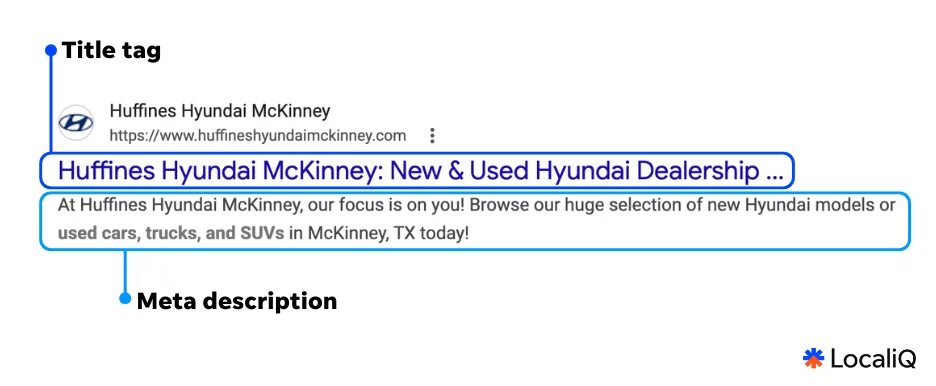
You can use HTML tags–like title tags, meta descriptions, and image alt text–to signal to these bots what a page is about, which helps simplify the indexing of the page and increases your chances of ranking for relevant searches.
Pay attention to website speed
Speed has long been a factor in increasing your chances of ranking in organic SEO results. Content still seems to be a more dominant factor, but investing in a fast-loading website and making sure your pages load at a reasonable clip of speed is a smart move.
Choose the right keywords
When most people hear the phrase “SEO,” they think keywords. Keywords are important in car dealer SEO because they signal to search engines what your dealership offers.
When it comes to keywords, it can feel like the possibilities are endless–your dealership likely has a large inventory of a variety of models, specific makes, and other services, and many keywords are broad and will be extremely competitive to rank for. For example, the top automotive keyword WordStream identified is “car” with over 9 million searches.

When it comes to determining keywords for your dealership’s SEO strategy, you want to get specific and include keywords for each part of the buying journey.
Find local market keywords
When car buyers are searching for dealerships, they may or may not include their location in the search term, but they’re going to want dealerships in their area.
This means you need to include local keywords as a foundational piece of your SEO keyword strategy. This helps you signal to Google where your dealership is located and what markets you serve.
You can do this by creating location pages and making sure you have a map and your address across your website.
Include long-tail keywords
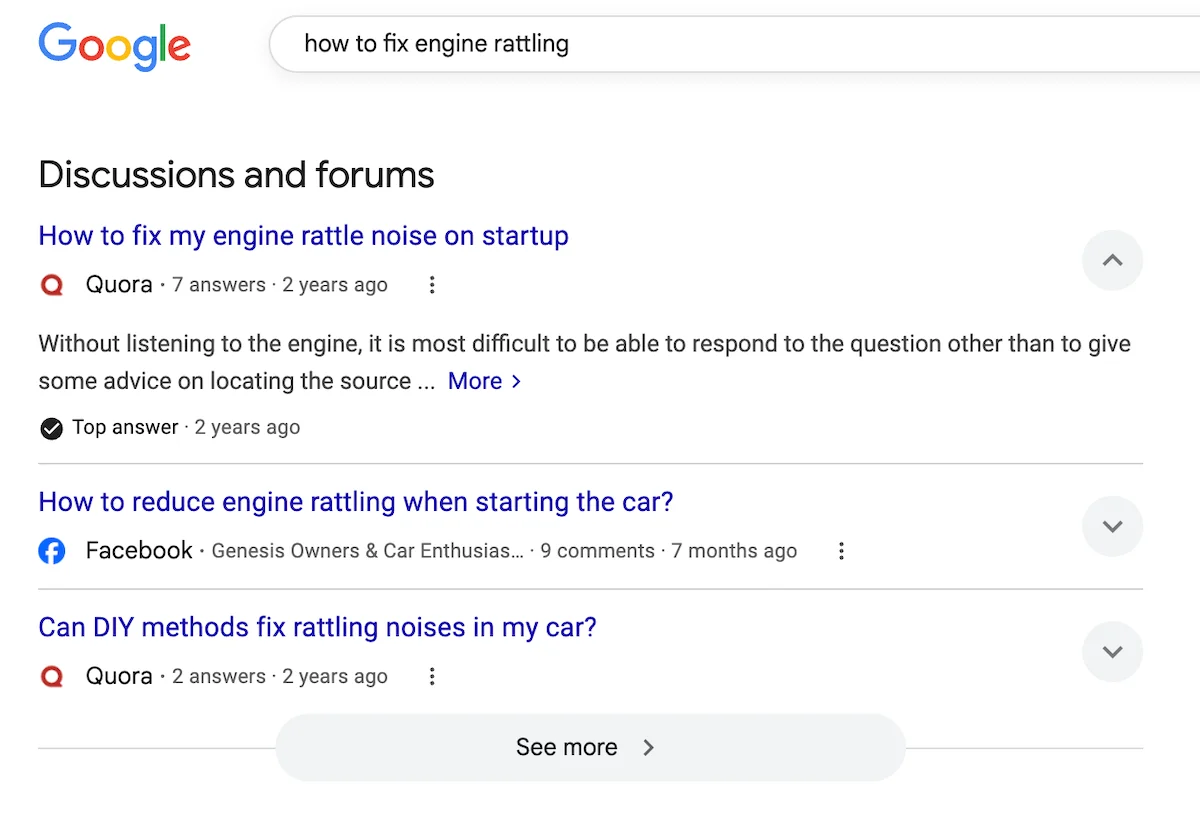
Long-tail keywords can help you target car buyers getting a little more specific in their search. Regardless of whether a customer is in Fairbanks or Fort Lauderdale, they may have occasion to do a search for “Hyundai dealership near me,” meaning they’re likely in the market for a car. Or, they might do a search for something like “car making a strange rattling sound,” meaning they probably need repairs for their current vehicle.
Both queries deal with services you provide if you’re a Hyundai dealership with a repair center. Local automotive SEO keywords need to address common scenarios like this.
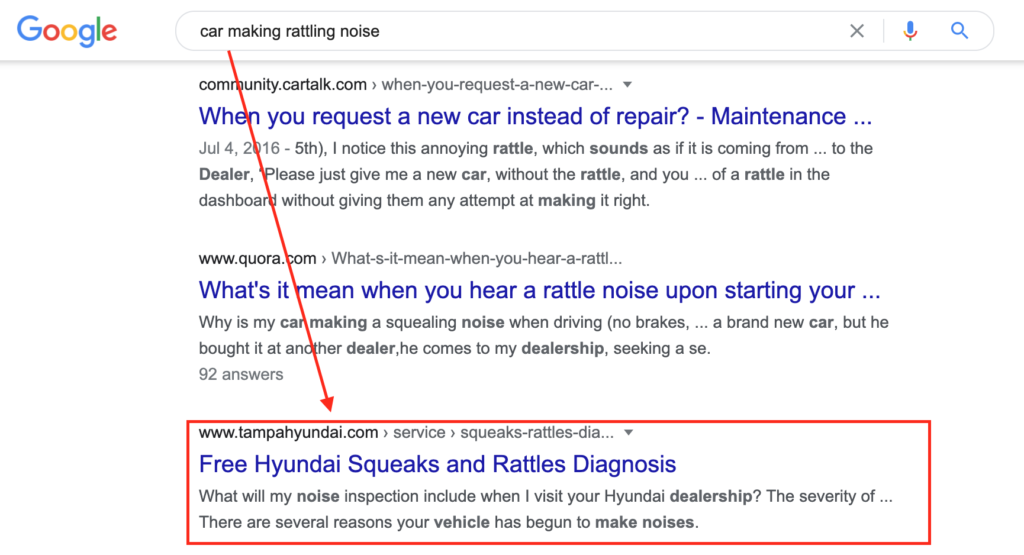
This dealership showed up when I searched “car making rattling noise” with a page for a diagnosis they offer.
Think about how car buyers are searching–even before they begin their car buying journey–and see if you can group these common questions or concerns into buckets you can target with your content.
Add brand and purchase-focused keywords
Once a car shopper has decided on a dealership, they may search for your dealership name specifically. You want to make sure you own this space by including brand-related keywords in your content and on your website.
You also want to target buyer-intent keywords like “[vehicle make and model] for sale,” which you can do through different pages on your website or by including your top makes and models in content on your site.
🔎 Want car buyers to see (and click on!) your site? Download our free guide >> Ways to Make Your Website More Visible on Google
Don’t forget local listings
Your dealership’s local listing, or local citation, is any online mention of your dealership’s name, address, phone number, website, business hours, and other basic information on the web.
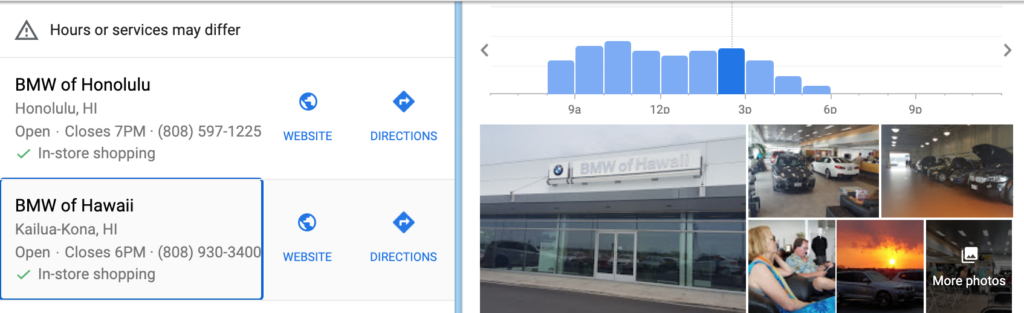
Your local listing is what comes up when a user types in a search term like “BMW dealership Hawaii,” what they see in the contact info when they visit your Facebook page, and even how a third-party source, like an online news website, has your information listed.

An example of the Google Business Profiles that show up when I searched for “BMW dealership Hawaii.”
The customer obviously needs this information to get in touch with you. Search engines use citations to verify the quality of your website, and to a certain degree, your business.
Here are some quick tips for your car dealership’s local listings.
Make sure your business information is consistent across all listings
If, say, a used car dealership in Stephen King’s fictional town of Castle Rock, Maine, shows a business address of “1313 Pet Semetary Road, Castle Rock, ME” in some key directories and “133 Pet Semetary Road, Castle Rock, ME” in others, search engines may treat the dealership page as “less reliable” and ding it on the results page.
You want to make sure your business information is the same across all listings–especially when it comes to dealership name, address, and phone number (also known as NAP).
This signals to Google and other search engines that your information is most likely accurate and can increase your chances of your listings getting surfaced for local searches.
Check that your information is accurate and up to date often
If you have the wrong phone number, address, or website listed on your local directory, you’re missing a way to connect with a car buyer who’s ready to take the next step and potentially buy from you. Check that your local listings are displaying the correct information so you don’t miss out on a sale.
📍 Get a free, instant look at how accurate your listings are right now with our Free Business Listings Grader >>
Complete your local listings
Many local listings, like Google Business Profiles, give you a way to add images to your profile. We know that car buyers are looking at pictures as part of their decision-making journey, and this is another place for you to display that information for them and hopefully win them over as a customer.
Pay attention to (and respond to) reviews
While we’re talking about listings, we’d be remiss if we didn’t mention reviews. Reviews are an important part of your online presence and can impact your SEO as well. Respond to all of your reviews and ask your customers for feedback to keep building up your online reputation.
Incorporate video SEO
Google is the world’s most popular search engine, but do you know what comes in at number two? It’s YouTube (which is owned by Google).
YouTube is a powerful SEO tool for your car dealership because not only do YouTube videos surface in Google search results for relevant searches, but car buyers are also searching on YouTube during their research phase.
Let’s revisit this graphic again:
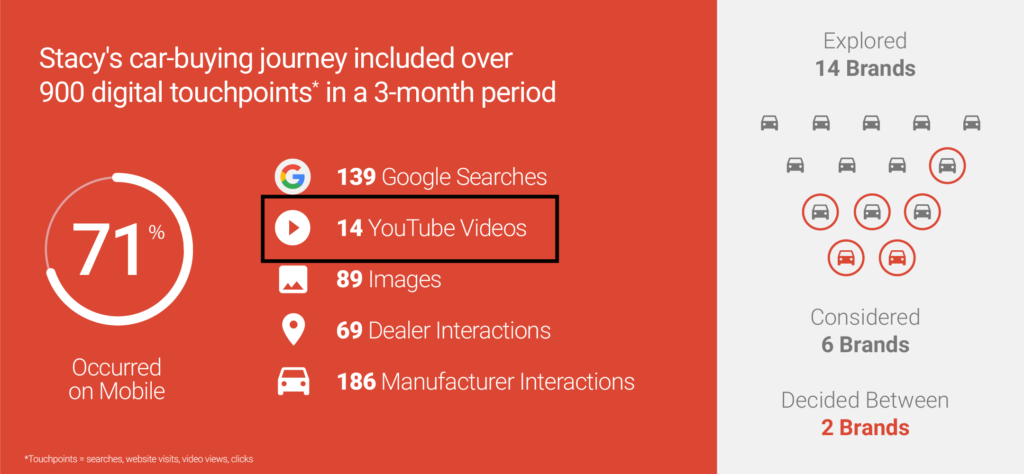
This car buyer watched 14 YouTube videos throughout their car-buying journey. In order to give your car dealership another opportunity to rank on Google (and on YouTube), you need to be incorporating video SEO into your overall car dealer SEO strategy. Here are a few tips to get started.
Optimize your YouTube channel description
Your YouTube channel description is the perfect place to incorporate some of your local and brand keywords and give viewers an idea about the types of content you’re going to create and share.

Make sure to use this space well!
Create and publish regular videos
Your dealership’s videos can include a mix of content that would be helpful to prospective buyers, including:
- New vehicle features: You can film the inside and outside of specific cars you have on the lot to give buyers a peek inside.
- Maintenance Q&As: You can interview your technicians or have them share information about regular questions they receive. This is a great way to build authority!
- Testimonials: You can ask your happy buyers to share a quick video about their experience, what they enjoyed, and why they chose your dealership. These types of videos can show up for brand-related searches and can also be featured on your website.
- Employee features: You can share videos featuring your employees so car shoppers know who they’ll be engaging with when they come in for their test drives or repairs.
You can also do keyword research and create videos that align with those queries to help you get found in local searches on Google and YouTube.
Get your site ready for AI search
It’s no longer enough to optimize your site for search engines; you now have to optimize for AI search if you want the best chance of getting found online.
Not only do AI search results show directly on the search results page (like in the case of AI Overviews), car buyers have also pivoted to doing some of their research directly through AI search platforms like ChatGPT. In fact, one study found that 62% of car buyers would be comfortable getting advice from AI chatbots during their car shopping experience.
Generative engine optimization, or GEO, is the practice of optimizing for AI search platforms and features like Google’s AI Overviews and AI Mode.
The basic principles are the same: GEO favors well-structured websites with accurate local citations. But there are a few other things you can do to optimize your online presence for GEO.
Build visibility outside of search
While a solid SEO presence does include some social signals, GEO seems to rely on these a little more. As such, it’s important to develop a strong presence on top social media sites like Facebook, Instagram, and TikTok.
By regularly producing and publishing content for these sites, you can increase your chances of getting mentioned in AI search results (and it doesn’t hurt for organic search, either–these sites show there, too).
Create authoritative content
AI search favors content created by experts. This can include written content about topics like maintaining your vehicle, what to look for in a dealership, or how to plan your dealership visit.
It can also include FAQ pages and YouTube videos created by your people to showcase your authority and credibility in the auto industry.
Look for backlink opportunities
Backlinks are links from another site to your site. These can be helpful for SEO but have also been proven to be valuable for GEO. Again, they add another weight of authority and credibility to your site.

For these results, ChatGPT mostly tapped into listicles linking off to different dealerships.
Backlink opportunities for your dealership could include local chambers of commerce, features in your local online news publication, or guest posts on industry-related sites.
Car dealer SEO checklist
Here are all the best practices in a handy checklist so you can get your strategy in driving shape:

Get your car dealer SEO in gear
SEO for car dealerships is an important strategy to invest in if you want to stand out in the local market and drive more car buyers to both your site and your dealership. By adhering to these best practices, you can increase your chances of getting found in the crowded online space. For help getting your car dealer SEO in gear, let’s talk.

Recommended for you


Unlock your business potential
We offer innovative technology and unparalleled expertise to move your business forward.