
A LocaliQ survey of 1,161 home buyers found that life changes, not investment goals, are the biggest driver behind today’s purchase decisions. More space, escaping rent, and finding a better neighborhood ranked well above building wealth as reasons buyers are entering the market. This was just one key finding from our home-buying study on how (and where) people search for a home, what they prioritize, and what would get them to pack up and move somewhere new.
LocaliQ’s 2026 home buyers study provides a deep dive into:
- What’s actually motivating today’s buyers to purchase a home.
- Which features, neighborhoods, and price points matter most.
- How buyers research, finance, and ultimately find their next home.
- And much more!
This exclusive data highlights the modern buyer’s path from consideration to closing day, and forms the foundation of a marketing strategy that meets them at the right moment with the right message. Here, we’re exploring the top takeaways from our study and what they mean for your real estate marketing.
Contents
- 11 findings from our real estate buyers study
- Life changes, not investment goals, are the biggest home-buying drivers
- Affordability is top priority for home buyers
- Mid-career buyers drive the luxury segment
- Buyers want flexibility in both home type and construction
- New construction buyers represent a distinct audience
- Construction quality and trust are critical for builders
- Safety and sociability are top neighborhood characteristics
- Modern buyers prioritize lifestyle-oriented home features
- Home buyers are willing to relocate for affordability and lifestyle improvements
- More real estate stats to influence your marketing strategy
- Real estate marketing infographic
11 findings from our real estate buyers study (+what they mean for your marketing)
Let’s look at the most insightful takeaways from our 2026 LocaliQ real estate study and see how they can help you build your dream real estate marketing strategy.
1. Life changes, not investment goals, are the biggest driver of home purchase decisions
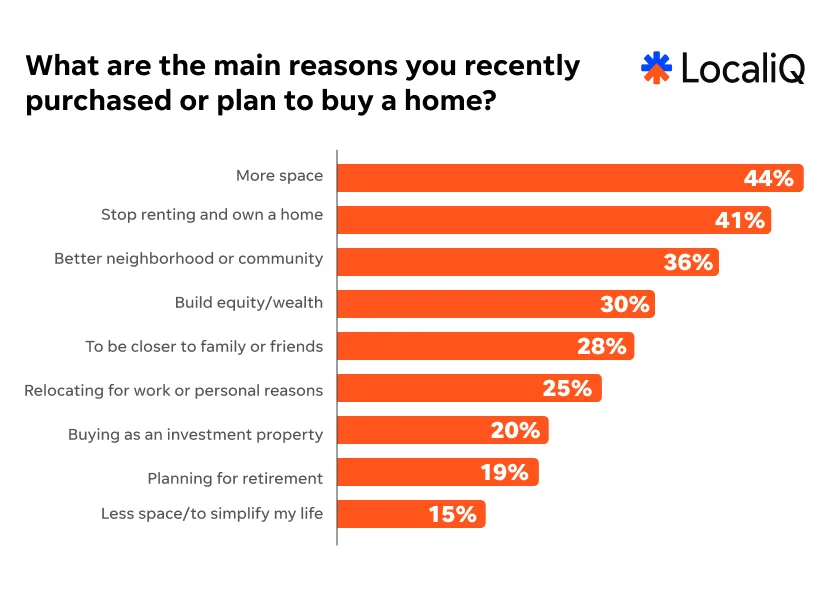
The biggest motivations for buying a home are practical and lifestyle-driven instead of financial. More space (44%) tops the list, followed by wanting to stop renting and finally own a home (41%), and finding a better neighborhood or community (36%). Wealth-building still matters to buyers, but it’s not the main focus. Most people buy a home to improve their day-to-day lives, not to grow a portfolio.
What this means for your marketing
Lead with the life change, not the investment angle. Messaging built around more room to breathe, owning instead of renting, or finally landing in the right neighborhood will resonate more than return-on-investment-focused copy. Save the equity-building pitch for buyers who’ve told you that’s what they care about.
2. Affordability is top priority for home buyers
Price is the single most important feature buyers look for, with 63% naming affordability among their top priorities. Three-quarters of buyers expect to spend less than $600,000, and almost 4 in 10 are targeting homes under $300,000.

What this means for your marketing
Affordability messaging should be an important cornerstone of your marketing. Whether you’re a builder, a lender, or an agent, your ads and listings need to address price directly and early. However, that doesn’t mean selling on price alone. It may be more about setting expectations (if there are no sub-$300K homes in your market) or drilling into value over bottom-line price.
3. Mid-career buyers drive the luxury segment
23% of buyers aged 30–44 plan to spend $1 million or more on their next home, by far the largest share of any age group in that price range. Buyers 45 and older skew heavily toward homes under $300K (48–51%) instead.
That’s a little counterintuitive, since people typically hit their peak earning years in their mid-40s to mid-50s. The likely explanation is empty nesters downsizing, not a lack of buying power.

What this means for your marketing
The takeaway here is to properly segment your audience by generation. Don’t assume your highest earners are your luxury buyers. If you’re marketing high-end properties, your sweet-spot audience may be mid-career professionals rather than older, higher-income buyers. And if you’re targeting the 45+ buyer, low-maintenance living and proximity to local activities are probably going to land better than square footage or luxury finishes.
🛑 What are the biggest challenges businesses are facing? Find out that and more in our Small Business Marketing Trends Report.
4. Buyers want flexibility in both home type and construction
Today’s buyers aren’t locked into purchasing new construction or an existing home. 38% prefer an existing home, 23% want new construction, and another 34% say they’re open to either. Most buyers are shopping for value, location, and features first. Whether the home is brand new or previously owned is secondary.

What this means for your marketing
The data suggests that you can’t really assume which type of home most buyers want. The spread between new and existing is pretty even, and a third of your audience hasn’t decided yet. This is where first-party data gathering comes in. Add a question to your appointment request form about home type, and use that information to make future outreach more relevant.
5. New construction buyers represent a distinct audience
Buyers interested in new construction tend to be younger, have higher budgets, and are more likely to see homeownership as a wealth-building move. They’re also more likely to want smart-home features, a dedicated office, and a gated community. This group relies heavily on builder websites and direct marketing when making decisions.

What this means for your marketing
If new construction is part of your business, really focus on audience targeting and personalized messaging. Treat that audience as its own segment rather than folding it into general homebuyer messaging. Younger, higher-budget buyers said they like smart-home tech, flexible office space, and added security, so highlight those features for this group. Dedicated landing pages coupled with targeted digital campaigns will do more work here than broad-reach advertising.
6. Construction quality and trust are critical for builders
Among buyers considering new construction, construction quality ranks as the single most important factor when choosing a builder or developer, with 92% saying so. But there’s not much spread between answers. Transparency (90%), warranty offerings (90%), and builder reputation (89%) follow close behind. Buyers clearly stated they want proof before they commit to a major purchase like this.

What this means for your marketing
New home buyers maintain a variety of sticking points when making their decisions. That’s to be expected with such an important purchase. But it’s important to note how strongly confidence in the builder influences choices. That’s a clear indictment for going big on trust signals. Reviews, customer testimonials, industry awards, and past project showcases should feature heavily on your website and in your marketing collateral.
👋 Free guide: 37 Ways to Promote Your Business (Whatever Your Budget!)
7. Safety and sociability are top neighborhood characteristics
Safety and low crime rank as the top community factor (61%), followed by proximity to everyday conveniences like grocery stores, pharmacies, and restaurants (44%). Buyers are evaluating the entire lifestyle a new home delivers, even more than the structure itself.

What this means for your marketing
There’s a huge opportunity to market what’s outside the front door. Highlighting neighborhood safety and convenient access to daily essentials can be just as persuasive as square footage or finishes. Grab B-roll footage from a local ice cream shop or walking path and publish on social media. Show off those low crime statistics. And help people imagine what life will be like outside the home as well as in it.
8. Modern buyers prioritize lifestyle-oriented home features
The most desired home features all center on comfort and flexibility. Indoor-outdoor living spaces (50%), open floor plans (49%), smart and energy-efficient features (45%), and primary suites on the main level (42%) were the top choices. Home offices also remain in high demand, a sign that flexible work arrangements aren’t going anywhere.

What this means for your marketing
Feature lists sell better when they’re framed around how people actually live. Instead of just listing square footage or room counts, highlight the lifestyle a home supports. Fold physical home features into a story about home comfort, entertaining outdoors, or aging in place on one level. These details are what buyers are actively searching for.
9. Home buyers are willing to relocate for affordability and lifestyle improvements
Nearly 6 in 10 homebuyers would seriously consider moving to another state.

Lower cost of living (49%), better weather (47%), and general lifestyle improvements (42%) are the top reasons.

Florida, Texas, and California are the most attractive destinations right now.
What this means for your marketing
This is where smart ad targeting and data-supported personalized messaging can help. If you’re in a state that draws relocators, try targeting ads at key origination locations. Highlight what makes your area great, like the cost of living or year-round access to outdoor activities. See what generates the most clicks, double down, and test it in other geographies.
10. Financing is still mortgage-driven, while cash buyers skew younger
44% of buyers plan to use a pre-approved mortgage, but more than 1 in 5 (22%) expect to pay cash. 18 to 29-year-olds are the largest age group planning to buy with cash. That seems surprising at first, but it tracks with the broader $84 trillion Great Wealth Transfer now underway as Baby Boomers pass wealth to help younger Millennials and Gen Z buyers afford down payments or full purchases outright.

What this means for your marketing
Don’t assume your youngest buyers are the most financing-dependent. A meaningful share of them are buying with family-backed cash, which makes them less rate-sensitive and less likely to need lender partnerships. Traditional mortgage messaging still matters for most of your audience, but it’s worth creating some content for confident, cash-capable buyers, especially younger ones. You could even try a unique campaign for that specific segment.
11. Real estate websites remain the dominant discovery channel, but it’s surprisingly generational
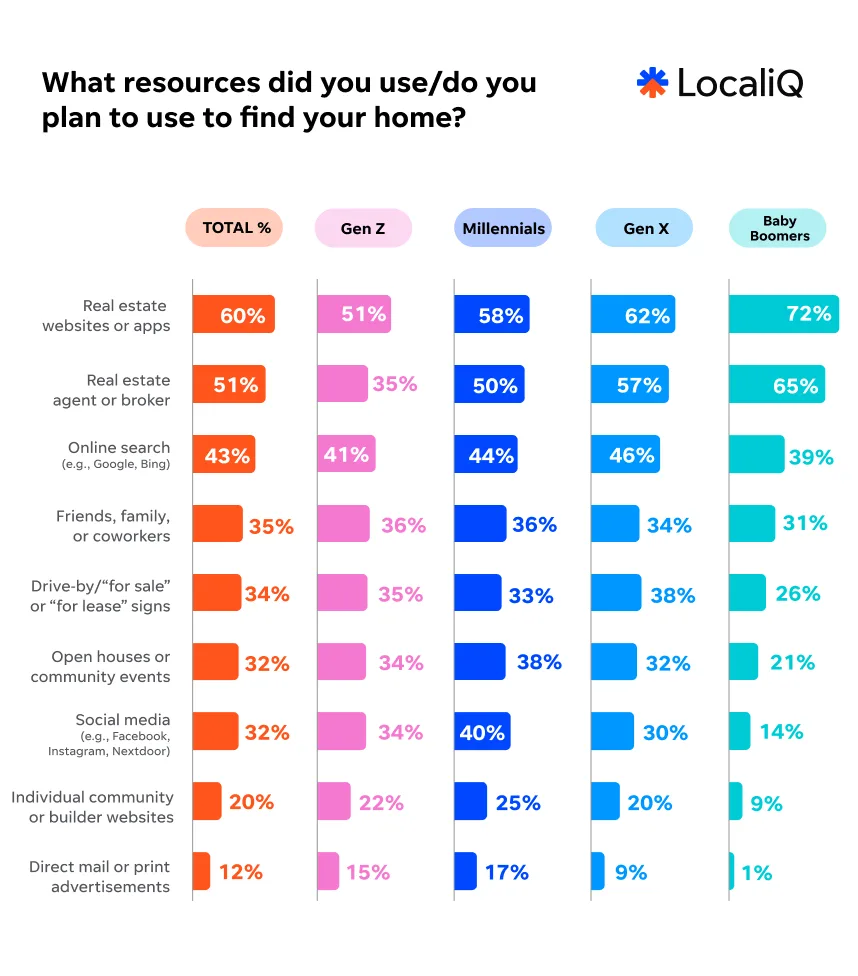
Nearly 60% of buyers use real estate websites and apps like Zillow, Realtor.com, and Redfin during their search, making them the single most influential discovery resource. Real estate agents and brokers are still important too, being used by 51% of buyers.
Note that the results here vary by age group. Millennials and Gen Z are more likely to use several resources—both online and offline—to find their net home. But for Baby Boomers, research is much more concentrated on real estate websites and apps.
What this means for your marketing
While digital channels dominate, the combination of online research and expert guidance continues to shape purchase decisions. It’s no surprise that a strong presence on major listing sites is critical for reaching home buyers. But the survey results warn against becoming too single-channel focused.
Buyers 30-44 are mixing digital ads, social media, local events, and direct mail to learn about their next home, so a multi-channel approach will reach them more effectively.
And if older buyers are part of your audience, keep your digital presence strong. They’re using it more than you might expect.
More real estate marketing stats to drive your strategy
We covered the biggest takeaways from our home buyers’ survey. But there was a lot more useful data to help guide your marketing strategy.
Stats about buyer behavior and motivations
- Nearly 3 in 10 buyers (30%) cite building equity or wealth as a main reason for purchasing, making it the fourth most common motivation overall.
- Being closer to family or friends (28%) and relocating for work or personal reasons (25%) round out the top buying motivations.
- 19% of buyers are purchasing as an investment property, with that share jumping to 24% among Millennial buyers.
- 81% of buyers report their primary residence is the home they’re purchasing or already own, while just 6% are buying an investment property.
Stats about home features and preferences
- Multi-generational layouts are a must-have for 26% of buyers overall, but that jumps to 34% among 18 to 29-year-olds.
- Natural surroundings and views matter most to Gen X home buyers, with 41% citing it as a top community feature, compared to just 26% of buyers under 30.
- Good local schools matter far more to Millennials (36%) than to buyers 60 and older (7%).
- Gated or private communities are most appealing to new construction buyers, at 26%, compared to just 13% of those buying existing homes.
Stats about affordability and financing
- 22% of all home buyers are planning to spend between $300,000 and $599,999, and another 14% are budgeting $600,000 to $999,999.
- Buyers 60 and older are the most likely group to expect to spend under $300,000 (51%), compared to just 25% of Millennial buyers.
- Nearly one in four buyers (23%) plan to use a combination of cash and mortgage financing to fund their purchase.
- New construction buyers are more likely to pay in cash (30%) than buyers of existing homes (25%).
Stats about discovery and research channels
- Drive-by or “for sale” signs are still used by 34% of home buyers, nearly as many as those using social media (32%).
- Friends, family, and coworkers remain a meaningful home research resource, cited by 35% of buyers overall.
- 35% of new construction buyers use individual builder or community websites to find their home, more than triple the rate of buyers considering existing homes (9%).
- Younger buyers (18–29) are the least likely to use a real estate agent or broker, at just 35%, compared to 65% of buyers 60 and older.
Real estate marketing infographic
This infographic offers a convenient visual roundup of some of the most important takeaways from our real estate study.

Build a solid foundation for your real estate marketing
The real estate market continues to offer growth opportunities. But how you market is changing with each generation of buyers—sometimes in unexpected ways. The data from our study will help you hone in on your targeting, channels, and messaging for the most important segments of your target audience.
We’ve studied marketing results and buyer behavior for more than a decade. Reach out to speak with one of our real estate marketing experts for more detailed and actionable insights and strategies.

Recommended for you



Unlock your business potential
We offer innovative technology and unparalleled expertise to move your business forward.