


How many deals do you miss out on each year? There are always some leads that were never meant to convert, but the losses that hurt are the ones you didn’t get a real shot at closing—the people you couldn’t respond to fast enough, or the ones who fell off your team’s overloaded radar screen.
Businesses with growth aspirations must develop clear, scalable processes for how to follow up on sales leads. Fortunately, digital tools make it easier to gather all incoming leads in one place, assign contacts to different team members, and automate touchpoints to reduce everyone’s rote workload.
Wondering what elements your sales process is missing? Read on to see a dozen tips that’ll help you follow up faster, track progress, and close more sales.
Contents
- Make it easy for leads to reach you
- Follow up quickly
- Personalize your communications
- Use a lead management system
- Be persistent
- Vary your follow-up channels
- Make each touchpoint valuable
- Keep it short
- Give your sales team the resources they need
- Use tools to automate
- Always follow up
- Track everything in a CRM
How to follow up on sales leads (12 expert tips)
Turn more leads into customers and generate useful sales data with these 12 lead follow-up tactics.
1. Make it easy for leads to reach you
Before you can follow up with anyone, you need to establish a clear path for leads to contact you. Take the time to audit your online presence and ensure leads can quickly and easily reach out.

This site has a phone number, contact us page, and “call for a free quote” CTA, all highly visible on the homepage.
Take a look at your:
- Website: Include a universal call-to-action (CTA) button that lives in the navigation bar across all pages and invites visitors to reach out (“Contact Us,” “Book a demo,” “Schedule a Call,” etc.). You should also include your contact information in the footer and on a dedicated contact page.
- Social media: Incorporate your contact information into your social media profiles. Add your website URL, phone number, email, and any other channels you use to communicate with leads.
- Local listings: Claim and update your profile across key local listings sites, like your Google Business Profile, Yelp, and Foursquare. Ensure your contact information is correct and consistent, so leads can reach out no matter where they find you.
🚀 Don’t leave leads lingering. Download 14 Super-Fast Ways to Boost Conversions
2. Follow up quickly
The first step to effective lead follow-up is speed. 82% of consumers say receiving an “immediate” response is important or very important, and two-thirds of buyers expect an answer within 10 minutes.
If you’re taking hours or days to reply, you’re losing business to your competitors that have a system that allows for near-instant contact. AI agents can help you automate replies to incoming calls and text messages, so you can be there with answers, ask the right qualifying questions, and effectively score your leads.

Solutions like Dash by LocaliQ can track incoming leads and even provide a fast response for you.
By handing off simple inbound conversations to virtual agents, your human team is free to handle more complex queries and to follow up with leads that have already been qualified.
3. Personalize your communications
Whether your leads are engaging with a human team member in real time, an automated message, or an AI agent, you want your communications to have a personalized touch. That’s because personalization has become table stakes; 71% of consumers expect it, and 76% are upset when it doesn’t happen.
Fortunately, digital marketing tools make personalization easy. Use digital lead forms to collect basic information, like name and contact details, for each inquiry. This allows your human team to address people by their names when they call them back.
If you’re using AI, you can program your scripts to ask for a lead’s name and use it throughout. The same goes for automated email campaigns, where you can add dynamic tags that auto-populate with the name you’ve saved in your email marketing platform or CRM.
4. Use a lead management system
Leads can come from a variety of sources, including contact forms, chat on your website, social media DMs, and calls into your service center. Keeping track of all incoming leads is tricky without a lead management system.
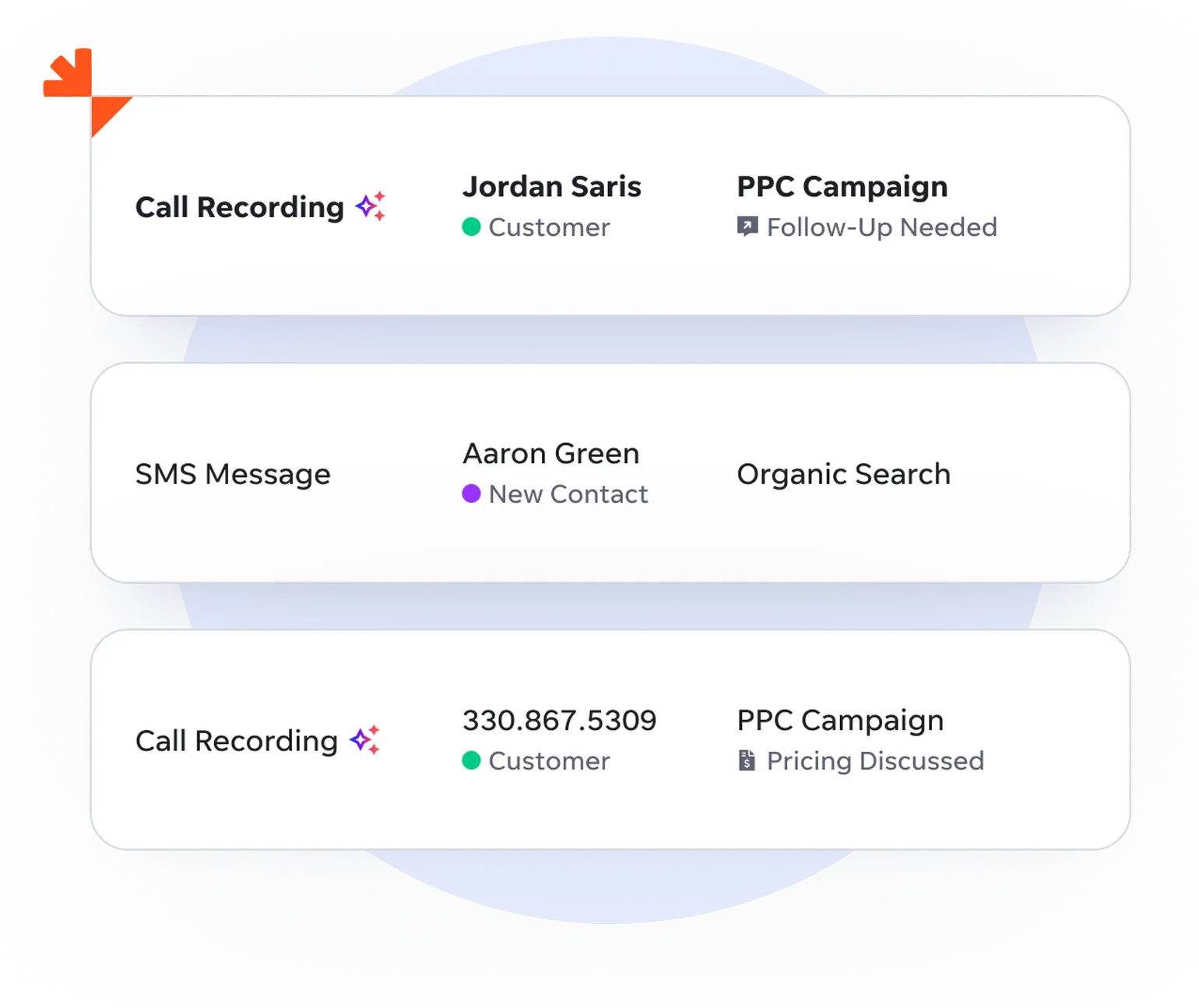
This centralized inbox unifies all your leads in one place and tracks where they came from.
A lead management tool creates a centralized database where you can see everyone reaching out to your business. Instead of worrying about a message falling through the cracks, your team has all the information they need in one location, empowering them to act quickly to engage those leads.
And with AI-enhanced lead management tools, your team can hand off the work of early communications and qualification to an AI agent. The agent can quickly assess whether or not a lead is a good fit, then route high-priority leads to a human team member.
5. Be persistent
Just because a lead doesn’t reply to your first outreach, that doesn’t mean it’s over. There are countless reasons they might not answer right away: they’re busy at work, their pet got sick, they’re evaluating other options to solve their problem—the list goes on.
If you give up after one unsuccessful touchpoint, chances are you’re missing out on business that could be converted. Instead, create a workflow that establishes a clear number of follow-ups. The right cadence will depend on your business. If you have a longer sales cycle, you can spread out your touchpoints; if people typically buy fast, condense it.
⁉️ Are there leaks in your sales funnel? Get 10 Marketing Gaps That Cost You Customers (& How to Fix Them) to find out.
6. Vary your follow-up channels
As you continue your follow-up cadence, you have a great opportunity to vary your outreach tactics. When you bring leads into your orbit, ideally, you’ll collect both an email and a telephone number for each contact. That allows you to try a mix of emails, texts, and calls.
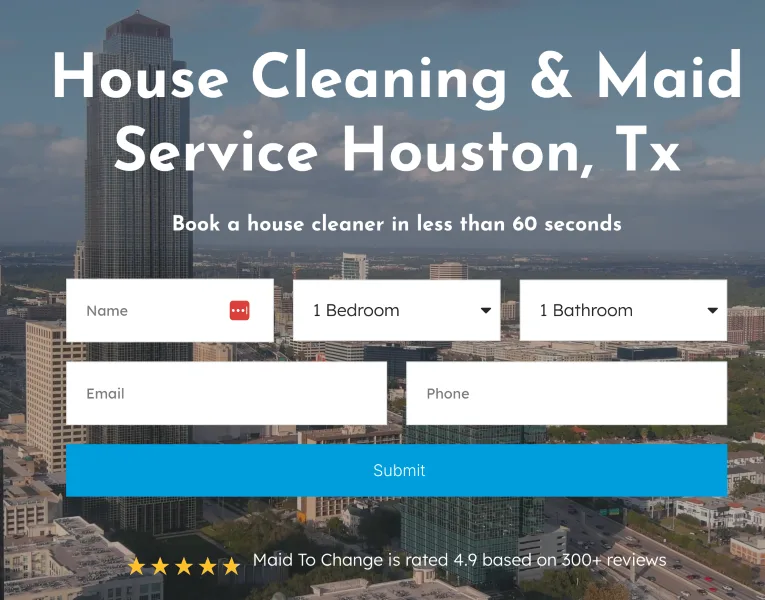
Collecting both phone and email allows you to connect with leads across several channels.
A study of B2B sales teams found that hybrid selling techniques drove up to 50% more revenue for the businesses using those tactics, so don’t be afraid to mix things up!
7. Make each touchpoint valuable
As you think through your follow-up cadence, picture each touchpoint as an opportunity to move the lead a little further down the funnel. What do they need to hear to grow trust in your brand and eventually decide you’re offering the best solution to address their need?
To build your case, offer a variety of information and resources across your outreach. Consider sharing:
- Quotes from happy customers, or other forms of social proof
- Detailed product or service information
- Advice that showcases your expertise
- Content that addresses common sales objections
And always include an invitation for the lead to reach out with any questions. Reinforcing that your team is here to support goes a long way toward endearing you to your audience.
8. Keep it short
When you’re trying to make the case for your business, it can be so tempting to overexplain. There are many things you’re proud of—your offering, your team, your mission and values—and you know that once a lead hears all of it, they’ll be sold.
But it’s important to put yourself in your leads’ shoes as you’re crafting your message. Do they really need to know everything about you? Probably not. They likely want to develop a baseline level of trust and know that your pricing and offering fit their needs.
You can often communicate what your lead needs to know in a few short sentences. And ensuring a human stays in the loop to answer specific questions that might arise is essential (see point #3 about personalization).
9. Give your sales team the resources they need
Sales can be a grind. It’s a lot of reading the room, navigating objections, juggling multiple conversations, and handling rejections with grace. To support your sales team through this obstacle course, provide them with resources that help move conversations forward.
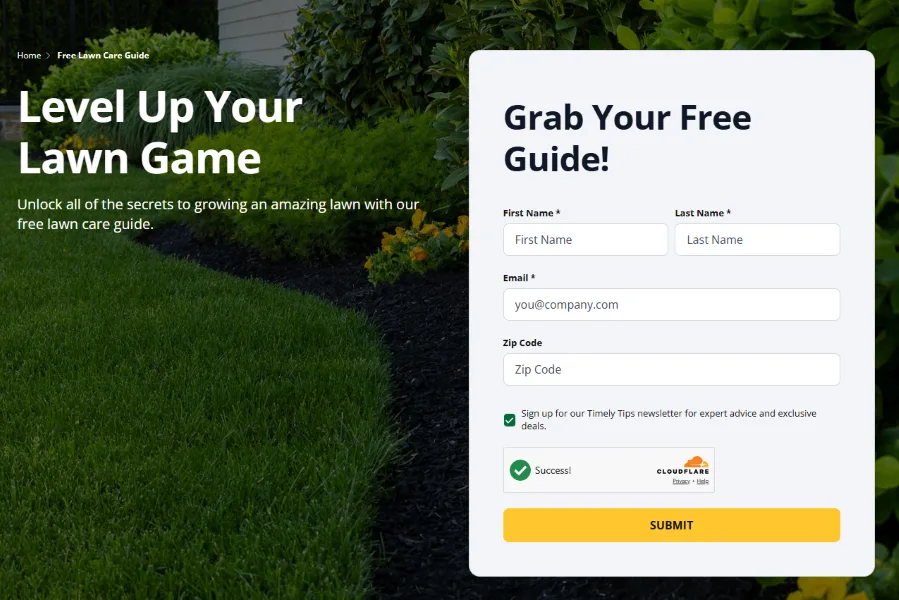
Long-form content, like this guide, can serve double duty as gated downloads on your website and as sales aids.
You might create these types of resources to support your sales cycle:
- Conversational scripts: Give your team talking points to support everything from cold calls to demos to objection handling.
- Email templates: Create email templates your team can draw from as they face common questions and hit key milestones in your sales process (following up on initial outreach, sending a proposal, etc.).
- Marketing collateral: The sales and marketing team can work together to create assets your sales team needs. Case studies, white papers, demo decks, competitor comparison one-pagers, product tear sheets, and more can all support conversations with leads.
- A clear follow-up cadence: Provide your sales team with steps for chasing leads. Define the appropriate number of touchpoints, what they should be, and when they should happen. A CRM can keep team members on track, give leadership visibility into conversations, and ensure no one slips through the cracks.
10. Use tools to automate
The sales process is never exactly the same twice—some leads are ready to buy right away, while others need more guidance. Automating as much of your follow-up process as possible gives your team the time to have in-depth conversations with the leads that need it.
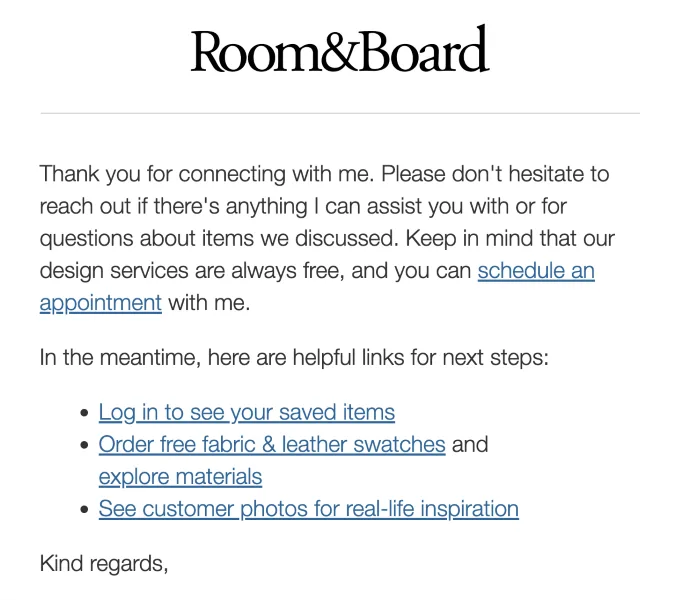
In addition to its marketing emails, Room & Board sends a follow-up directly from the sales associate who helped a lead in the store.
Creating an automated follow-up sequence using SMS and email can help you stay in front of the leads who don’t have questions but need more time before they make a decision, while creating space for your team to engage directly with more high-priority or involved requests.
11. Always follow up (even after you lose a sale)
Just because a sale seems lost doesn’t mean it’s over. Businesses lose sales for all sorts of reasons. Sometimes the lead goes with a competitor. Other times, they decide not to buy right now. Your team doesn’t always have visibility into where a lead goes—who hasn’t been ghosted as part of the sales process?
No matter what happened, you should always stay in touch. You never know when that lead will go from ice cold to hot again. Maybe they’ll end up unhappy with the provider they chose. Or perhaps their circumstances change, and they become ready to buy again. Whatever the case, if you remain top-of-mind, you have a chance to become the one they return to.

Ongoing email communications are a great way to remain top-of-mind for lost leads or lapsed customers.
Consider adding these lost leads to your email marketing platform so you can send them regular communications, like your newsletter, product updates, or information about upcoming sales. Additionally, have your sales team set a cadence for regular, direct follow-up.
12. Track everything in a CRM
The longer you’re in business, the longer your list of contacts becomes. It’s vital to keep track of all your prospects, leads, and customers (past and present), and a CRM can help you do that. Unlike a lead management platform, which is focused specifically on organizing incoming leads, your CRM is the go-to location for historical data on every interaction you’ve had.
As your business grows more complex, a CRM can help ensure everyone on your team has access to the same data about contacts, and it becomes the go-to resource for anyone who wants to know anything about any relationship. Of course, your CRM is only valuable when its data is accurate, so train your team to update it regularly. Many CRMs integrate seamlessly with lead management tools, so you can automate much of the data collection around your sales process.
How to follow up on sales leads with greater ease
The key to capturing more leads and closing more deals is creating a repeatable, scalable follow-up strategy. By incorporating AI and automation, you can keep all your leads warm while freeing up your team to engage in deeper conversations with those who need it. And tools like lead management platforms and CRMs ensure no conversations fall through the cracks, which is essential if you wish to close more deals.
Managing, tracking, prioritizing, and responding to incoming leads can be a tough job to tackle—especially when you’re working hard to service current clients. Reach out, and we’ll show you how our solutions can shoulder much of the load while helping you close more deals.

Recommended for you







Unlock your business potential
We offer innovative technology and unparalleled expertise to move your business forward.