


A LocaliQ study of over 300 small businesses found that only 28% of businesses are investing in reputation management. Which means over 70% of businesses are missing out on the opportunity to positively impact potential customers through online reviews.
Reviews, comments, or social media mentions can shape how potential customers view your business and whether or not they connect with your brand. That’s why reputation management is critical. Here, we’ll cover everything you need to know to manage your small business online reputation and improve it!
Contents
- How to build an effective reputation management strategy
- Tips to improve your online reputation
- Reputation management checklist
- Reputation management FAQs
8 steps to build a 5-star reputation management strategy
A strong reputation management strategy ensures that people can find you online, learn about your business, and see how happy your existing customers are. This requires actively managing your brand online, improving the experience, and showing up where your customers are searching.
And that requires a proactive strategy. In fact, it’s most effective to treat reputation management like a structured marketing initiative. Here’s how to get started.
1. Audit your online reputation
The first step to developing a reputation management strategy is to understand where you are. Search your business name (and variations of it) on Google. What appears? Reviews? Directory listings? News mentions? Old social profiles you forgot about? Be sure to review the first results, sponsored listings, maps, and images, as well as the results for the first two pages.

Take the time to find where your business ranks on Google with the map option, for example.
Next, review your ratings across platforms. Look at both the star rating and the content of reviews. Are there recurring themes? For example, a tutoring center might see repeated praise for knowledgeable instructors but complaints about slow response times. Or a travel agency might receive great feedback about itinerary planning but criticism around communication during delays.
Finally, take a look through your recent mentions on social media. What are customers saying? What are they sharing?
Now, you have a clear picture of themes, trends, and, most importantly, action items.
📍 Need help finding everywhere your business is listed online? Get an instant look with our free business listings grader!
2. Claim all of your online profiles
If you realize during your audit that you haven’t claimed any of your business profiles, do this right away. Your Google Business Profile is especially critical for local search visibility. Beyond that, check review sites, industry directories, and social platforms relevant to your audience. Here’s a checklist of where to start:
- Google Business Profile
- Apple Maps
- Bing Places
- Yelp
- Facebook Business Page
- LinkedIn Business Page
- Better Business Bureau
Depending on your industry, there will be other key ones (like TripAdvisor for travel, or G2 for software, for example).
Claiming your profiles is important because it gives you control. You can update contact information, business hours, service descriptions, photos, and more. Remember, inconsistent information—think outdated hours or an old phone number—creates friction. This not only makes for a poor experience, but it also erodes trust.
3. Identify areas for improvement and reputation goals
Once you know where you stand, you need to define what “better” looks like. Do you want higher rankings? Better response times from your team? Focusing on a few areas where you’d like to see improvement is a good place to start. Then, you can get specific. Maybe your goal is to raise your average rating across platforms from 3.8 to 4.5, or to keep the response time under 24 hours.

You could even focus on a single platform to start. Honeybear Cafe in Chicago has over 300 reviews with 96% recommending the coffee shop on Facebook.
If you’re not exactly sure where you should be focusing your attention, take a look at recurring complaints and decide what’s fixable. If customers frequently mention long wait times, that’s an operational issue worth addressing.
The key is to set specific goals tied to real, measurable improvements. Reputation management works best when it aligns with customer experience improvements.
4. Set guidelines for responding to comments and reviews
Responding to comments and reviews is a big component of managing your small business’s online reputation. And it’s tricky to do, especially with negative reviews from customers who are upset.
Consistency matters, and that is within your control. So draft internal guidelines for how your team responds to both positive and negative feedback. Identify any words to avoid, decide on your standard tone (which should align with your brand voice), response time expectations, and escalation procedures for serious complaints.
For negative reviews, it’s best to acknowledge the concern, apologize when appropriate, and offer to continue the conversation offline. Always avoid getting defensive. Remember that your response isn’t just for the reviewer—it’s for every future customer reading it. That same goes for positive reviews, though these have less room for error. For those, thank the reviewer by name and reference something specific they mentioned.
Whether the review is positive or negative, be sure to correct any factual inaccuracies kindly. Here’s a great example from Hudson, NY business The Antique Warehouse, responding to a 5-star review that had a few mistakes.

5. Document and share your reputation management strategy
This is important: Put your reputation management strategy in writing. This could be super simple, like a document outlining your profiles, goals, tone guidelines, response templates, and responsibilities.
If you have a marketing team, customer service staff, or front-desk employees, make sure everyone understands the process. If you’re working as a team of one, it’s still worth the time to capture the results of your hard work and your plan for moving forward. That way, if you get off track, you don’t have to redo any work—or waste any of your time.
6. Keep monitoring your online reputation
Now that you have your strategy in place, it’s time to, well, keep going. Reputation management, after all, is an ongoing process. Set up regular monitoring, weekly or monthly, depending on your business. Create alerts for your brand name, as well as key team members or products. Keep an eye on new reviews and social mentions.
The stakes are, unfortunately, high. Just one negative review can cause a business to lose out on 30 new customers.
7. Treat reviews, comments, and more as a feedback channel
Reviews are a persuasive component of your online presence. They’re also an important channel for listening to your customers. So when you’re reviewing and replying, pay attention to patterns. Are customers consistently praising your onboarding process? Lean into that strength. Are they confused about pricing? Maybe your website needs clearer messaging.
Take this example review. The user notes multiple positives, including the way the stylist kept her informed about products without pushing a purchase. If this comes up in multiple reviews, it would be a great training note for new staff or a refresher for existing stylists.

8. Track your progress
Remember when we said that you’ll see the most success if you treat reputation management as a structured marketing initiative? Well, that includes tracking. In order to keep improving, you need to track your progress toward your goals.
If you’re looking for more inspiration, here are a few common metrics related to reputation management:
- Average star rating
- Total number of reviews
- Review growth month-over-month
- Response time
- Sentiment trends
One or more of these might make sense to monitor for your business and your goals. Over time, you should see both qualitative and quantitative improvement. And if you’re not seeing that, it’s time to adjust your strategy.
Tips for improving your small business reputation management
Once your strategy is in place, you can experiment with additional ways to improve your online reputation. Here are a few things to try.
Ask for reviews
This is first because it’s the least effort with the most impact. You likely already have happy customers, and they might just need a nudge. BrightLocal found that 28% of respondents reported they would always leave a review when asked. Not bad!
So make asking for reviews part of your process, whether that’s after a completed service, a successful trip, or a purchase.

This email from Yoto is great: Courteous, brief, and with a promise of no more nudges.
This doesn’t have to be too complicated. Send a follow-up email with a direct link to leave a review, and instruct staff to ask politely in person. The easier you make it, the more likely customers will follow through. And a steady flow of authentic reviews also helps offset the occasional negative one.
⭐️ Need help getting more reviews? Get templates, tips, and ideas in our free guide >>
Focus on your SEO
SEO and reputation management are closely connected. When someone searches your business name, you want accurate, positive, and relevant content to appear. That’s up to SEO.
If you’re not already focusing on your SEO, consider prioritizing this with your online reputation in mind. Optimize your website with updated service pages, team bios, and FAQs. Publish helpful blog content that answers common customer questions. Make sure key information like contact information and business hours are easily accessible to users and search engines.
Strong SEO helps you get more positive or helpful content on the search results page, ideally pushing outdated or less favorable content further down. It can also help you appeal directly to your ideal customers. Take The Attic, a thrift store in Cambridge.

The search results page not only has the store’s hours, reviews, and location, but it also features a review in the Harvard Crimson, excellent social proof to encourage students to stop by. This brings us to our next tip.
Build social proof beyond reviews
Reviews are powerful, but they’re not the only form of social proof that you can. And, even better, they’re not the only form of social proof that you can solicit from happy customers.
You can work with repeat customers on case studies to feature on your website, which are excellent, in particular for service businesses. You can encourage testimonials from your audience that you can use as user-generated content on social media or feature on your website.
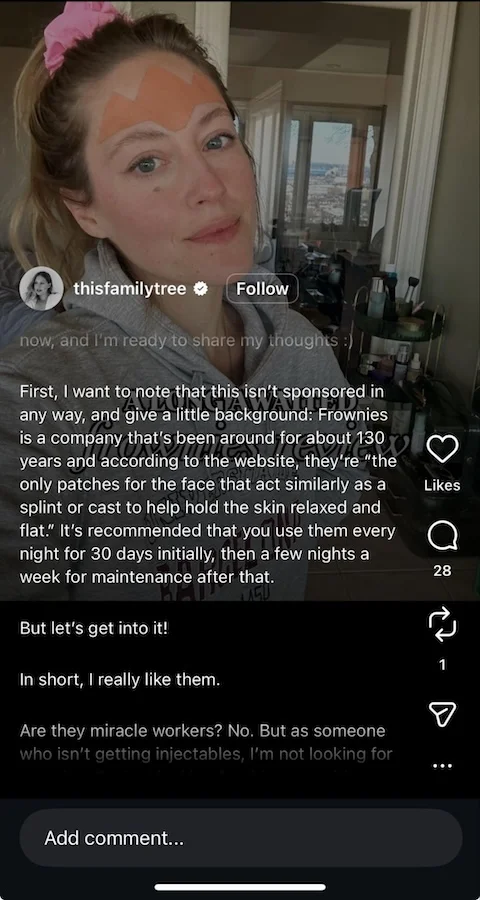
@ThisFamilyTree reviewed the wrinkle-reducing face tape Frownies in an honest, non-sponsored post that would make compelling UGC.
Before-and-after examples, certifications from recognized organizations, press mentions, awards, and even in-person community involvement at events are all forms of social proof, as well. The more evidence you provide that others trust you, the easier it is for new customers to do the same.
Test out tools for reputation management
If you’re thinking that all of this sounds like a lot, you’re not wrong. But it doesn’t have to be completely manual. There are lots of tools designed to help with review management, social listening, and sentiment tracking. The right choice depends on your size, industry, and budget.
Here are a few good places to start:
- LocaliQ helps small business owners monitor and manage online listings.
- NiceJob automates sending review requests and displaying them on your website or social.
- Mention helps with basic online mention alerts.
- Hootsuite automates social media monitoring and listening.
- Google Alerts is a free, easy way to get mentions of your business name on the web sent to your email inbox.
Start small. Test platforms that centralize reviews or automate review requests, and then evaluate whether they’re saving enough time and helping you stay on top of it. Remember, consistency is key for reputation management.
Reputation management checklist
Curious what this all looks like in practice? Our friends at WordStream put together a handy reputation management checklist!

Reputation management FAQs
Still curious about reputation management? Here are some frequently asked questions and their answers.
What is reputation management?
Reputation management is the process of shaping how your business is perceived both online and offline.
This might sound squishy, but it’s anything but. For small businesses, reputation management isn’t about public relations. It’s about growing your brand with visibility, encouraging trust in your customers and your audience, and, perhaps most importantly, it’s about increasing your revenue to build your business.
Why is reputation management important?
Here are some reasons reputation management is so important for your business:
People rely on reviews
93% of customers look at reviews before making a purchase. If those users find information that is negative, inaccurate, or misleading about your business, it could influence whether they choose your products or services over your competitors.
Reviews rank in search results
Those digital locations that mention your business can also end up ranking on the first page of search results for any queries that include your brand name. That’s why trying to influence them is critically important. Research from Moz estimates that businesses risk losing 22% of customers if just one negative article shows up in branded search queries.
People pay more for businesses with good online reputations
Did you know that people are willing to pay more (22% more, to be exact!) if a business has good reviews? And that’s the case across nearly any industry. A collection of positive reviews signals to customers that they are highly likely to have a good experience with your business, and that removes some of the hesitations they may have about trying your business.
What are some ways to manage your online reputation?
The process of managing your reputation will vary from business to business, but it always includes a focus on the voice of the customer. Reputation management includes monitoring what people say about your brand, responding to reviews and comments, encouraging positive feedback, and addressing concerns before they escalate.

These concerns can be offline, such as in-person comments, complaints to your local Chamber of Commerce, or op-eds in newspapers. But more often today, the reputation of your business will live online. Your customers and prospects will search on platforms like Google, browse reviews on Yelp, check for updates or information on Facebook, and scan photos or tags on Instagram. That’s why we focused this guide on strategies and tips for online reputation management.
How do I fix my online reputation?
By following the tips in this guide, you can get a good handle on your online reputation. It’s crucial to understand and benchmark your current reputation—including reviews and ratings across sites and listings, consumer sentiment about your business, and how your brand is perceived. From there, you can identify areas of improvement and focus there.
For example, if your Google reviews aren’t so great, you can reach out to happy customers to see if they’d be willing to leave you a review, ask your employees to encourage happy customers to review you on Google, and include a link to review you on Google in your email follow-ups.
Where should you manage your online reputation?
Here are the top places to pay attention to:
- Third-party review sites like Yelp and Google Business Profiles.
- Industry-specific review sites like Nextdoor, Angi, Healthgrades, and more.
- Social media sites like Facebook.
- High domain authority websites that cover your industry or location, like local online publications or Chamber of Commerce sites.
- Online forums and message boards like Reddit and Quora.
- Your own website!
Set yourself up for better reputation management
Reputation management isn’t a one-time campaign. It’s an ongoing commitment to monitoring, improving, and tracking how your business is represented online. Because, after all, your audience will find you online and form their opinion of your brand and your offering based on your listings, reviews, and online presence.
By auditing this presence, setting clear goals, responding thoughtfully, and using feedback to drive real improvements, you can develop a solid reputation management strategy. And, even better, use this to help grow your business.

Recommended for you







Unlock your business potential
We offer innovative technology and unparalleled expertise to move your business forward.