


A LocaliQ study of over 1,800 adults who planned to make purchases for friends and family this holiday season found that not only are they starting to shop earlier, they’re continuing to seek out holiday bargains long after New Year’s.
This was just one of the key findings from our study on how people shop for the holidays and what motivates them to make a purchase.
LocaliQ’s holiday shopping study provides a deep dive into:
- How shopping plans change by generation
- Which types of promotions will win buyers over
- When shoppers plan to buy
- And much more!
This exclusive data highlights how holiday buyers plan to complete their shopping lists and forms the basis of a marketing strategy that informs and inspires them as they do so. Let’s explore the top takeaways from our study and what they mean for your holiday marketing plans.
Contents
- Key findings from our holiday marketing study
- Holiday shopping starts earlier than you may think
- Post-holiday shopping offers a welcome boost to the new year
- Consumers are overwhelmingly value-driven this holiday season
- Price drives decisions, but reviews and recommendations still matter
- Inflation is changing how people shop, not whether they shop
- Most shoppers set budgets, but many still overspend
- Holiday shoppers blend digital and physical shopping experiences
- Gift inspiration comes from everywhere
- Online marketplaces dominate, but lower prices can pull shoppers away
- Gift buying is emotional, and choosing gifts is increasingly difficult
- Discounts trigger impulse purchases more than urgency tactics
- Small businesses win by offering what big retailers can’t
- Social media is where holiday advertising gets noticed and remembered
- Search and AI advertising drive surprisingly strong purchase influence
- AI chatbots are becoming trusted holiday shopping guides
- More holiday marketing stats to inform your strategy
- A helpful holiday marketing infographic
15 takeaways from our 2026 holiday shopping study (+what they mean for your marketing)
The data from this year’s study revealed some very useful insights. Let’s look at the most influential takeaways and how you can leverage them for your best holiday marketing strategy ever.
1. Holiday shopping remains concentrated around major shopping events, but starts much earlier than businesses may think
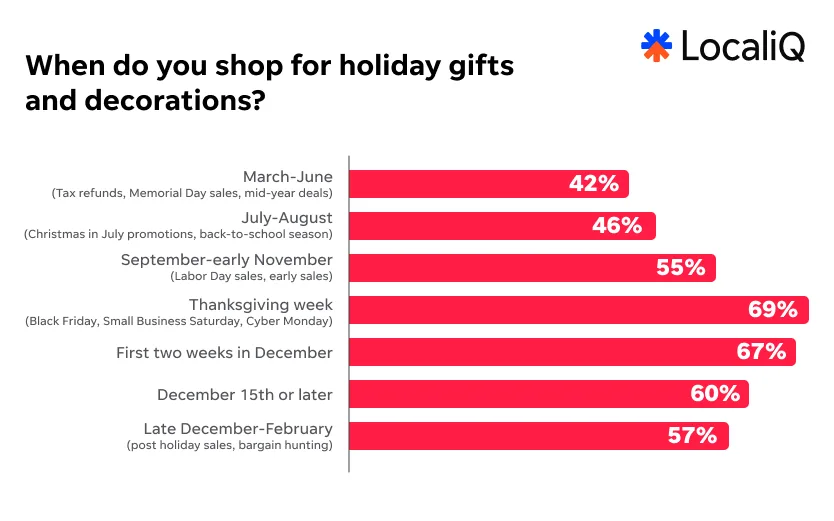
While Thanksgiving Week (69%) and the first half of December (67%) remain the busiest shopping periods, more than half of consumers begin shopping as early as September through early November, and nearly half participate in Christmas in July and other mid-year promotions.
Younger shoppers are especially likely to start early and buy last minute, giving brands a much longer window to build awareness and influence purchase decisions with that demographic.
What this means for your marketing
Your holiday marketing planning should start in August at the latest. That gives you a few weeks to get in front of early buyers and a little time to pivot if your initial tactics need tweaking. If your target buyers are young adults, nudge that plan a few weeks earlier. Then build an always-on strategy through the fall and ramp up for the major shopping events. And like a good baseball swing, follow through to those post-holiday sales. The next takeaway explains why.
🎁 Give yourself the gift of easier (and more effective) marketing. Download The Happy Holiday Marketing Guide: 27 Promotions, Campaigns, & Social Posts to Unwrap
2. Post-holiday shopping offers a welcome boost to the new year
Post-holiday shopping (late December through February) is nearly as common as early shopping, with 57% of shoppers participating in post-holiday sales. That offers an opportunity to continue momentum after the new year.

What this means for your marketing
The post-holiday season is worth planning for. January and February consistently see strong consumer spending driven by gift card redemption, returns that turn into purchases, and New Year’s resolution buying. With consumers remaining cautious heading into the holidays, many shoppers deliberately hold off on certain purchases until clearance prices kick in, so promote those deals and discounts hard.
3. Shoppers are overwhelmingly value-driven this holiday season
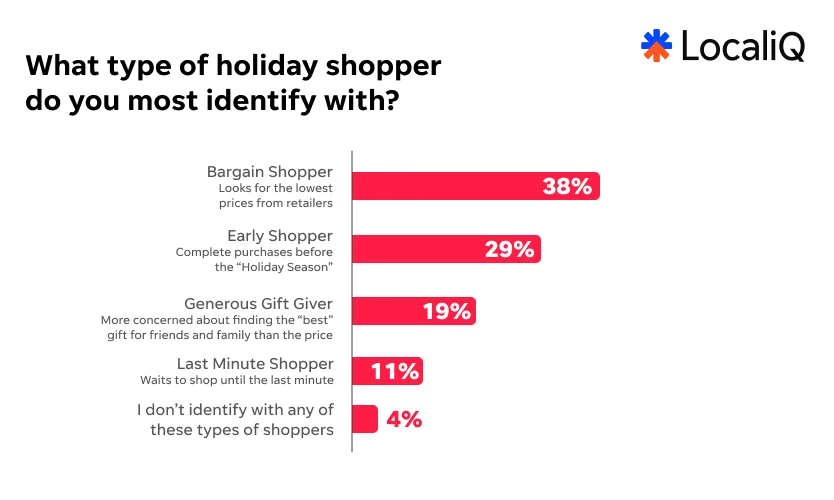
Price continues to dominate nearly every purchasing decision. Consumers identify most strongly as Bargain Shoppers (38%). Bargain shopping identity peaks among 45–59 (42%) and 60+ (44%) buyers, while Gen Zers are the least likely to call themselves Bargain Shoppers (30%). Generous Gift Givers skew younger and higher income.
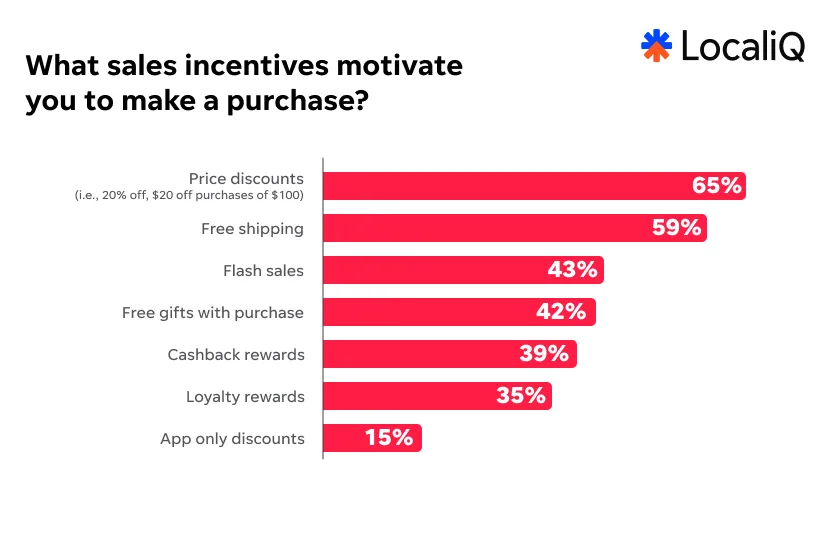
Meanwhile, price discounts (65%) and free shipping (59%) are the biggest purchase motivators.
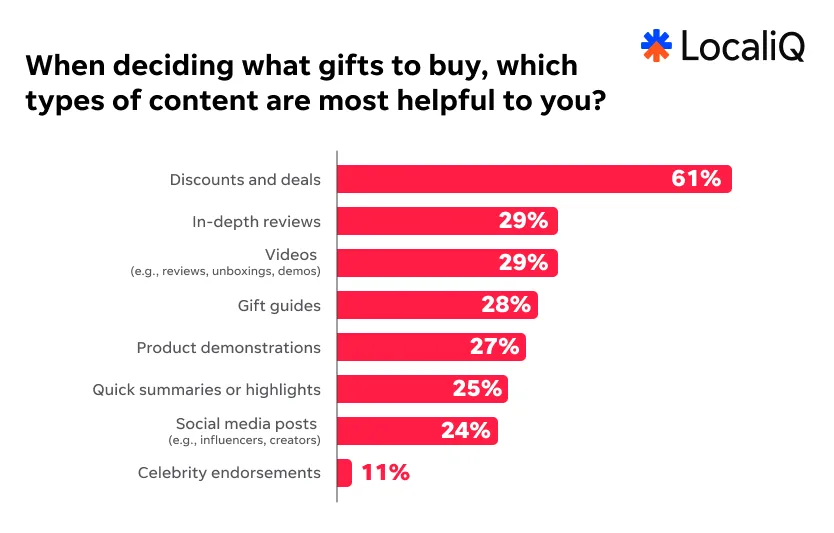
Plus, 61% say discounts and deals are the most helpful type of holiday shopping content.
What this means for your marketing
These results are backed by the bigger economic picture. Consumers have less disposable income, and their spending is starting to slow. To attract these value-focused buyers, lead with price, discounts, and free shipping across your ads, landing pages, and email subject lines. That’s especially true for older and middle-aged shoppers.
For a younger and higher-income audience, test messaging that focuses more on better quality and the gift experience before leaning too hard on discounts.
4. Price drives decisions, but reviews and recommendations still matter
Price and promotions remain the top factor influencing purchase decisions, but consumers also rely heavily on recommendations from friends and family, product reviews, and trusted sources.

Among shoppers who value reviews, customer reviews are considered by far the most trustworthy, followed by familiar publishers and unbiased content.

What this means for your marketing
Value messaging is important, but it should be backed by solid social proof. Shoppers are cross-referencing deals with customer reviews before they buy, which means a strong rating and a healthy volume of recent reviews can bump your conversion rate up. All the basic steps apply here: Get as many reviews as possible now, make them visible on your website, and include them in both paid and organic social content and emails.
This is also a call for engaging trusted influencers and getting exposure in trusted publications, ideally before buyers head to search, so you can influence what they look for.
🎄 Make your messages more meaningful and memorable this year. Get The Giant Guide to Cliche-Free Holiday Copywriting
5. Inflation is changing how people shop, not whether they shop
Most consumers still plan to celebrate the holidays, but they’re becoming more strategic with their spending. Nearly four in 10 plan to wait for sales before purchasing, while over one-third expect to spend less per gift. You also can’t overlook that a meaningful margin, 14% of shoppers, say economic conditions will have no impact on their plans at all.

And 42% anticipate spending about the same overall as last year, suggesting shoppers are finding ways to stretch their budgets rather than abandoning holiday purchases altogether.

What this means for your marketing
The good news for marketers, and the economy in general, is that most people still plan to do some holiday shopping. They’re just going to be more deliberate about it.
You don’t have to go overboard on huge discounts, especially with so many shoppers saying they plan to spend the same as before. Promotions that give buyers a sense of control, like layaway options, price guarantees, and “spend $X and save $Y” deals can perform really well without huge discounts when budgets are tight.
6. Most shoppers set budgets, but many still overspend
Seven in 10 shoppers establish a holiday budget, yet the largest share (40%) admit they typically exceed it. Another quarter don’t formally budget but try to monitor their spending. 31% do set spending limits and either stick to them or spend even less.

What this means for your marketing
Here’s where a little nuance comes into play. Of course, a 30% off promotion will appeal to strict budgetarians. But for the majority who don’t tightly track spending, reaching them may be more about giving more for each dollar they spend. BOGO deals, bundled savings, and a “give a gift, get a gift” promotion will help convert these less-strict but budget-aware buyers.
7. Holiday shoppers blend digital and physical shopping experiences…
Consumers are evenly split between shopping online and in-store, with 41% saying they shop equally across both channels.

Most shoppers research online before buying online, but many also research in-store or move between channels before making a purchase.

What this means for your marketing
A seamless cross-channel experience is increasingly becoming the expectation rather than the exception. A shopper will shop an online store while standing in a physical one. If you have both, make sure your in-store and online experience is connected and consistent. Click-and-collect options and QR codes help bridge the physical and digital experience.
As the season wears on, invest in some messaging around physical stocking levels. A shopper who typically buys online will jump in their car if they can fulfill their last-minute needs in your store.
And if you only sell online, remove any and all friction in the buying process. Offer free shipping and publish a “buy by X date to get by the holiday” message. Do what you can to keep people from wandering off your site before converting.
8. …and inspiration comes from everywhere
Consumers discover gift ideas through a wide variety of touchpoints. In-store browsing is the leading source of inspiration, followed by online retailers, asking recipients directly, and social media.

Facebook, TikTok, YouTube, and Instagram all play major roles, reinforcing that inspiration happens across both physical and digital environments.

What this means for your marketing
This is one of the most challenging takeaways to leverage, but it will bear the most fruit. Map out all the channels your target audience is likely to be on while they’re in the holiday shopping mood. Notice we didn’t just say “while they’re shopping.” A gift guide ad shown next to an article about holiday party planning can help you instigate inspiration instead of waiting for it.
It’s also important to coordinate your touchpoints here. You want to be visible without causing fatigue or confusion. A true cross-channel strategy connects social, email, and search so a buyer sees a consistent message everywhere.
9. Online marketplaces dominate, but lower prices can pull shoppers back to brands
Online marketplaces, like Amazon, remain the top destination for researching holiday purchases, but they’re not unbeatable.

Among marketplace shoppers, 71% say lower prices would motivate them to purchase directly from a retailer, while faster shipping, trust, and exclusive products also play meaningful roles.

What this means for your marketing
If you’re competing with Amazon and other large marketplaces, price is your most direct lever, but it’s not your only one. Faster shipping, a stronger return policy, and exclusive or hard-to-find products all move the needle with marketplace shoppers. Be explicit about these advantages in your ads and on your product pages.
And don’t forget to promote your story and ethos. Many shoppers will choose a product, even a higher-priced one, if the brand reflects their values.
10. Gift buying is emotional, and choosing gifts is increasingly difficult
Half of shoppers say finding the right gifts is difficult.

The biggest challenge is knowing what recipients actually want. Budget limitations have also become a much bigger obstacle compared to last year.

People will often default to giving gift cards if they’re unsure what to buy. That’s part of why gift cards are the most popular gift category (56%), well ahead of clothing (49%), toys and games (40%), and cash (36%).

What this means for your marketing
Reduce the decision fatigue wherever you can. Gift guides organized by recipient, price point, or interest give shoppers a starting point when they’re stuck. Curated recommendations, “staff picks,” and personalized shopping experiences can help, too. If your site has a search or filtering function, make sure it’s easy to use on mobile.
Promoting gift card options earlier in the season is also worth considering, rather than treating them as a last resort. Shoppers default to gift cards when they’re overwhelmed, so positioning them as a thoughtful choice rather than a fallback can actually drive higher average order values when paired with a suggested amount or curated experience.
11. Discounts trigger impulse purchases more than urgency tactics
Nearly two-thirds of shoppers say a good deal or discount leads them to make impulse purchases, while finding the “perfect” gift for someone ranks second. Traditional urgency tactics like limited-time offers and low-stock messaging trail behind discounts, suggesting consumers are motivated more by perceived value than by fear of missing out.

What this means for your marketing
Discounts are your strongest impulse trigger this season, so structure your promotions to create genuine perceived value rather than artificial urgency. Flash sales, percentage-off thresholds, and free shipping minimums consistently outperform countdown timers and low-stock warnings with today’s shoppers. That doesn’t mean urgency tactics have no place, but lead with the deal instead of the deadline.
12. Small businesses win by offering what big retailers can’t
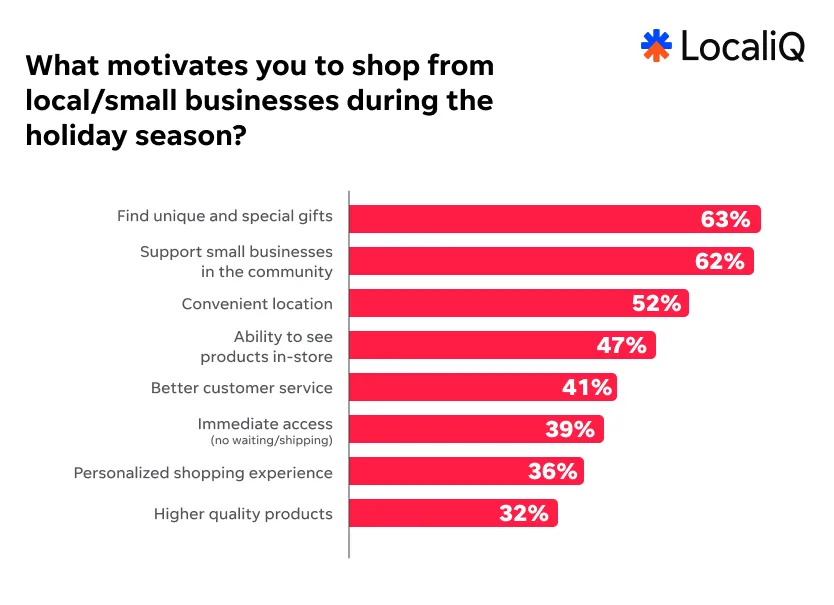
Consumers choose local businesses because they offer unique gifts (63%) and allow shoppers to support their communities (62%). Personalized service, convenience, and higher-quality products also contribute to their appeal, giving small businesses a clear positioning advantage over large retailers beyond simply competing on price.
What this means for your marketing
Small businesses have a real advantage here that big retailers can’t easily replicate. Lean into it. Highlight what makes your products unique, showcase your community ties, and make the local angle part of your creative.
Shoppers who prioritize supporting small businesses are already motivated to choose you. Your job is to make that choice easy and visible. A “shop local” campaign, a behind-the-scenes social post, or a gift guide featuring locally made products can all reinforce the things buyers already value about shopping small.
13. Social media is where holiday advertising gets noticed and remembered
Social media (44%) is the most commonly recalled place consumers see holiday advertising.

Facebook (71%) leads all platforms, followed by YouTube (54%), TikTok (50%), and Instagram (47%).

As you’ll recall, these same platforms also serve as major sources of shopping inspiration, making social media a full-funnel marketing channel that drives both discovery and purchase consideration.
What this means for your marketing
Social media is your highest-visibility channel this season, and it’s pulling double duty as both an ad platform and an organic discovery engine. Facebook still leads on recall, but YouTube, TikTok, and Instagram are all driving meaningful inspiration, especially for younger shoppers.
Research shows that video content performs particularly well during the holidays, when shoppers are actively looking for gift ideas and browsing more than usual. Facebook and YouTube offer a huge reach, while TikTok is worth testing, especially if your audience skews younger.
14. Search and AI advertising drive surprisingly strong purchase influence
Although consumers encounter holiday ads across many channels, search engines and AI tools generate some of the highest reported purchase influence. Roughly three-quarters of consumers who recall seeing holiday ads in search results or AI tools say those ads influenced a purchase, outperforming many traditional advertising channels.

What this means for your marketing
Search traffic, especially from keywords with a high buying intent, has always been valuable. We’re now learning that shoppers referred by AI also convert at a higher rate than those from many other traditional sources.
Make sure your search campaigns are well optimized heading into the season, and start thinking about how your products and brand appear in AI-generated responses. That means clean, structured product data, strong reviews, and clear pricing, all of which help AI tools surface your business when shoppers ask for recommendations.
15. AI chatbots are becoming trusted holiday shopping guides
More than one in four shoppers have already purchased a product recommended by an AI chatbot. While that’s not a huge percent, it’s important because the number is growing, and AI is so influential (as we saw in the last takeaway).

And those shoppers use AI for a variety of reasons. 29% ask AI for gift ideas, 29% turn to it to surface deals and discounts, 24% want product reviews, and 23% query AI about product comparisons. While still emerging (41% said they don’t use AI for holiday research), AI-assisted shopping is becoming a meaningful discovery channel.

What this means for your marketing
These results give us a practical to-do list for showing up in AI answers. Use keywords in product descriptions that help AI suggest your products (“a great gift for busy dads who love to BBQ”). Structure deals and discounts clearly. Place contextually relevant product reviews (“I bought this as a holiday gift…”) on product pages. And write comparison posts that position your products against your competitors.
More holiday shopping marketing statistics to drive your strategy
We covered some of the biggest insights, but there was a lot more data you can use to inform your marketing campaigns.
Stats about shopping behavior and timing
- Among early shoppers, the top motivations are enjoying the holiday season without the rush (43%) and making sure gifts arrive on time (43%).
- A third of last-minute shoppers (33%) say they’re waiting for better sales, making them a high-value audience for late-season promotions.
- 3% of procrastinators cite next-day and two-day shipping as the reason they feel comfortable waiting.
- Nearly 12% of shoppers say they’ll travel as far as needed to find the right gift.
- Most shoppers are buying for 5 to 9 people (38%), though nearly 1 in 5 buys for 10 to 14.
Stats about what shoppers buy and who they buy for
- Children are the top gift recipient (60%), followed by spouses and partners (54%), friends (47%), and parents (46%).
- Nearly 1 in 4 shoppers buys gifts for their pets (25%).
- Shoppers spend the most per person on spouses and partners, with coworkers and pets surprisingly tied for the next-highest per-person spend.
- Gift cards top the category list at 56%, but clothing (49%), toys and games (40%), and cash (36%) round out the most common gift types.
Stats about promotions, pricing, and payment
- 58% of shoppers agree they’ll spend more at retailers that offer tiered savings (spend $X, save $Y).
- 58% say they’d be willing to share their email or phone number in exchange for access to upcoming promotions.
- Nearly 1 in 4 shoppers (24%) say they’d consider a “Buy now, pay later” option for more expensive purchases, with that number rising among younger buyers.
- Debit cards are the most common payment method (70%), followed by credit cards (47%) and cash (38%).
Stats about where shoppers go
- General merchandise stores like Walmart and Target lead all retail categories (65%), followed by online marketplaces (55%) and discount stores like TJ Maxx (37%).
- Local and small businesses are used by 26% of holiday shoppers, putting them roughly on par with electronics stores and department stores.
- Only 7% of shoppers say they shop exclusively online.
- Facebook leads all platforms for both holiday ad recall (71%) and gift inspiration (65%).
Holiday marketing infographic
We’ve bundled up the biggest takeaways from our holiday shopping survey into this convenient visual.

Use buyer feedback to build your holiday marketing plan
While consumers are a little more cautious about where their money goes this year, they still plan to shop. Your job is to make your messaging match their mood, and promote it where they are. The data in our study will help you choose the right channels, craft the best creative, and pick the most influential promotions for your target buyer.
Reach out to speak with one of our marketing experts for more in-depth and actionable holiday marketing strategies.

Recommended for you





Unlock your business potential
We offer innovative technology and unparalleled expertise to move your business forward.