

Planning out your marketing for the year ahead is always a big lift and a challenge. One thing that makes it a little easier? Reliable data around what businesses like yours are doing, including where they’re investing, how much they’re spending, and what trends they’re preparing for.
Lucky for you, we’ve gathered all that data and more in our third annual Small Business Marketing Trends Report! We surveyed over 380 small business owners and marketers to uncover where they’re spending, what’s working, what they’re planning for 2027, how they’re using AI, and so much more.
We’re diving deep into the data and sharing actionable insights to help you plan smarter, make the most of your marketing budget, and stay ahead of the competition in 2027.
Key takeaways from our report:
- 53% of SMBs plan to increase their marketing budgets in 2027, while just 7% expect to spend less.
- Paid social ads are the most-used marketing tactic (followed by organic social media marketing).
- Only 30% of SMBs are investing in SEO, down from 53% last year, but satisfaction among businesses using SEO increased to 76%.
- 57% of SMBs credit digital marketing and online advertising as their top source for new customers, up from 46% last year.
- 60% of SMBs use AI for marketing, with 69% of those businesses using it for content creation.
What you’ll find in the 2027 Small Business Marketing Trends Report:
- Standout trends: What to know for your 2027 marketing
- The who, what, and where of this report
- The most popular and effective small business marketing strategies
- Future planning: How small businesses will evolve in 2027
- Time and tech: How small businesses are managing their marketing
Standout trends: What to know for your 2027 marketing
Before we dive into all of the data, here are some standout trends we uncovered based on the responses to our survey.
Despite concerns about the economy, budgets are increasing
There’s no question small businesses are feeling the pressure of economic uncertainty. In fact, it’s by far their biggest challenge heading into 2027. But that’s not stopping the majority of them from increasing their marketing budgets next year. And only 7% plan to decrease them.
And that investment makes sense. As small businesses see leads and customers coming from their marketing and advertising, they may be more willing to put more budget behind the strategies that are working.
“Small businesses aren’t simply pulling back in response to economic uncertainty. They’re getting more intentional about where they invest and putting more budget behind strategies that can help them reach customers and drive measurable results,” said Noel Robbins, VP of Strategy & Enablement for LocaliQ.
Social media remains the most popular tactic (but paid edged out organic)
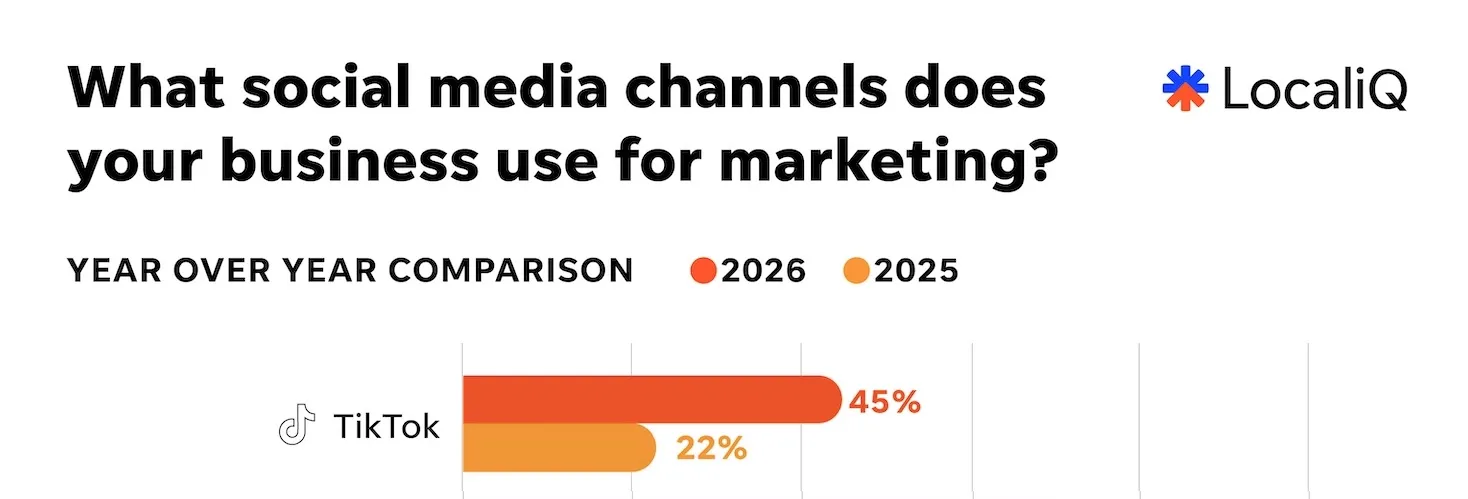
Last year, unpaid social media marketing was the most popular strategy for small businesses. This year, paid social ads took the top spot. Social clearly continues to be a winning strategy. And while Facebook and Instagram still dominate, TikTok saw substantial growth year over year.
SEO saw the largest channel-usage decline (but SMBs are still satisfied with their results)
In 2025, over half of small businesses were running SEO compared to just 30% in 2026. That’s a pretty substantial decrease! We’ll cover this even more throughout our report, but SEO is getting more difficult. Organic results are getting pushed farther down the page, AI search is growing, and more searches are ending without a click. Businesses are seeing sharp traffic decreases, which could lead them to abandon SEO altogether.
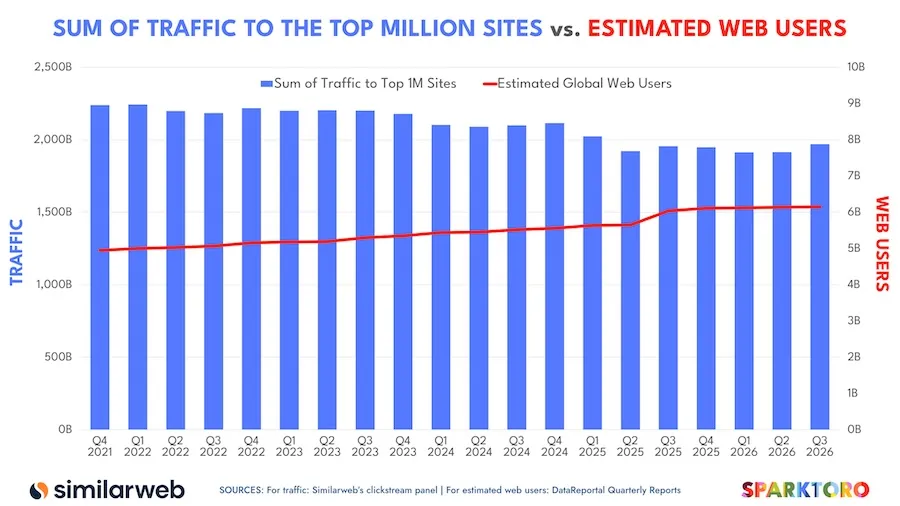
This chart illustrates the decrease in web traffic to top sites despite an increase in users.
But here’s the really interesting part: The businesses still doing SEO are actually more satisfied with their results. Satisfaction increased from 67% in 2025 to 76% in 2026.
These businesses could be adjusting their strategies for the new world of SEO and GEO (generative engine optimization) and identifying the metrics that matter most for measuring success now. These metrics have shifted away from rankings and direct organic traffic to conversion rates, traffic from listings, and branded search queries.
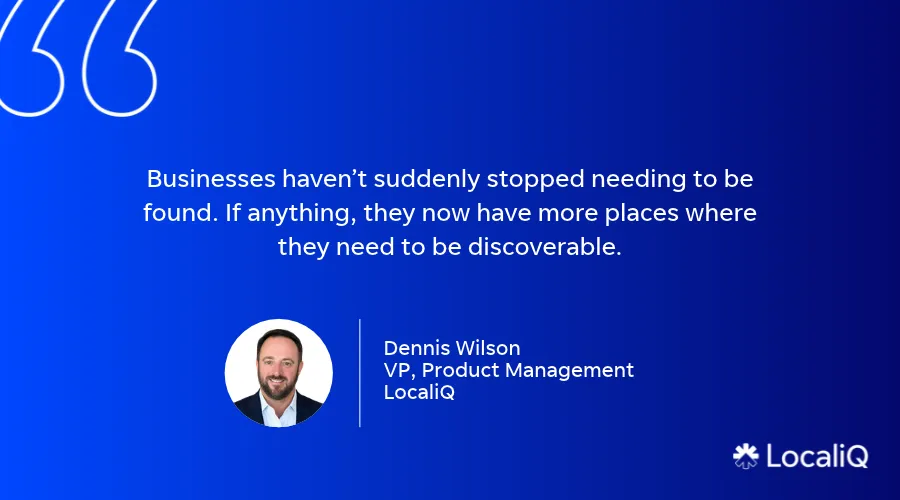
“AI search is rapidly blurring the lines between SEO, GEO, listings, reputation, and content,” said Dennis Wilson, VP of Product Management for LocaliQ. “Businesses haven’t suddenly stopped needing to be found. If anything, they now have more places where they need to be discoverable.”
Customer referrals still reign, but digital is gaining
Customer referrals remain the top source for driving new leads and customers for small businesses. But digital marketing and advertising is gaining ground, increasing from 46% in 2025 to 57% in 2026.
This could be due to several factors. One, most advertising platforms have integrated AI, making it easier to scale and optimize based on what’s driving the best results. Two, small businesses are expanding their strategies to reach audiences across channels—most businesses we surveyed are running marketing on multiple platforms, giving them access to a wider audience of potential customers.
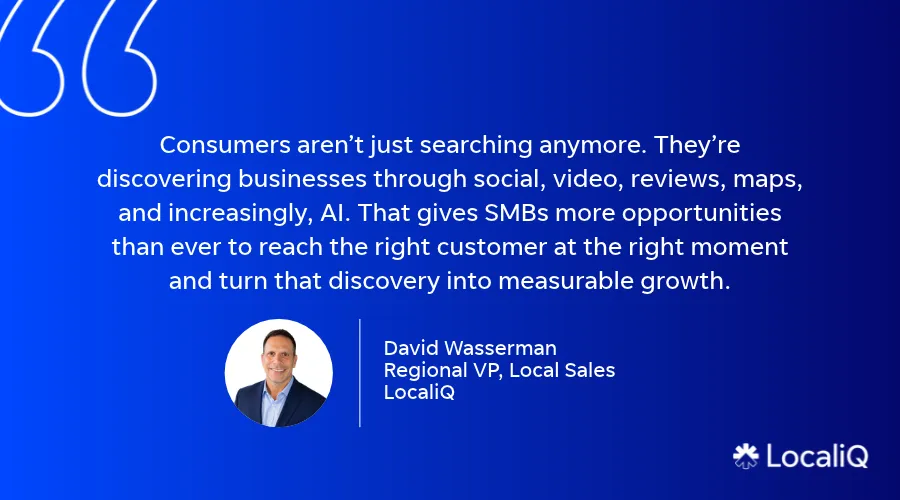
“The way people discover businesses has fundamentally changed,” said David Wasserman, Regional Vice President of Local Sales for LocaliQ. “Consumers aren’t just searching anymore. They’re discovering businesses through social, video, reviews, maps, and increasingly, AI. That gives SMBs more opportunities than ever to reach the right customer at the right moment and turn that discovery into measurable growth.”
Now, let’s get into the nitty-gritty so you’re equipped to build the best 2027 marketing strategy.
The who, what, and where of this report
Here’s a breakdown of the businesses we surveyed to build the foundation of this report.
What industry is your business in?
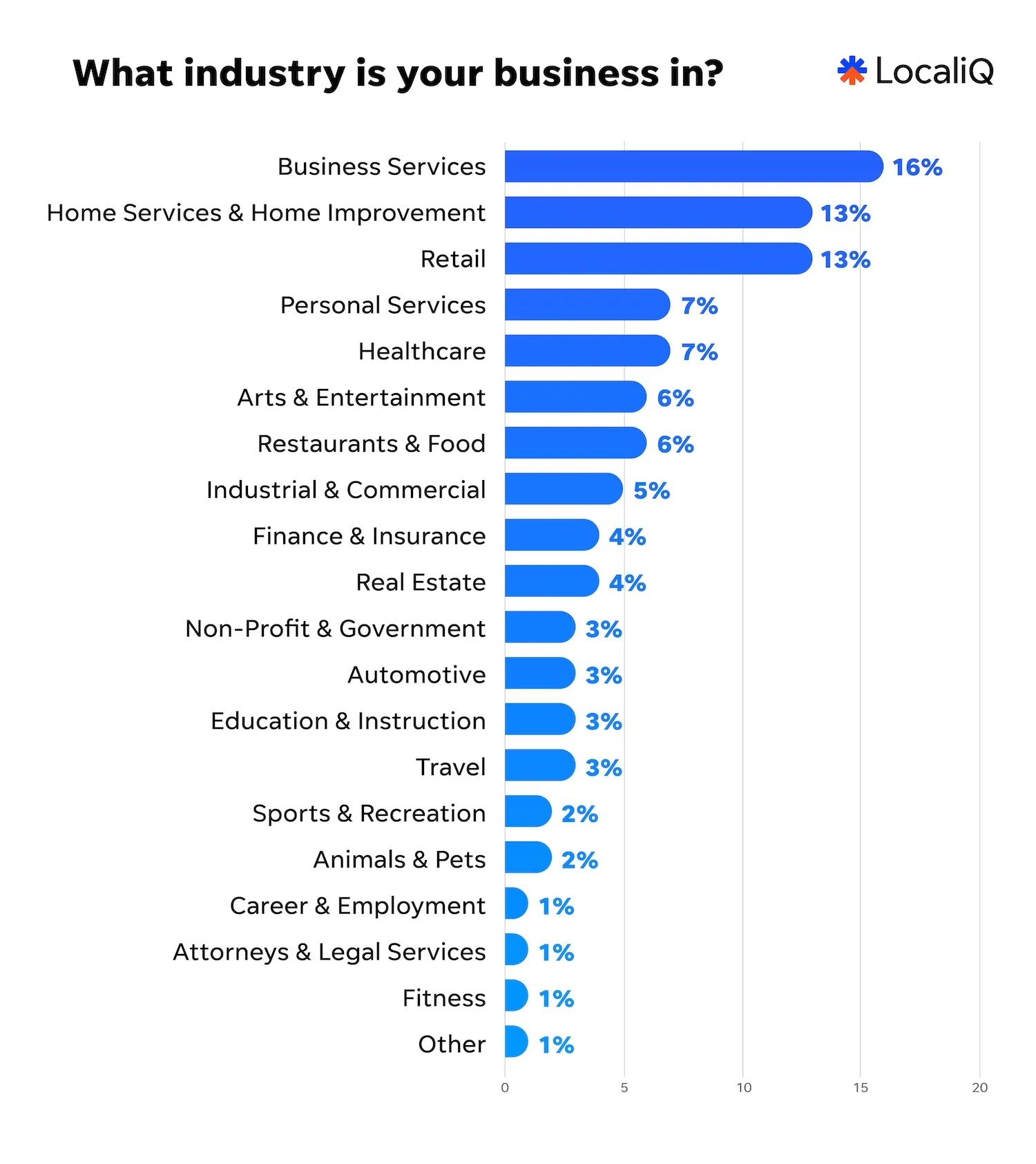
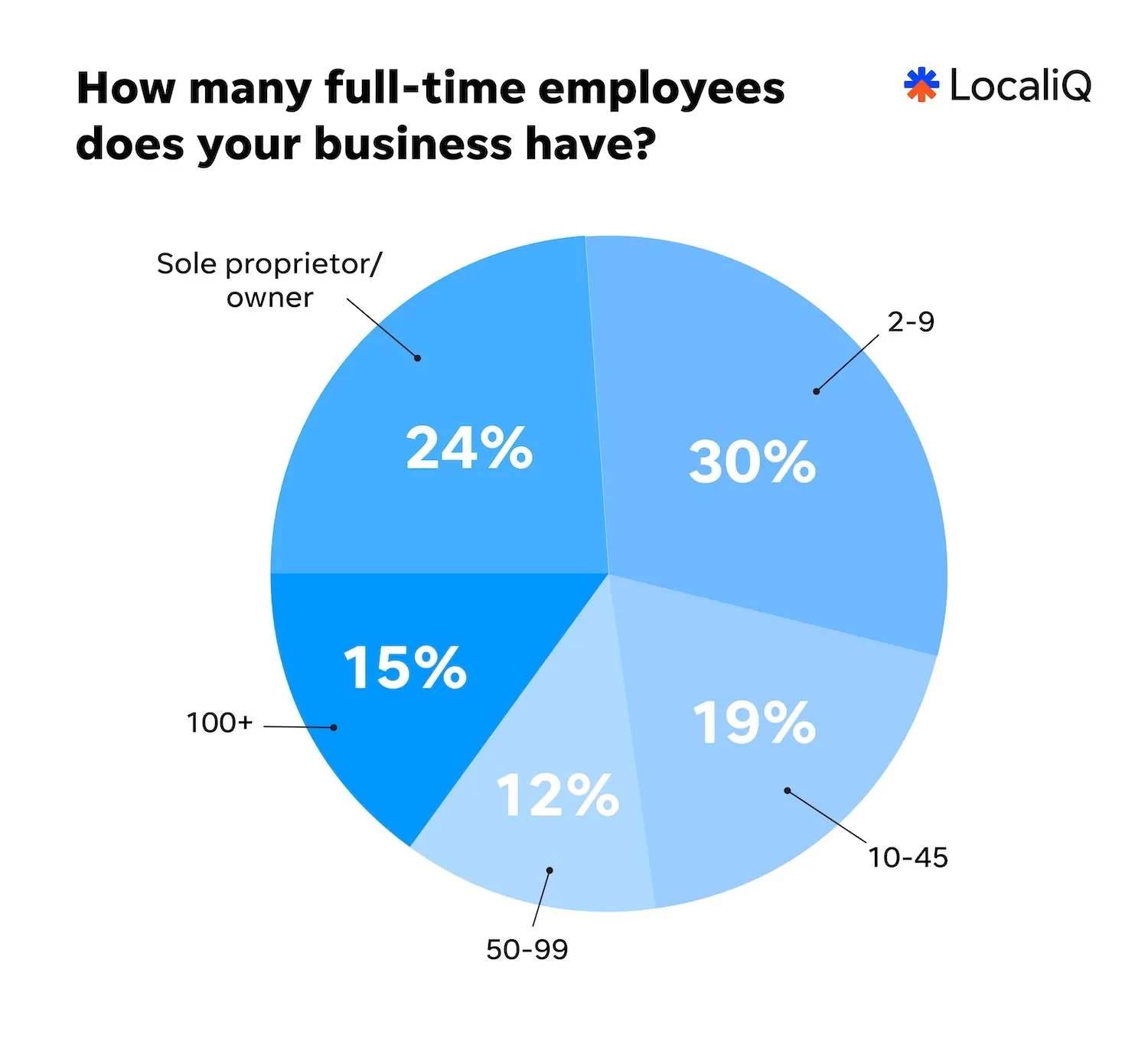
We were thrilled to have such a wide range of survey respondents that truly reflect the small business landscape. Businesses surveyed were spread out across industries and sizes (which we’ll cover more next), and 98% were in the US or Canada.
How many full-time employees does your business have?
What is your monthly marketing budget?
Does your business have employees dedicated to marketing full-time?
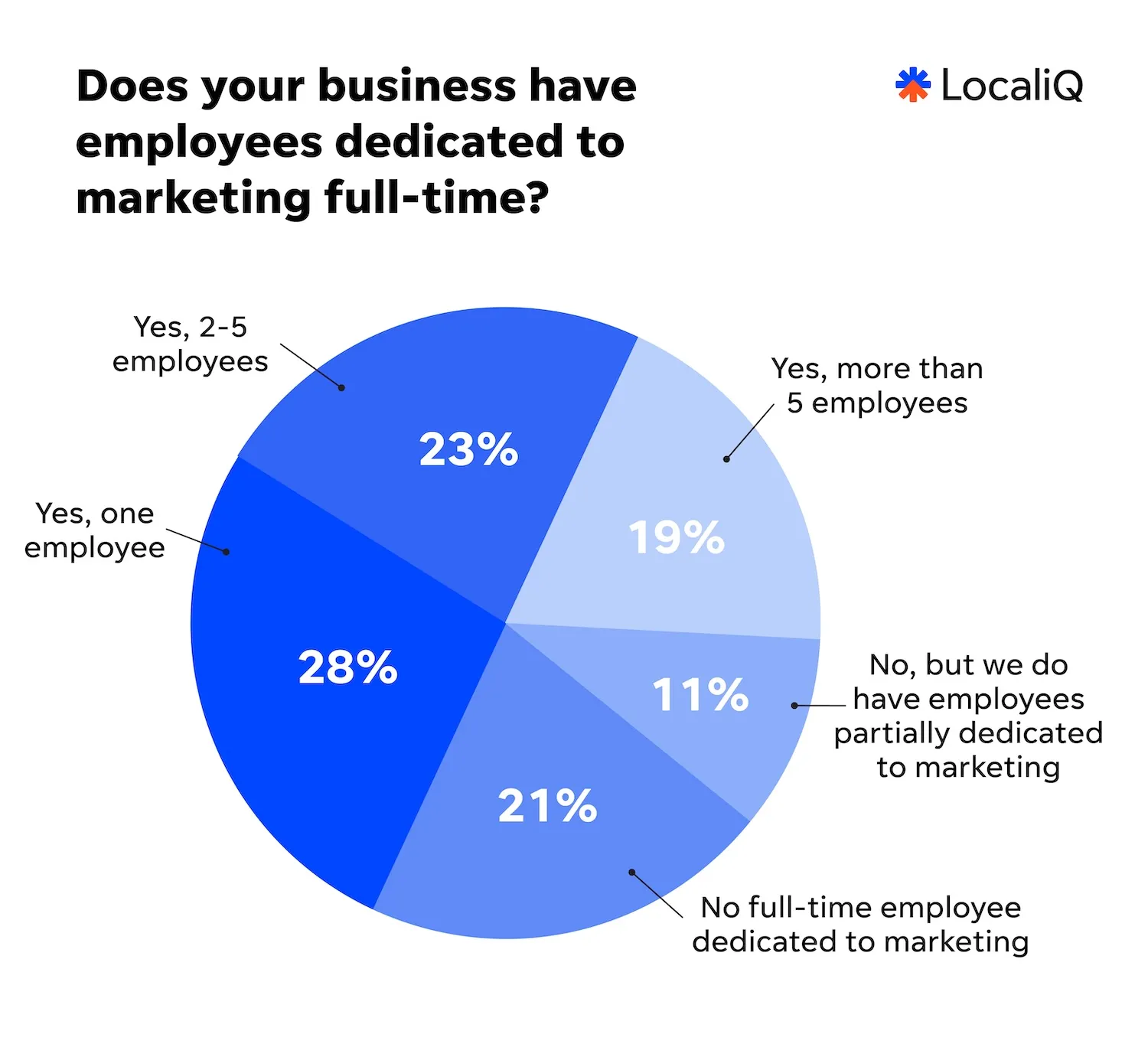
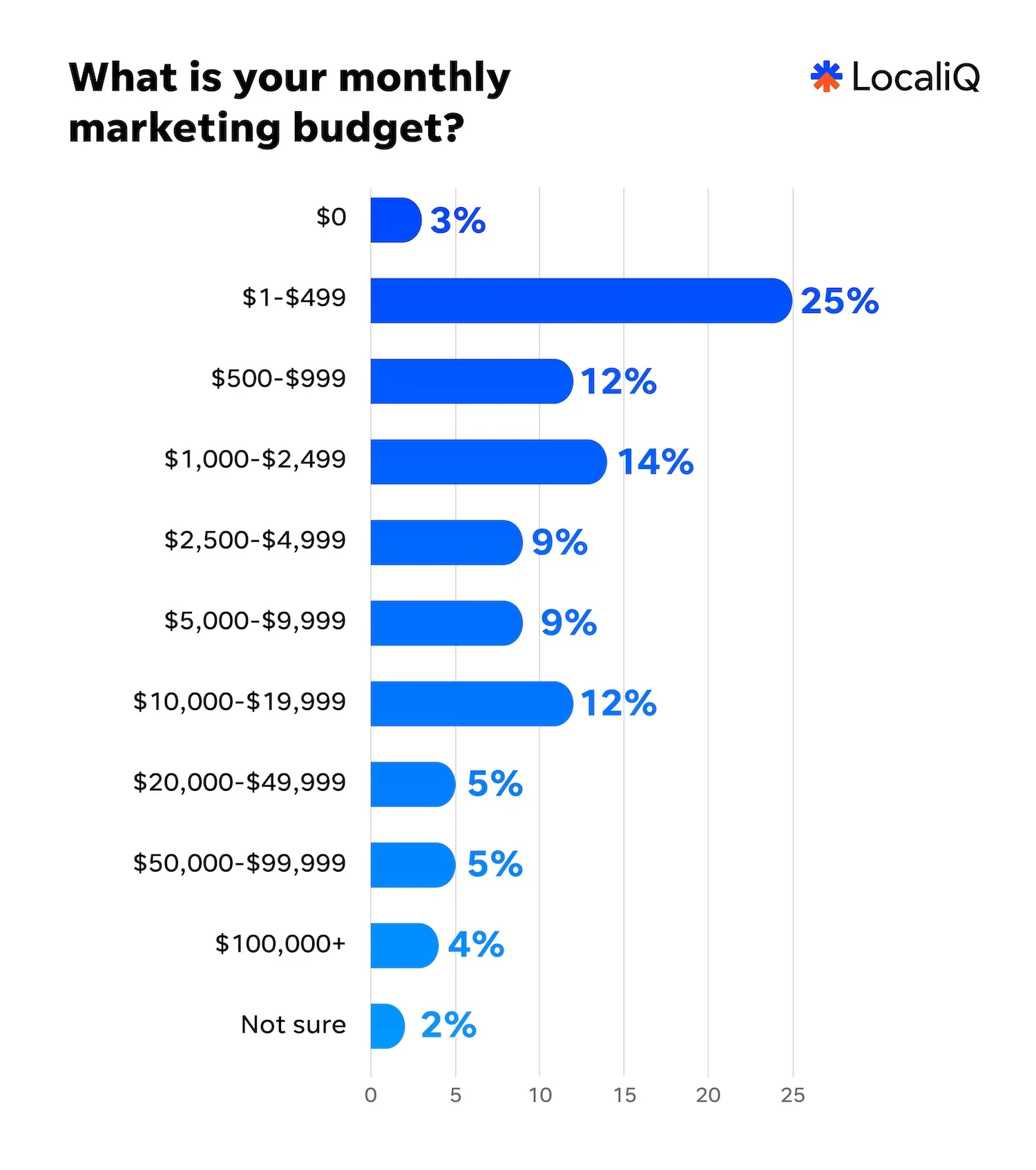
To get a peek into how the small businesses we surveyed operate, we wanted to know their size and current marketing budget. Unsurprisingly, smaller businesses tend to have smaller budgets.
When drilling into the data further, we found that nearly 60% of businesses with fewer than 10 employees have a marketing budget under $1,000 a month (45% of these businesses have budgets under $500 a month) and were nearly 50% more likely to have no full-time employees dedicated to marketing. That means these smaller businesses are truly tasked with doing more for less.
The most popular and effective small business marketing strategies
To better understand the current state of small business marketing, we asked what types of strategies SMBs are currently investing in and how they feel about their results.
What marketing/advertising channels and tactics are you currently using?
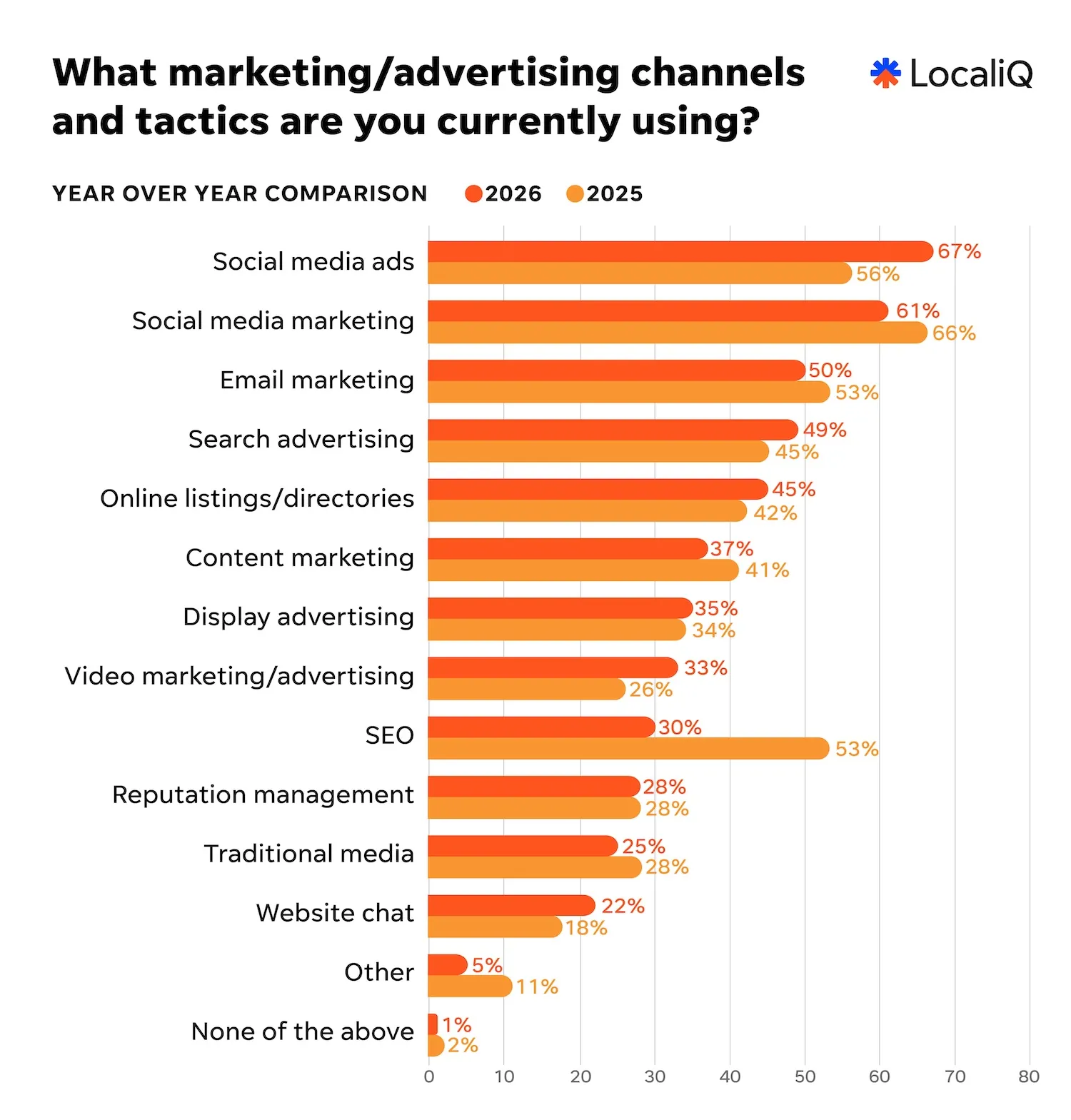
The three most-used marketing channels this year are social media ads (67%), unpaid social media marketing (61%), and email marketing (50%). It makes sense: These channels are extremely effective for small businesses and can help them easily connect with their audiences where they’re spending time online.
We saw a slight increase in the number of small businesses investing in search advertising—from 45% in 2025 to 49% this year. But only 34% of businesses with monthly budgets under $1,000 are running search ads. This could be a missed opportunity for that remaining two-thirds of smaller businesses, especially because 65% of people will click on a search ad when they’re looking to make a purchase. And our 2026 search advertising benchmarks saw cost per lead decrease for the first time in five years, making this an opportune time to get into the search ads game.
One finding we found particularly interesting: There was a pretty steep decline in the percentage of businesses investing in SEO strategies—from 53% in 2025 to just 30% in 2026. Our interpretation? Search engine shakeups and the explosion of AI search have made SEO more difficult and harder to track than before. However, it does present a pretty big opportunity if 70% of small businesses aren’t investing in SEO at all. If you’re willing to invest the time, expertise, and budget for this strategy, you can stand out in both organic and AI search.
🔎 Get updated tips for your SEO strategy with our free guide: How to Do SEO Right–Right Now! >>
What social media channels does your business use for marketing?
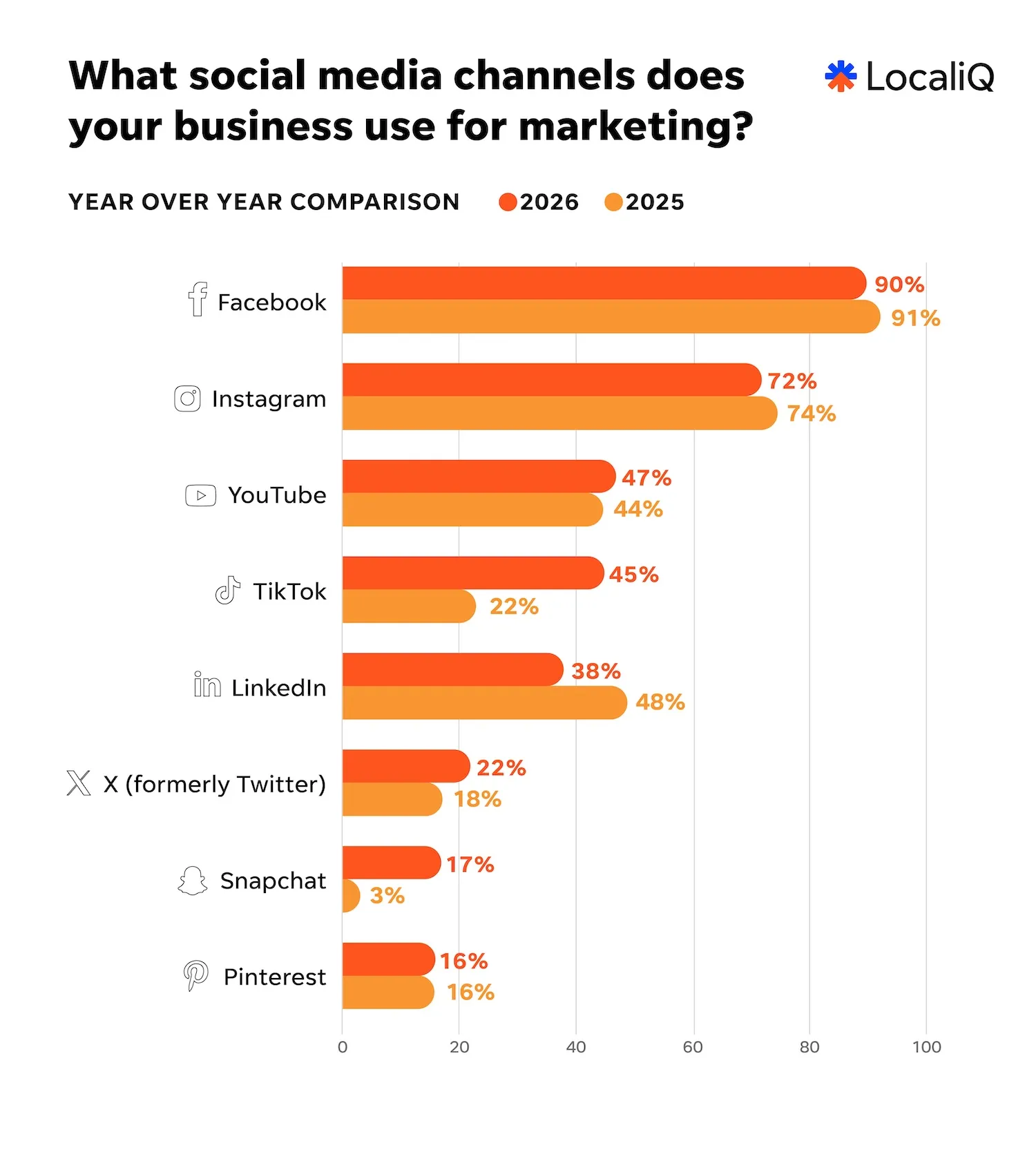
Facebook remains the top social channel for most small businesses for three years running. 90% of small businesses surveyed are using Facebook as part of their social media marketing (down slightly from 91% last year), followed by Instagram at 72% (down from 74%), and YouTube at 47%. This means businesses know where to find their audience: YouTube, Facebook, and Instagram are the three most popular social media platforms for users.
TikTok saw a huge increase in usage year over year—from 22% in 2025 to 45% in 2026. In 2025, there was a lot of uncertainty over the future of the app, but at the end of 2025, TikTok agreed to a US sale to keep it from getting banned. That sale helped ease fears, and TikTok has remained a staple for social media users. It’s now the fourth most-used social media platform in the US.
Snapchat saw an increase year over year, as well—from just 3% to 17%, but it still rounds out the bottom of this list along with Pinterest.
👍 Want to learn more about social media marketing and how to make it work for your business? We’ve got you covered in this complete guide: Social Media Marketing Simplified >>
How satisfied are you with the results you get from each marketing/advertising channel and tactic you’re using?
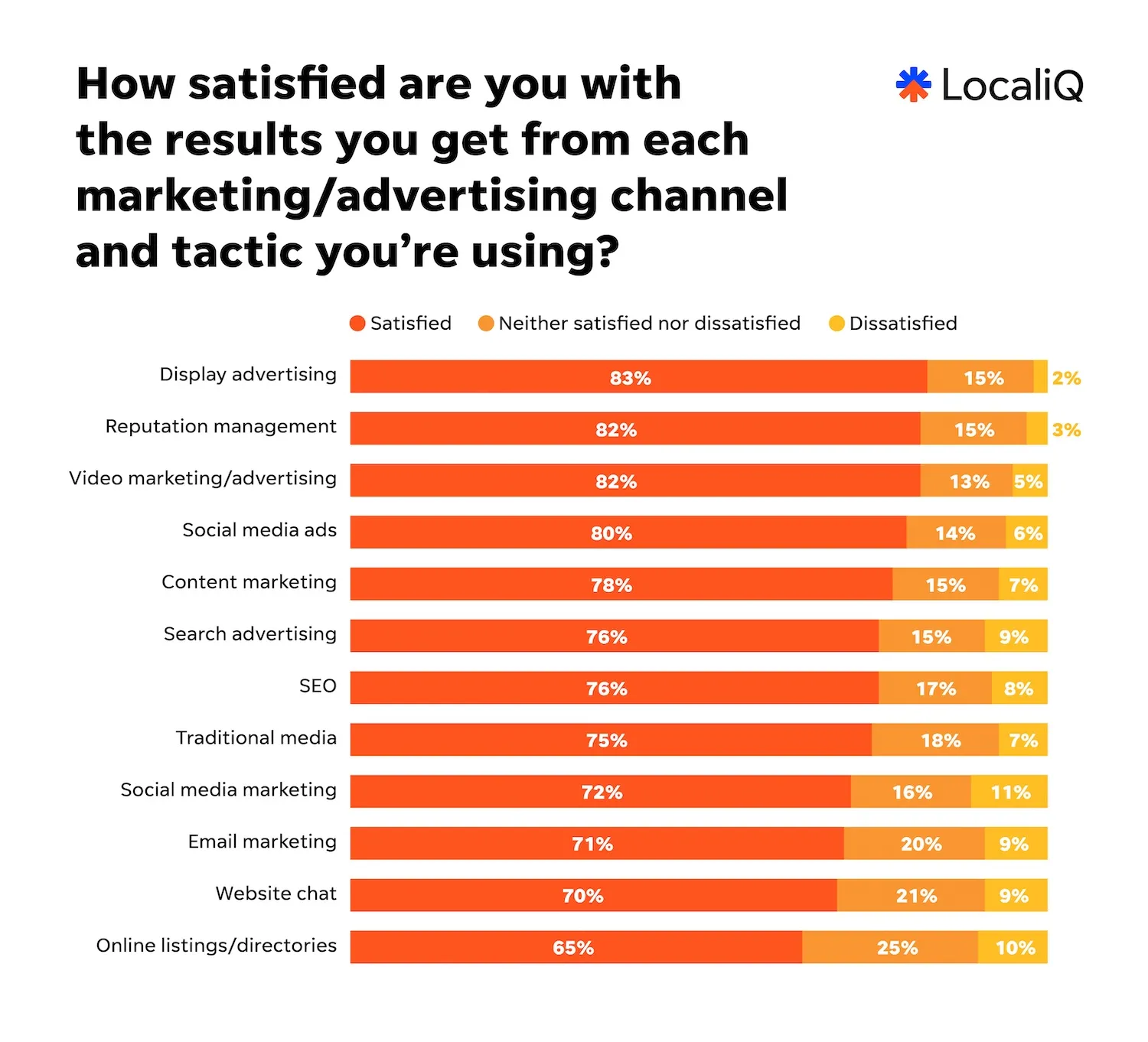
Display advertising, reputation management, and video marketing and advertising topped the list of channels and tactics SMBs are most satisfied with. This is interesting given display advertising can be difficult to track and tie back to conversions, but it’s an excellent strategy for driving brand awareness and reaching customers as they spend time across a range of websites. This list is also surprising as these three tactics are some of those lesser-used by SMBs.
Small businesses also reported they’re satisfied with the results they’re seeing from tactics like social media ads, content marketing, and search advertising. These also represent three different ways to educate, engage, and reach potential customers in various places they’re spending time online.
While fewer businesses are investing in SEO strategies, 76% of those that are report they’re satisfied with their results. SEO coupled with content marketing and reputation management can help businesses establish a firm presence across search engines and AI search results.
Social media marketing had the highest rate of dissatisfaction at 11%. This is a little surprising given the majority of businesses are investing in this strategy. But many businesses struggle with identifying the right metrics to showcase social media’s effectiveness; in many cases it’s not driving direct traffic and leads but can contribute to a strong web presence and build brand awareness. Plus, with so many businesses on social media, it can be hard to cut through the clutter and stand out.
What are your best sources of getting new leads and customers?
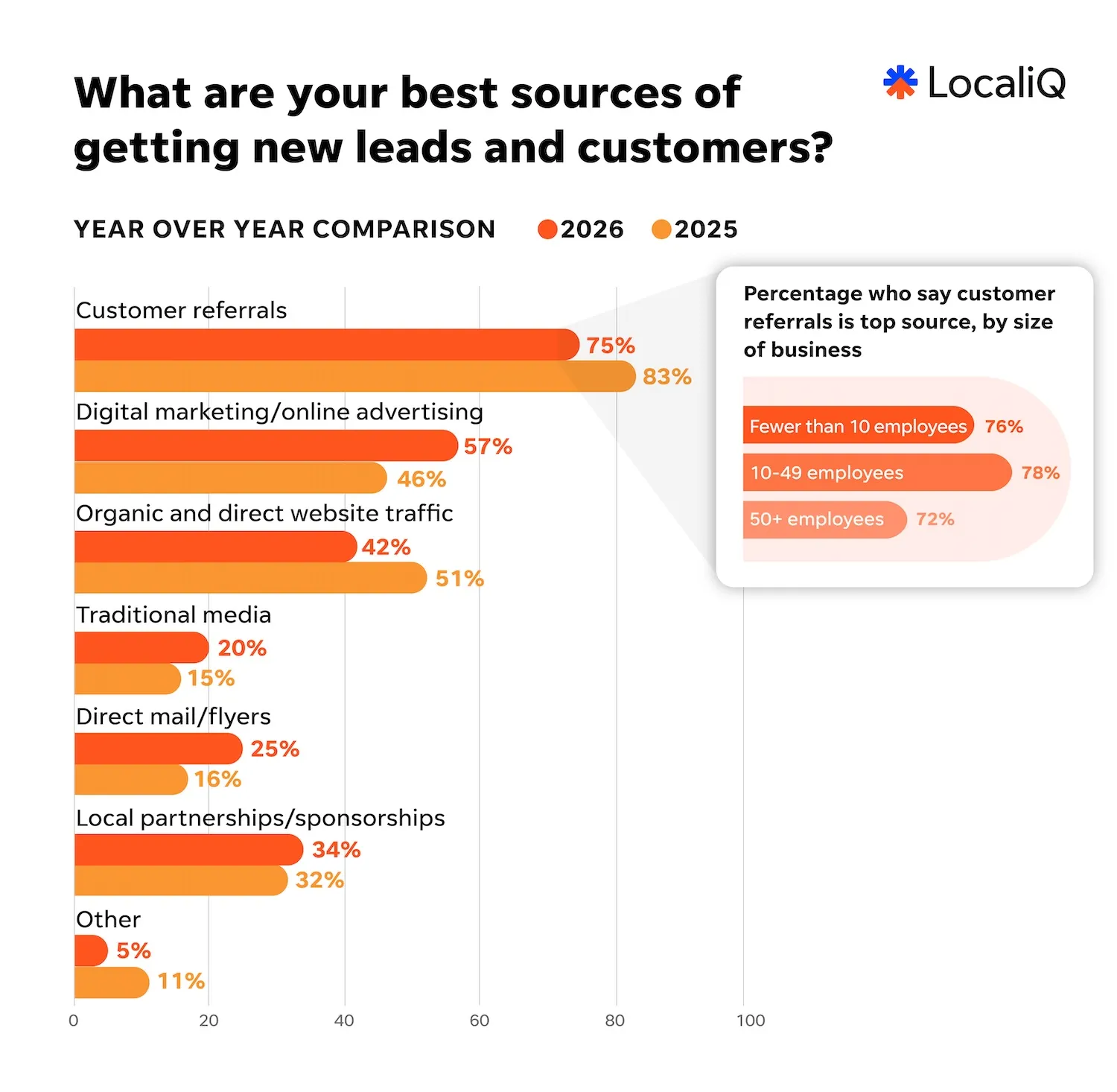
The majority (75%) of small businesses said customer referrals are their best source for customer acquisition, surprisingly down a bit from 83% last year. However, it still remains the top source no matter the business size.
For nearly 60% of businesses we surveyed, digital marketing and online advertising was another top source for new customers and leads, and for businesses with a monthly budget of $10,000 or more, it was the top source for new customers (74%). And it was still the second-best source for new customers for nearly half (46%) of those with a budget of less than $1,000.
Digital marketing and advertising often require a budget, so it’s not surprising that businesses with a larger one are seeing more new customers and leads from their investments. But it’s encouraging to see that businesses with smaller budgets are also finding ways to make the most of their marketing spend and turn their campaigns into new customer opportunities.
Last year, more than half of the SMBs we surveyed noted organic and direct website traffic as a top source for new customers, but that dropped to 42% this year. This is likely due to the increase in zero-click search. Nearly 70% of searches now end without a click, and businesses are seeing less traffic overall (a 40-60% loss, in some cases).
This is a big challenge for businesses that once relied on search engine discovery and website traffic to get new leads and customers, and many marketers will need to find alternative sources of leads, such as investing more in paid strategies like search, social, and display ads.
What performance metrics are most important to your business?
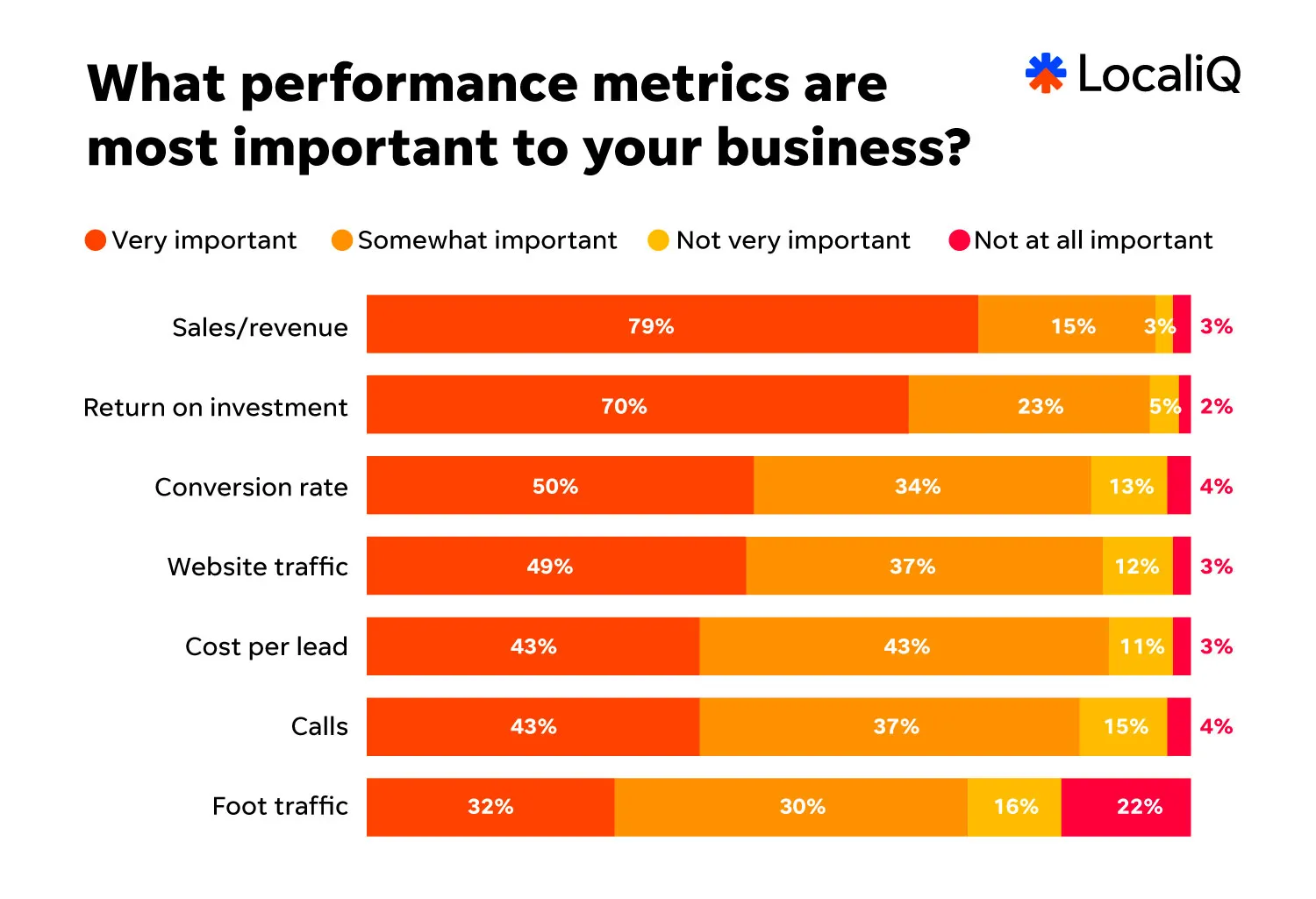
When asked about which metrics are most important to them, the majority of SMBs surveyed answered that they all are. Sales and revenue was the top reported metric, with 79% indicating it is “very important,” followed by return on investment (70%). Other important metrics, including conversion rate and cost per lead, are directly tied to online advertising.
Website traffic was another important metric for SMBs—which, as mentioned, has become even more challenging to drive over the last year. Website traffic is expected to continue declining in 2027.
Future planning: How small businesses will evolve in 2027
Now that we have a grasp on the current state of marketing, let’s look at what small businesses are planning for the next year to help inform your strategy.
What are the biggest challenges your business will face in 2027?
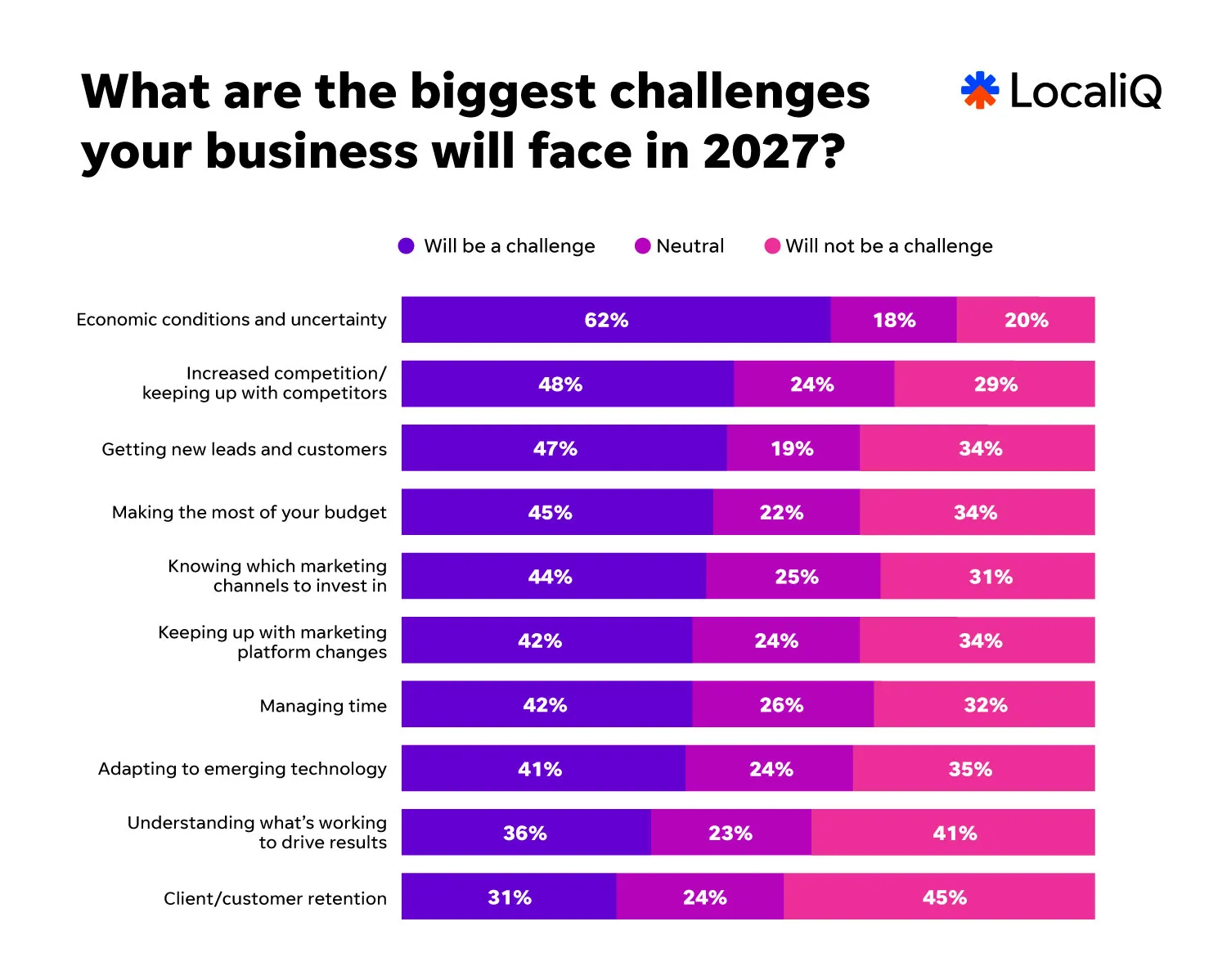
62% of small businesses think economic uncertainty will be somewhat or very challenging in the coming year—down slightly from last year (66%) but still higher than in 2024 (48%). This isn’t surprising given continued inflation and a recent increase in interest rates (with another increase reportedly on the way in December 2026). Businesses and consumers alike are worried about costs increasing, which can put a strain on operational costs and consumer buying power. Economic uncertainty can also make it difficult to project, plan, and budget for the new year.
Keeping up with the competition is another concern for SMBs, with nearly half saying it will be challenging in 2027 (15% of those noted it will be very challenging). Small businesses are also concerned with getting new leads and customers (47%) and making the most of their budgets (45%). Unsurprisingly, this was noted as more challenging for businesses with monthly budgets under $1,000. They want to make sure they’re spending what they have on the most successful tactics.
On the other hand, SMBs feel confident in their ability to know what’s working for their business. 41% said that would not be a challenge compared to just 30% last year. They also feel confident about customer retention—fewer than 1 in 10 said this area is “very challenging.” Way to go!
Do you expect your marketing budget to increase or decrease in 2027?
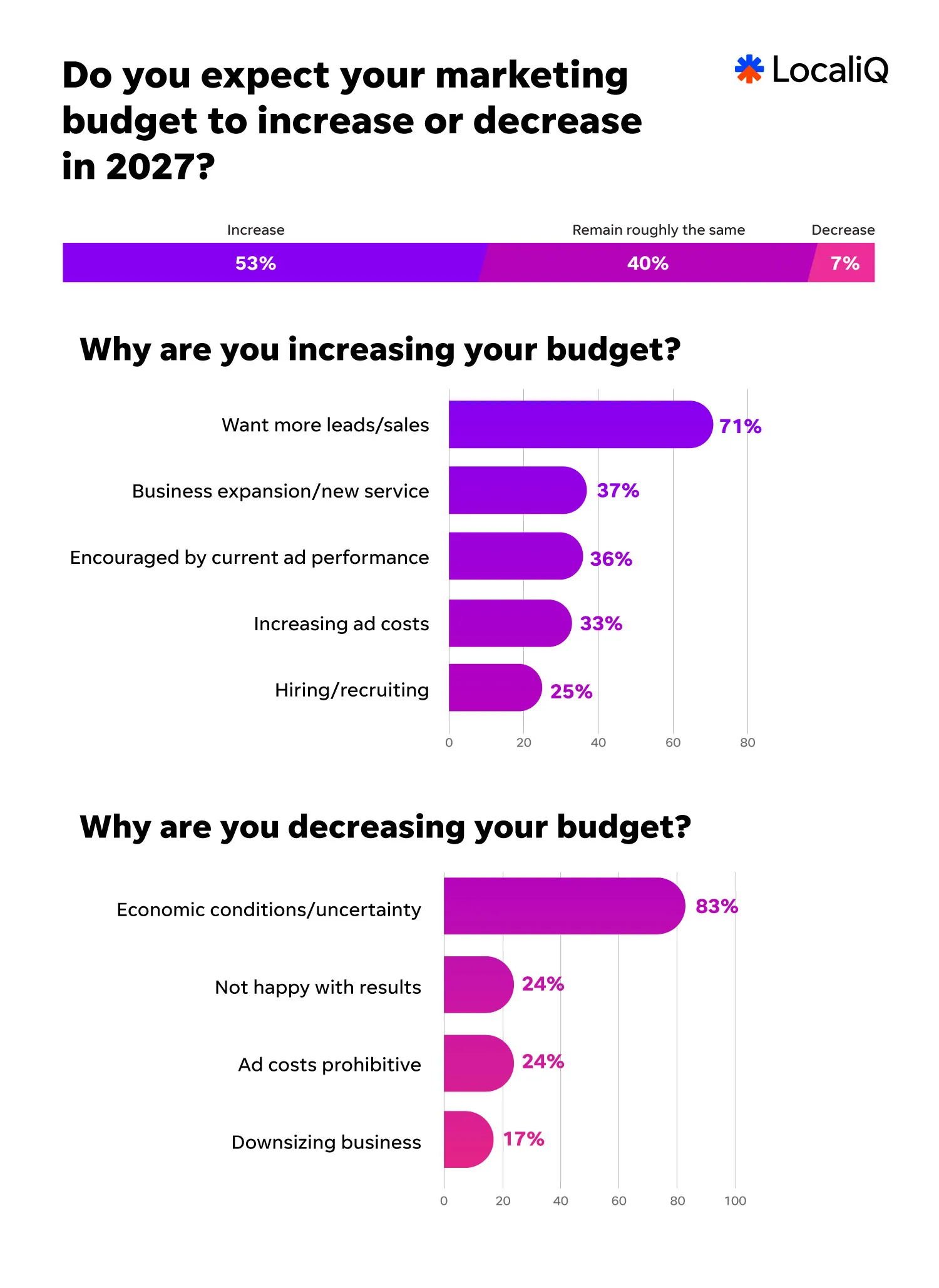
Despite concerns about economic challenges, only 7% of small businesses are planning to decrease their marketing budgets in 2027. And over half of small businesses are planning to increase their marketing budgets. 40% of SMBs plan to keep the same budgets.
Most SMBs (71%) are increasing their budgets to drive more leads and sales. This makes sense as many marketing strategies built around lead acquisition require budget, and if you’re getting a good return on your investment, it’s easy to scale. In other words, you can typically drive more leads by spending more.
For those decreasing their budgets, the majority (a whopping 83%) are doing so because of the economy. This is understandable after a couple of years of record inflation, the addition of tariffs in 2025, and increased costs throughout 2026.
Are you planning to invest more or less in these channels in 2027?
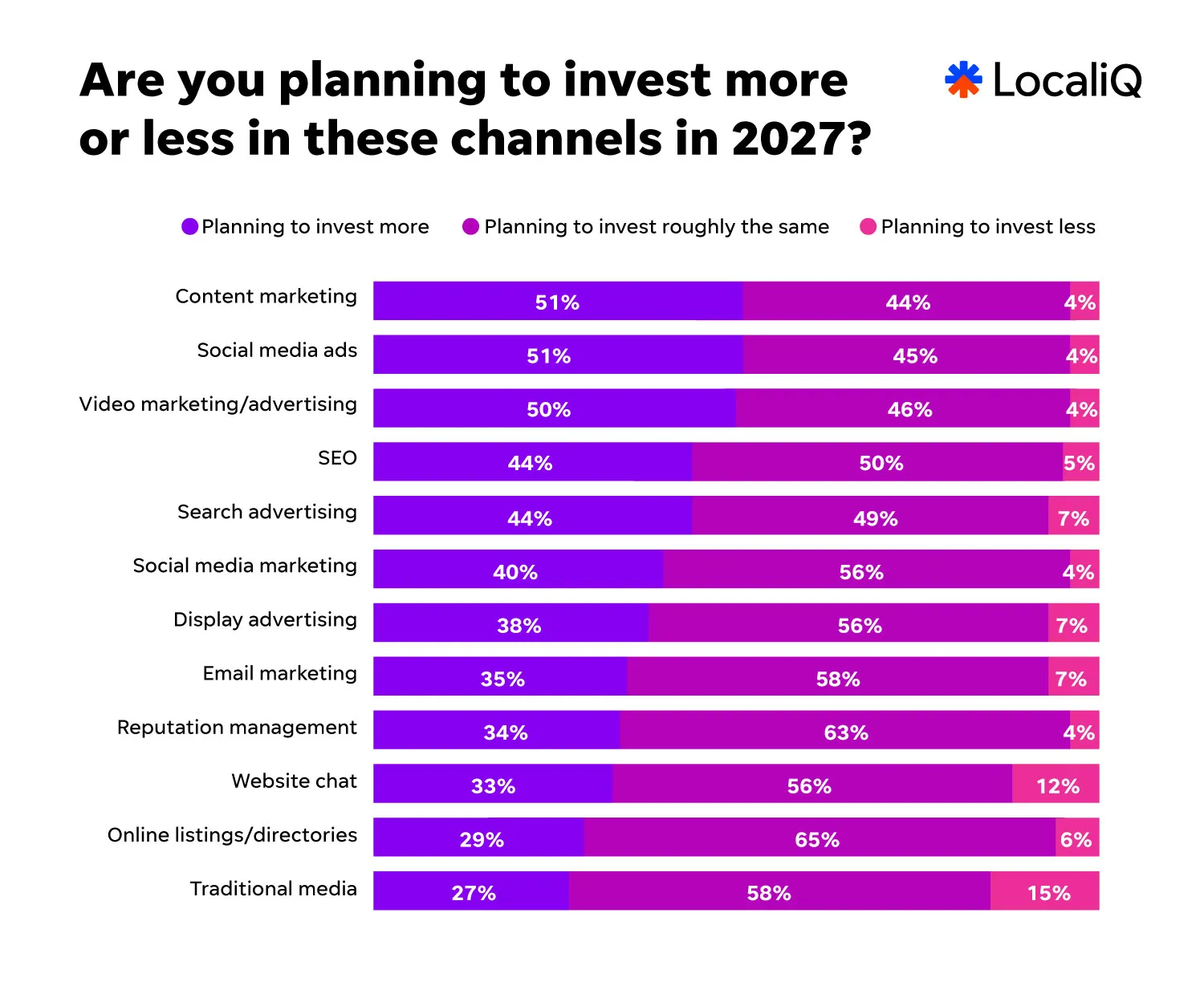
To better understand where small businesses are planning to allocate their marketing budgets in 2027, we asked how they’ll be investing in these top strategies. Over half plan to invest more in content marketing and social media ads (both 51%), while half plan to invest more in video marketing and advertising.
Most SMBs are planning to keep their investments roughly the same for many tactics, including SEO, display advertising, email marketing, social media marketing, reputation management, website chat, and more, while 15% plan to invest less in traditional media in 2027—this is down from 24% in last year’s report.
For these channels and tactics you are not currently using, are you planning to invest in them in the next 12 months?
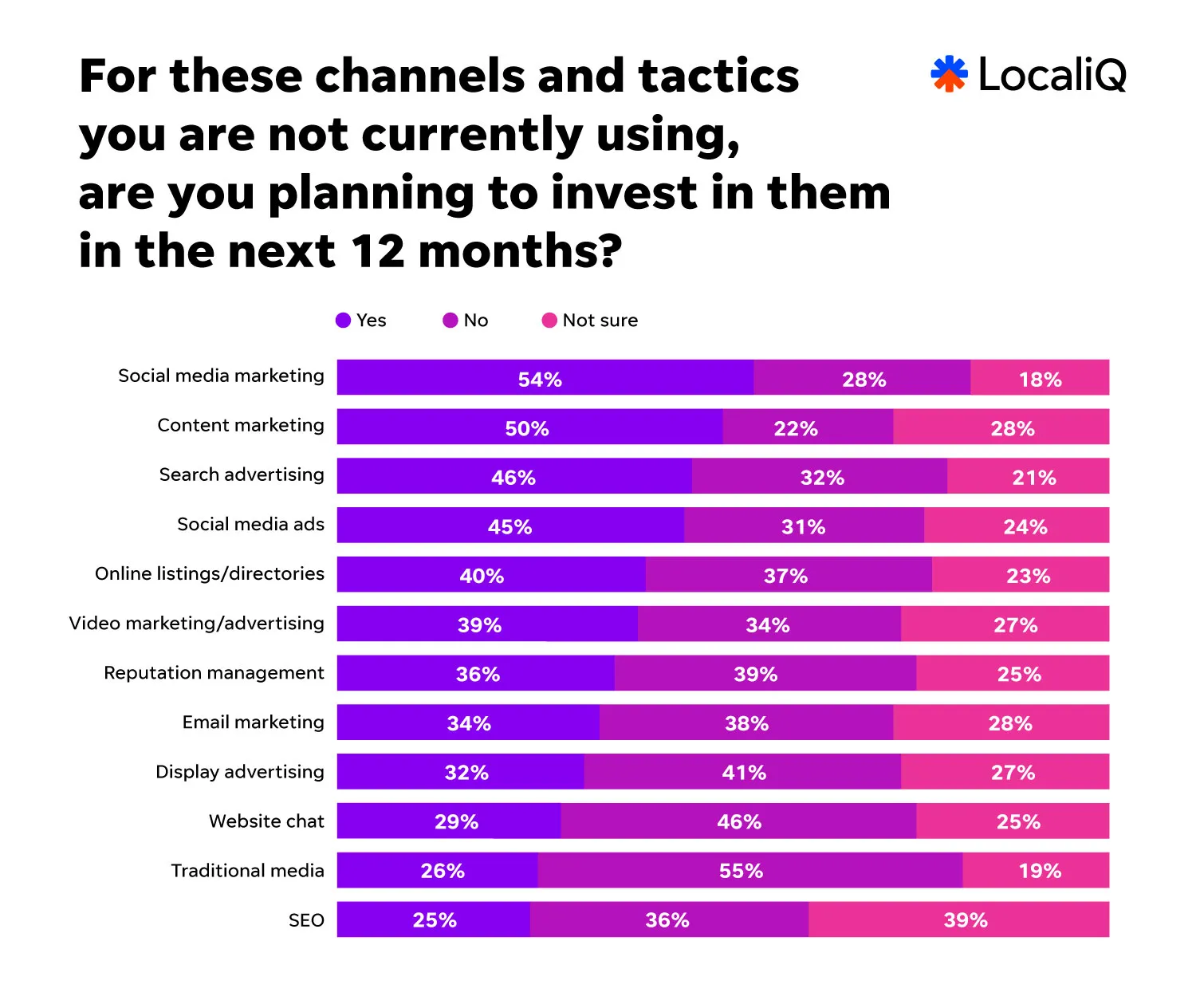
Over half (54%) of small businesses we surveyed who are not currently using social media marketing as part of their strategy are planning to invest in it over the next 12 months. Half are planning to invest in content marketing while 46% are planning to invest in search advertising (this is up from 23% last year). Small businesses are also planning to invest in social ads and online directories and listings.
The focus on largely unpaid strategies in 2027 isn’t shocking given the economic challenges many SMBs are bracing for in the coming year—investing in low-cost strategies can be a good bet to maximize budgets without sacrificing an online presence. However, we are seeing more SMBs plan to invest in advertising strategies on search and social, which can help them expand their existing audience and reach a targeted segment of most likely customers.
Traditional media tops the list of tactics small businesses are not planning to invest in through 2027. This was highest for SMBs with monthly budgets under $1,000—60% said they wouldn’t invest in traditional media next year. This isn’t a surprise as many businesses feel traditional media might be out of reach for their smaller budgets. However, there are plenty of traditional advertising options that are both affordable and highly effective for small businesses, such as direct mailers and print ads.
Time and tech: How small businesses are managing their marketing
Small businesses are busy. We wanted to understand how much time they were spending on their marketing each week and what tools and technology (like AI) were helping them keep it all running smoothly.
How much time do you spend on your marketing per week?
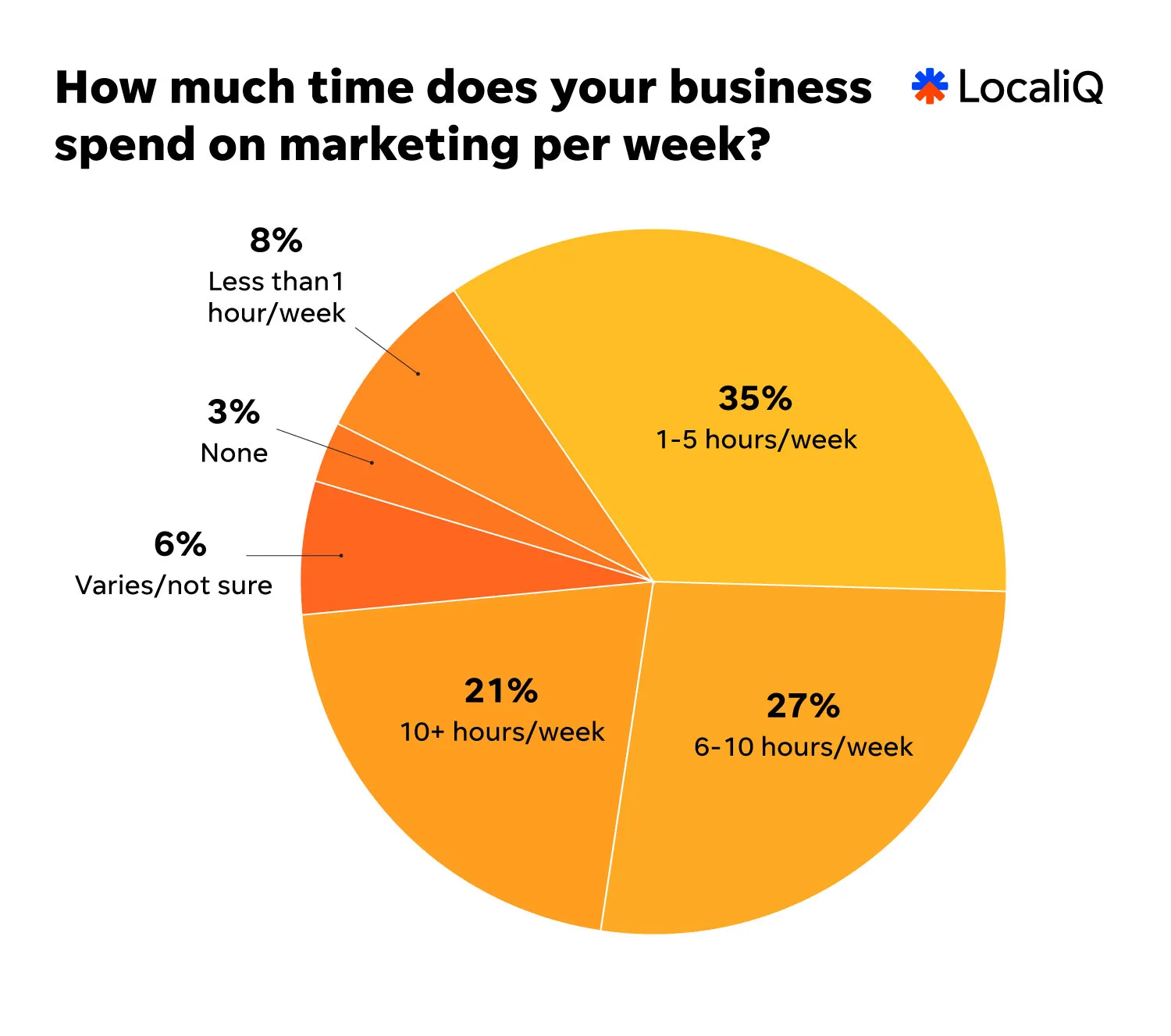
The majority (62%) of SMBs surveyed spend between 1-10 hours per week on marketing. This rate was higher for small businesses with fewer than 10 employees (65%). Because SMBs with fewer employees and smaller marketing budgets tend to have fewer (or no) employees dedicated solely to marketing, their day-to-day schedules are spread across a range of activities that may include marketing.
Compared to last year, small businesses are spending more time on marketing overall. In 2025, only 17% spent 6-10 hours a week on marketing compared to 27% this year.
What tools and software do you use to help with marketing your business?
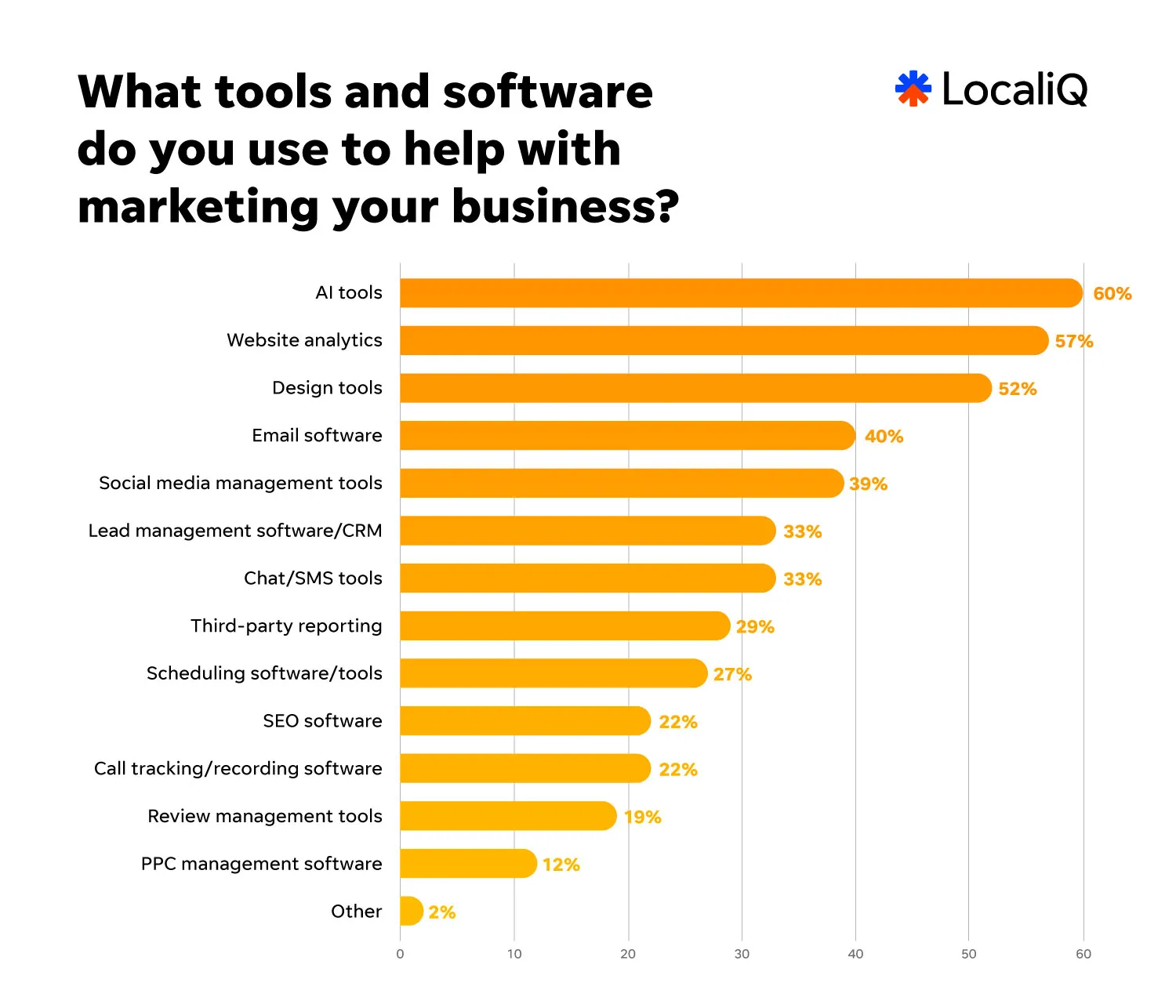
SMBs are using a variety of available tools to help market their businesses. Nearly 60% are using website analytics like Google Analytics, and 52% are using design tools like Canva or InDesign.
It was surprising to see that so few SMBs (33%) are using lead management software to help them keep up with leads driven from their marketing strategies. Many of these tools are available in free versions, which are great for small businesses with low budgets.
Speaking of free tools…try some of ours:
Are you using AI for any part of your marketing?
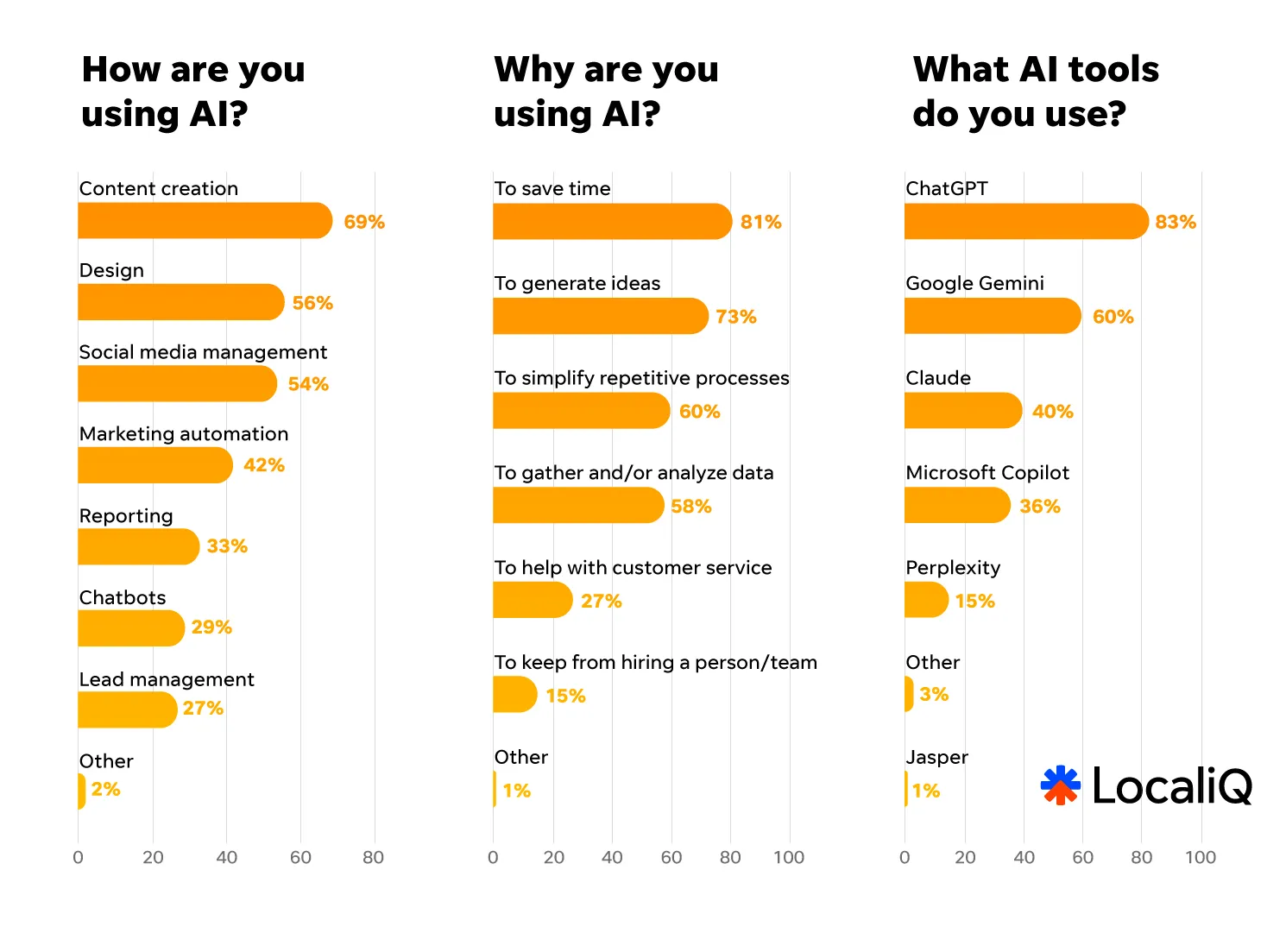
Unsurprisingly, the majority (60%) of small businesses are using AI tools for their marketing. Most (69%) are using it for content creation—down from 81% last year, with other popular applications including design (56%) and social media management (54%). The most popular AI tools SMBs are using are ChatGPT (83%), Google Gemini (60%, up from just 38% last year), and Claude (40%).
81% of small businesses said they’re using AI to save time, and 73% said they use it to help them generate ideas. AI can help automate many marketing tasks but can also pose challenges and risks if used unchecked. Small businesses should pay careful attention to AI outputs and take the time to develop clear, directive prompts.
Are you working with a marketing partner or agency for any part of your marketing?
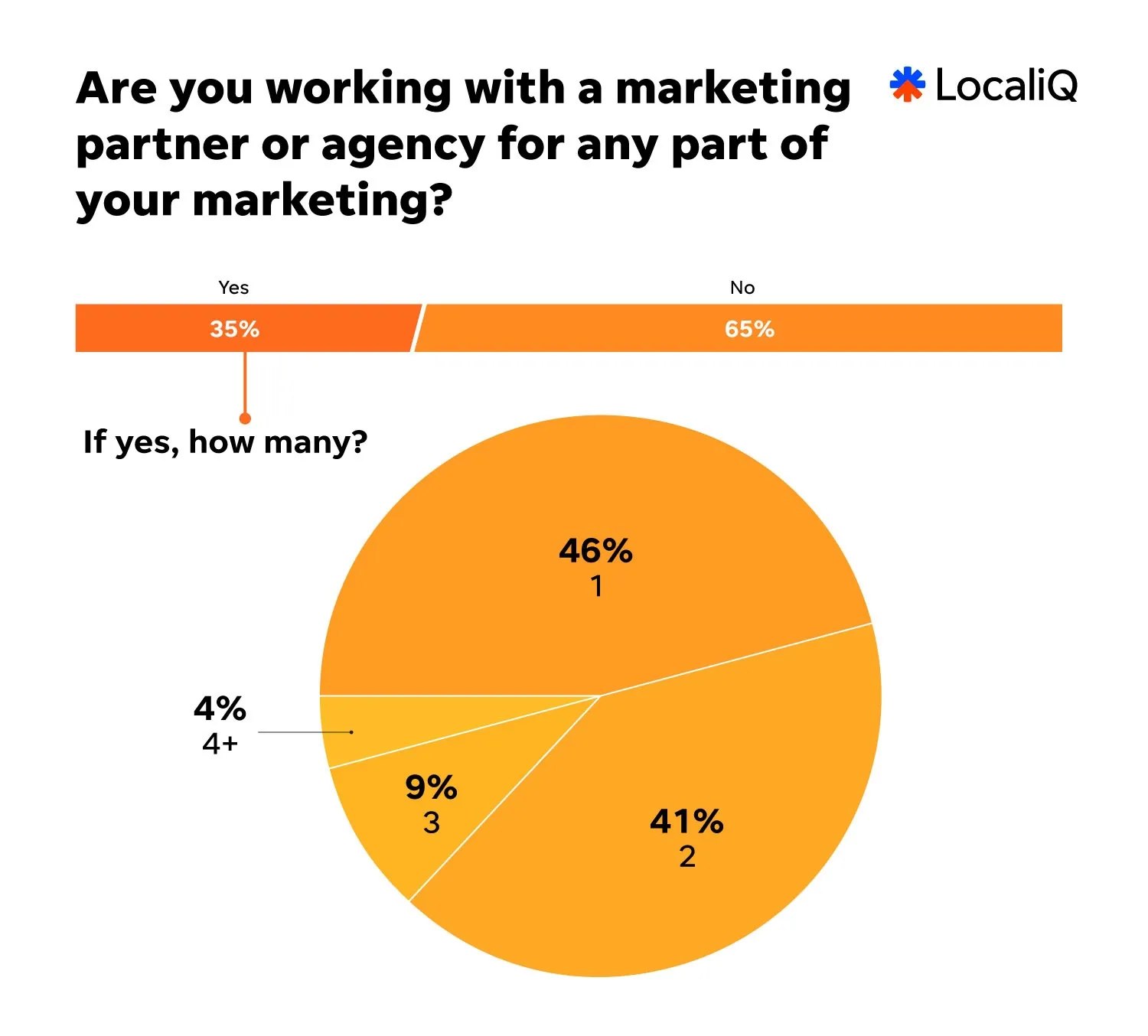
When it comes to marketing partners, only 35% of the SMBs we surveyed are currently working with at least one. Of those SMBs working with a marketing partner, nearly half (46%) are working with just one, while over half (54%) are working with two or more.
What’s most important to you in a marketing partner?
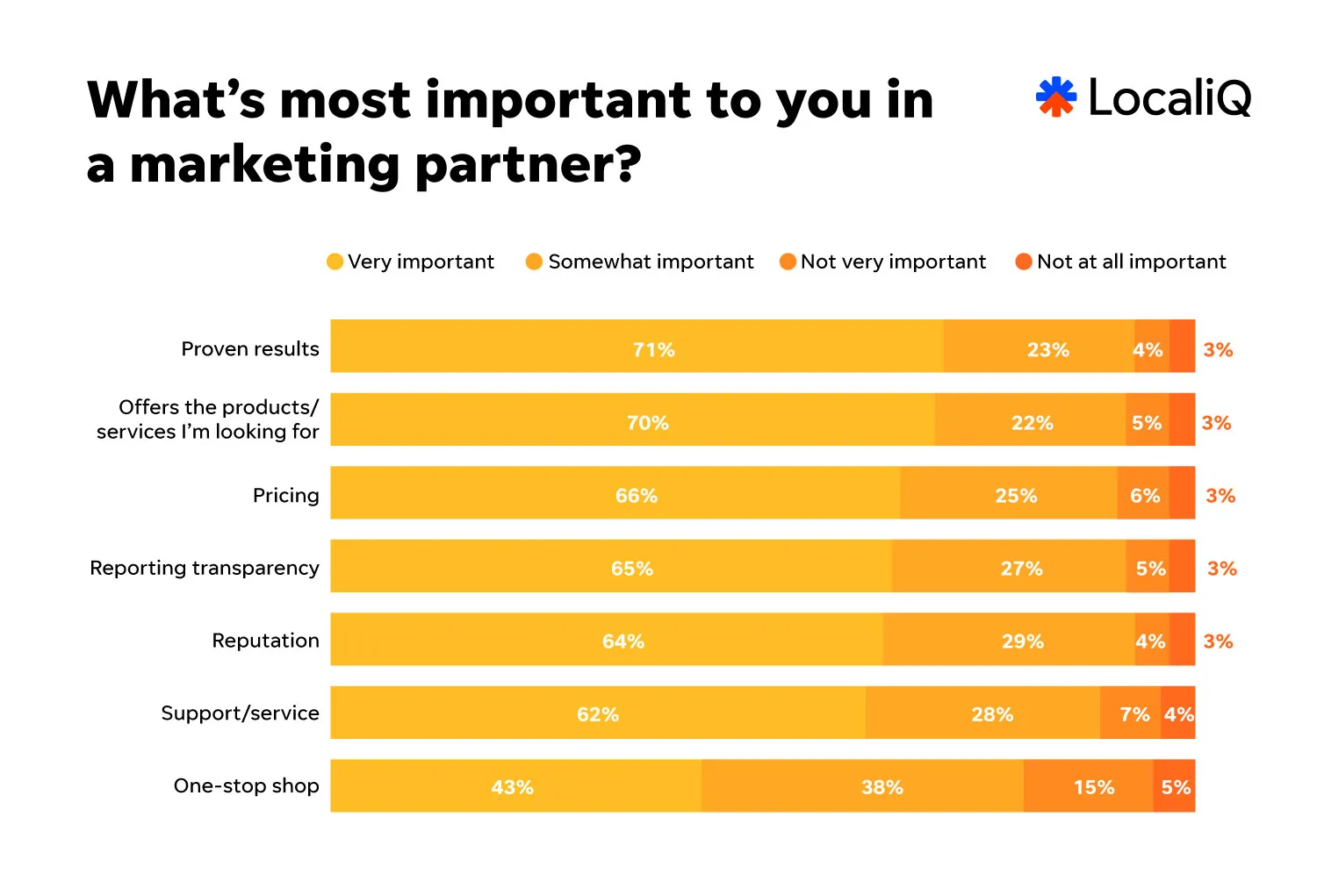
Small businesses prioritize proven results, followed by the right product/services offering, pricing, and reporting transparency when evaluating a marketing partner. Basically, they want to make sure they’re paying for real results on the right channels from a proven partner.
Surprisingly, a one-stop shop was less important to small businesses, but 43% still categorized it as “very important.”
Get a leg up on the small business competition
So what does this all mean for your 2027 marketing? “Be discoverable everywhere, make video a larger part of the strategy, and measure outcomes, not clicks. Consumer attention is more fragmented than ever, so SMBs can’t rely on one channel or tactic. The businesses that connect search, social, video, AI, and their own digital presence, and understand which investments are actually creating valuable customers, will be the ones that win,” David said.
If you want help finding the right marketing mix for your business, we’re here for you. Reach out to learn how our digital marketing solutions can help you blow away the competition in 2027 and beyond!
About the data
This report is based on responses to a LocaliQ survey of 389 respondents of small business owners. The survey was fielded between September 28, 2026, and October 12, 2026. 98% of respondents were in North America (US and Canada), and 1% were in Asia.

Recommended for you





Unlock your business potential
We offer innovative technology and unparalleled expertise to move your business forward.