


According to a LocaliQ study of more than 300 small businesses, nearly half of SMBs spend over five hours a week on marketing. Without a plan to guide the work, that could be 20-plus hours (and lots of dollars) wasted each month on actions that don’t deliver results.
At LocaliQ, we’ve been working with businesses to build and execute marketing plans for more than 20 years. In this guide, we’re showing you how to create a small business marketing plan that helps you achieve your goals and optimize your resources.
At first, creating such a plan can seem overwhelming. That’s why we’ve broken the task out into a step-by-step process. We’ve also included business plan examples and templates to make the process even easier and more effective.
Let’s get to work building your small business marketing plan!
Contents
- What is a small business marketing plan?
- How does a marketing plan help your small business?
- How do you build a small business marketing plan?
- Marketing plan examples
- Marketing plan templates
- 7 strategies for your small business marketing plan
- Small business marketing plan FAQs
What is a small business marketing plan?
A marketing plan is a documented outline of how a business will attract and retain customers over a specific period of time. It defines your target audience, the goals you want to achieve, the channels and tactics you’ll use to reach them, and the budget you’ll allocate to make it happen.
A great marketing plan will be goal-oriented and customer-focused. With the goal in mind, you’ll be better able to set steps to achieve it. And with the audience known and in view, your actions will more likely deliver the desired results.
As mentioned, the SMBs we recently surveyed said they spend more than six hours per week on marketing (some dedicating more than 10 hours to the task). A marketing plan keeps those efforts on track.

SMBs spend a lot of time marketing their business.
Your marketing plan will be unique (and we’ll show you how to build it!). But in general, it’ll always consider these focus areas:
- Opportunity: The industry, your competitors, goals, etc.
- Strategy: Your target markets, customer segments, product positioning, etc.
- Actions: Your tools, team, budget, various marketing channels, etc.
🚀 Build your flexible and resilient marketing roadmap! Download 6 Simple Steps to a Complete Small Business Marketing Plan (+Template)
How does a marketing plan help your small business?
A marketing plan provides structure to the time and money you spend promoting your business. It helps you keep business goals in view, exposes opportunities before your competitors see them, and shows you when you need to pivot before you’ve wasted budget on ineffective tactics.
More specifically, a marketing plan:
- Removes the marketing guesswork: A plan pushes you to ask hard questions about each investment, so you’re taking intentional action rather than making reactive and risky bets.
- Gives you a competitive advantage: The process of creating a plan will help you notice profitable gaps in your market, focus on your best-fit customers, and build a consistent presence, giving you a distinct advantage over businesses just winging it.
- Keeps you aligned with business goals: The structure of a marketing plan sets guardrails for your team, so each action is tied to a specific objective.
- Creates a faster feedback loop: Marketing is a game of “trial and refine.” A marketing plan gives you clear goals and a baseline to measure against so you can quickly adjust to invest in the tactics that deliver the highest returns.
SMBs say that uncertainty, especially over economic conditions, is their biggest challenge. A marketing plan gives you a framework for adapting to changes.

How do you build a small business marketing plan?
To create a small business marketing plan, you’ll conduct research and document details about your customers, market, resources, and objectives.
If that sounds like a big job, never fear. Just follow this step-by-step process to build a marketing plan for your unique small business.
Assess your current situation
Before you map out your plan, it’s a good idea to look at where you’re starting. We’re going to use two tools to drop a pin in your current location: The SWOT analysis and the competitive analysis.
SWOT analysis
A SWOT analysis is a simple framework that helps you take an honest look at your business. It highlights what you do well, where you fall short, where addressable solution gaps exist, and what outside forces could work against you.
SWOT stands for:
- Strengths
- Weaknessess
- Opportunities
- Threats

A SWOT analysis is helpful when creating your small business marketing plan because it allows you to take an objective look at your business and determine areas where you’re doing well right now and areas where you might want to improve.
For example, you might already have a good social media presence, so that would be a strength, but you’re not getting as many website visits as you think you should be, which could be an opportunity.
Take a little time here. This step will inform the rest of your marketing plan. This guide will walk you through your SWOT analysis.
Competitive analysis
A competitive analysis is basically doing your homework on the competition. You’ll review what they’re good at, where you can compete against them, and how you can give customers a reason to choose you instead.
Use this competitive analysis guide to complete the work. It has several tips and a template you can use to document what you learn.
Set marketing goals and KPIs
Your marketing goals are the business-specific objectives you want your promotional efforts to achieve. The key performance indicators (KPIs) are the metrics you’ll use to measure them.
Create SMART goals
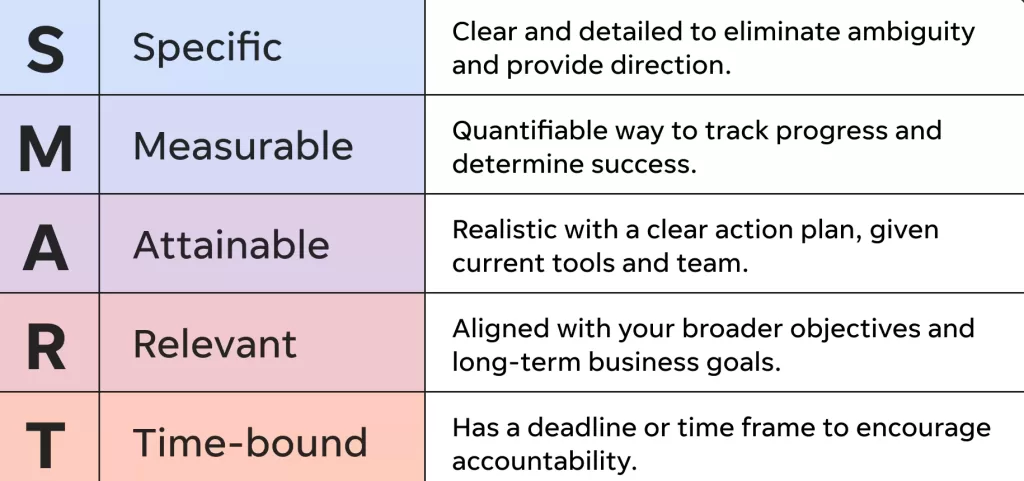
Every marketing goal you set should be SMART:
- Specific: Your goal should answer exactly what you want to achieve, not just “increase social following” but “get 1,000 new followers.”
- Measurable: You need a number attached to it so you know when you’ve hit it.
- Achievable: Ambitious is good, but the goal has to be realistic given your budget and resources.
- Relevant: It should connect directly to something that actually matters to your business right now.
- Time-bound: Every goal needs a deadline to keep it moving forward.
An example of a SMART goal would be:
“Generate 15 new customer leads per month through search ads and a Google Business Profile by June 30, with a cost per lead under $40.”
Choose your KPIs
With your goals in mind, decide which KPIs, or marketing metrics, are the best options for measuring them.
For example, let’s say you’re promoting a new location for your nail salon in a month. Your goal is to boost brand awareness in the new market. KPIs like video views on TikTok or click-through rate in Google Ads would be good choices.
There are dozens of metrics to consider. SMBs told us that revenue, return on investment, and conversion rate were the most important.

Determine your resources
Your available resources—both money and time—are going to dictate what you decide to invest in. It’d be great to run a brand takeover on TikTok, but if you don’t have an extra $10K to spend, then a more strategic ad investment is in order.
With a few tricks up your sleeve, you can do a LOT, even with a small budget. Here are a few guides that’ll help you set and stretch your marketing budget:
- How to Create a Marketing Budget (+Examples & Free Template)
- 12 Ways to Increase Foot Traffic (Even on a Shoestring Budget)
- 9 Expert Tips to Make Your Marketing Budget Last All Year Long
Solidify your brand messaging
This step is all about deciding what you want to say and how you want to say it. What makes your business stand out from competitors? Do you want people to see your brand as super fun and approachable or more sincere and authoritative?
Your messaging will also help inform which channels and media you use. If your brand is playful and funny, it’d play well on TikTok. If you’re all Business, investing in LinkedIn ads might be a good play.
Consider these points while dialing in your brand messaging:
- Mission statement: Your mission statement is a short, plain-language description of what your business does, who it serves, and why it exists beyond just making money. This is your “why.”
- Value proposition: Your value proposition is the clearest possible answer to the question every customer silently asks: Why should I choose you over everyone else? (Read these unique, powerful value proposition examples for inspiration)
- Voice and tone: This refers to the personality your business consistently shows in every email, ad, post, and conversation. Be it friendly, professional, no-nonsense, or whatever fits your brand.

You can have a playful tone, even with topics like personal finance.
Identify your target audience
Who is most likely to buy your product? That answer may depend on where they’re located, their age, income, interests, and a bunch of other factors.
Get this nailed down, and you’ll be able to choose the right channels, offers, and messaging to reach them. If you learn that Gen Z is your next best customer base, a print ad is probably not your best choice.
You’ll evolve your target audience over time. And it’ll change as you enter new markets, launch new products and services, etc. To get started, ask these eight questions:
- Who are your best current customers? If you’re already in business, look at who actually buys from you, comes back, and refers others. Your best existing customers are usually a blueprint for who you should be targeting.
- Who are your competitors targeting? Look at your competitors’ ads, their website copy, and their social media. You don’t have to go after the same audience, but knowing who they’re talking to helps you find gaps and know how they’re reaching the same people. (Not sure where to start? Learn how to find your biggest competitors).
- Who has the problem your business solves? Describe the problem you fix as specifically as possible, then work backward to picture the person most likely dealing with it. That mental image is the start of your audience profile.
- Where is engagement already happening organically? Check your own analytics to see who’s visiting your website, following your social accounts, or opening your emails.
- What do your best customers have in common? Age, location, profession, lifestyle, values, and so on. Look for patterns across the customers you enjoy working with most.
- Who is NOT a good fit? Sometimes the fastest way to define your audience is to get clear on who you don’t want to serve. Ruling out the wrong customers can save you a lot of wasted promotional effort.
- What communities or groups does your ideal customer belong to? Think about the Facebook groups, local organizations, online forums, or neighborhoods where your ideal customer is likely to show up.
- Who do your best customers say referred them? If word-of-mouth is driving business, find out who’s doing the talking and who’s doing the listening. That referral network often points directly at a concentrated audience you haven’t fully tapped yet.

Knowing your audience’s pain points, location, and other factors will make your marketing much more effective.
Remember to be mindful of your customers’ buying journey and funnel stage. Even within the same target audience, you’ll have some people who have never heard of you and some who have almost made a decision.
Choose channels and tactics
Marketing channels are the platforms you’ll use to reach customers, like Facebook and Google. Tactics are the actions you’ll take on those channels, like posting how-to videos or buying PPC ads.
Everything you’ve documented in your marketing plan so far will inform your choices here. If your budget is super tight, you can focus on free tactics like SEO and organic posts on social media. If lots of people regularly look on Google for the things you sell, search ads could be a good option.
Overall, social media and organic search are two of the biggest sources of website traffic for SMBs.

We’ll dig into the most effective channels and tactics (plus share some examples) in a bit.
💡 Want a year’s worth of marketing ideas? Get The Only Marketing Calendar You Need
Build a marketing calendar
A marketing calendar is a shared schedule that maps out every planned marketing activity, like campaigns, emails, social posts, promotions, and ads, across a set period of time so nothing falls through the cracks and your team always knows what’s coming next.
A good way to tackle this is to create a 30-day, 60-day, and 90-day plan that focuses on easy wins and aligns with your business goals.

For example, if your goals include generating brand awareness and growing your social media traffic and following with Millennials who love the outdoors, you might:
- Schedule out a series of organic, educational posts with tips to hike, camp, and bike safely.
- Engage an outdoor influencer to post about your brand three times.
- Plan a giveaway that encourages people to share your account with their friends.
Include a plan for measurement and review
No marketing is “set it and forget it.” You’ll need to trial channels, messaging, and tactics to see which work best.
Match each item in your marketing calendar with the metrics you’ll use to measure it and where the metrics will come from (like Google Analytics or your own conversion tracking). Note when you’ll review as well. Some channels, like PPC ads, will require daily monitoring. Others, like SEO content marketing, can be reviewed weekly or even monthly.
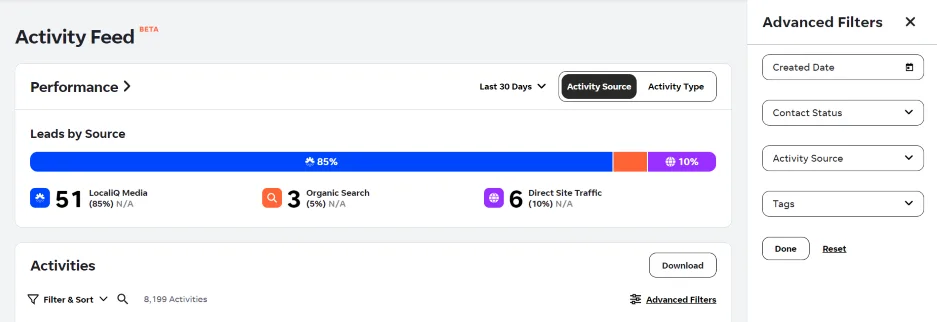
Solutions like LocaliQ’s Dash can track how many leads you’re getting and where they came from.
Write your executive summary
An executive summary is a short, plain-language overview of your entire marketing plan. It covers what your business is, what you’re trying to accomplish with your marketing, how you plan to get there, and what resources you’re putting behind it.
The temptation is to write this section of your plan first because it appears first. But since it’s meant to quickly encapsulate the whole document, it’s best to write it after you’ve done the rest.
Also, there’s no need to go overboard here. Two or three tight paragraphs are plenty. Think of it as the version of your plan you’d hand to a busy business partner, investor, or new employee who needs to understand your marketing direction in under two minutes.

An executive summary should be a brief review of your marketing plan.
3 marketing plan examples
Let’s look at these principles in practice through three examples. First, we’ve created a complete, basic marketing plan for a fictitious local business. We’ve also curated two examples of larger marketing plans, one from a state university and one from a national beauty brand.
Together, these will give you a full picture of what your marketing plan can look like.
Peak Performance local business marketing plan
Peak Performance is a fictitious physical therapy practice with a local presence in Maplewood (also fictitious), NC.

Local businesses have different objectives, resources, and tactics than bigger brands. This example shows how you can structure your marketing plan quickly and simply to accomplish your goals without overwhelming your team with a giant document.
See the full Peak Performance marketing plan here.
University of Illinois recruitment plan
This marketing plan outlines the University of Illinois’ student recruitment strategies. It showcases the messaging, channels, and types of marketing the school used to entice students to choose its educational programs.
Notice how this plan uses visuals to illustrate each section. For example, it includes actual recent ads that highlight the plan’s variety of messaging.

A few visuals can bring your marketing plan to life.
Lush’s flipbook
Lush is an ethically driven cosmetics retailer known for handmade skin, hair, and body care products. Its 33-page marketing plan is more in-depth than most small businesses will ever produce. But it has some interesting features you can use.

A flip-book style marketing plan is a nice alternative, especially if your plan is a little more in-depth.
For example, the flip-book format is attractive and easy for readers to use (AI tools can help you make it). The SWOT analysis, calendar, and budget sections are worth reviewing.
3 marketing plan templates
Building the framework of your marketing plan is one of the hardest parts. Let’s make it much easier with these three marketing plan templates!
LocaliQ’s small business marketing plan template and guide
Small businesses face unique marketing challenges compared to much larger organizations. The LocaliQ small business marketing plan guide considers those differentiators.
The guide breaks down each plan section to help you understand how they work. Then, it gives you a worksheet to keep everything organized.

Business.com’s comprehensive marketing plan template
There’s nothing flashy about this marketing plan template from Business.com. But it is comprehensive enough for you to include all of your strategies and ideas.

AddThis’s basic marketing plan template
AddThis was a social bookmarking app that was shuttered after Oracle bought the brand. Luckily, the internet forgets nothing, and you can still use the marketing plan template AddThis created. It’s a basic option with several other downloadable assets.

7 strategies to consider for your small business marketing plan
There are nearly endless marketing strategies available to use in your plan (you could hire a skywriter to spell out your promotion, for example). The options we’ve listed here are among the most popular because they deliver strong returns and are highly measurable (it’s hard to calculate conversions from word-shaped clouds).
SEO
SEO (search engine optimization) is the process of making your website and online presence more visible in search results so that when someone nearby searches for what you offer—like “plumber near me” or “best pizza in [your town]”—your business shows up.

For a small business, it’s one of the highest-return marketing investments you can make because it keeps working for you long after the initial effort.
We’ve compiled a lot of helpful information about SEO. These guides are a great place to start:
- The Complete Local SEO Checklist
- Our 14 Best Local SEO Tips (+Mistakes to Avoid)
- 5 Trending Questions about Local SEO, Answered!
PPC ads
PPC (pay-per-click) ads are paid advertisements that appear at the top of search results or across social media platforms, where you only pay when someone actually clicks on your ad.

For a small business, PPC is the fastest way to get in front of customers who are actively looking for what you sell, making it a smart strategy to get leads now and to complement SEO. PPC ads are also
PPC ads are also highly targetable, making them really useful for attracting very specific audiences.
Here are a few foundational PPC guides that’ll help you master the channel:
- What is PPC? Learn the Basics of Pay-Per-Click (PPC) Marketing
- 7 Quick PPC Optimization Tips for Small Businesses
- 9 Ways to Build the Best Paid Search Strategy
Media buys
A media buy is when you pay to place your ad in a specific publication or platform, like a banner ad on your local newspaper’s website or a sponsored post in a regional online magazine.

With modern targeting and personalization, your ad can show up for local audiences on national news outlets.
For a small business, it’s a solid way to build name recognition with a local audience that already trusts the publication, especially when you want to reach people who aren’t actively searching for you but might become customers once they know you exist.
Social media marketing
Social media marketing is the practice of using platforms like Facebook, Instagram, and TikTok to build awareness, engage your audience, and drive customers to your business. That can be through a mix of organic posts and paid ads.

Social media is a great channel to promote events, sales, and new locations.
For a small business, it’s one of the most cost-effective ways to stay visible in your community and reach the specific type of customer you’re looking for based on their age, location, and interests.
Email marketing
Email marketing is the use of email to communicate directly with current and potential customers. Newsletters, promotional offers, product updates, and seasonal campaigns are really good uses of this strategy.

One of the best aspects of email marketing is that it lets you stay in front of customers you’ve already earned without paying for reach every time. For a small business, it’s one of the highest-ROI channels available because you own the list, so you’re not constrained by a social media or search algorithm that decides who sees your message.
Content marketing
Content marketing is the strategy of creating and publishing useful, relevant content like blog posts, videos, guides, and FAQs. The goal is to produce content that helps your target audience solve a problem or answer a question, which builds trust while bringing them into your marketing funnel.

For a small business, content marketing does a lot of heavy lifting for multiple channels. It boosts SEO and GEO, it generates fodder for social media channels, and it creates the backbone of a solid newsletter.
Direct mail and physical signage
Direct mail is the physical delivery of marketing materials like postcards and catalogs directly to a targeted list of addresses in your area.

Direct mail puts something tangible in the hands of potential customers, which, in a world of overflowing inboxes, can actually stand out more than a digital ad.
For a small business, it works especially well for hyper-local targeting. If you want to reach every household within a specific zip code or neighborhood, direct mail lets you do that with a precision that’s hard to match online.
Small business marketing plan FAQ
Here are a few of the most frequently asked questions about small business marketing plans.
What are the types of marketing plans?
There are four common types of marketing plans, including:
- Annual or quarterly marketing plan: A roadmap that outlines all of your marketing goals, channels, budget, and campaigns for the coming quarter or year.
- Content marketing plan: A focused plan specifically for the content you’ll create and publish, including blog posts, videos, and social media posts, plus how that content supports your broader marketing goals.
- Product launch marketing plan: A time-bound plan built around introducing a new product or service to the market, covering how you’ll build awareness, generate interest, and drive early sales.
- Campaign marketing plan: A short-term plan tied to a specific campaign or promotion, such as a seasonal sale or event, with its own goals, budget, and timeline.
How much money should a small business budget for marketing?
Most small businesses should plan to spend between 5% and 10% of their gross revenue on marketing. Newer businesses trying to build awareness may need to lean toward the higher end. The right number also depends on your industry, goals, and how competitive your local market is, but as a starting point, that range gives you a realistic budget without overextending.
How much time should a small business spend on marketing?
Nearly half of SMBs say they spend at least six hours per week on marketing. That number will vary greatly depending on the tactics a business uses and who actually does the marketing. A small business that works with a marketing partner can enjoy greater returns while spending less time each month focused on the task.
Build your small business marketing plan
Your small business marketing plan is a big deal. It can help you generate reliable sources of leads and customers while greatly reducing time and money wasted on strategies that don’t work.
The hurdle is creating it in the first place. But if you take each step listed above one at a time, and use the business plan templates and examples we provided, it’ll be a very manageable process.
If you’d like help building, executing, optimizing, and tracking your marketing plan, our marketing solutions are ready and waiting for you.

Recommended for you





Unlock your business potential
We offer innovative technology and unparalleled expertise to move your business forward.